Journal Reco. “Sino-Pacifica”: Conceptualizing Greater Southeast Asia as a Sub-Arena of World History

Map of Southeast Asia
Image via Wikipedia

I just got my hands in a great article on Southeast Asia issues.  Here’s the abstract for the article (via Project MUSE) and I hope you’ll get to enjoy it too,

Conventional geography’s boundary line between a “Southeast Asia” and an “East Asia,” following a “civilizational” divide between a “Confucian” sphere and a “Viet­nam aside, everything but Confucian” zone, obscures the essential unity of the two regions. This article argues the coherence of a macroregion “Sino-Pacifica” encom­passing both and explores this new framework’s implications: the Yangzi River basin, rather than the Yellow River basin, pioneered the developments that led to the rise of Chinese civilization, and the eventual prominence of the Yellow River basin came not from centrality but rather from its liminality—its position as the contact zone between Inner Eurasia and Southeast Asia.

In a sense . . . the frontier of Southeast Asia has retreated slowly from the line of the Yangzi (in what is now central China) to the Mekong delta (in what is now southern Vietnam).

—Charles Holcombe, The Genesis of East Asia

[T]he Vietnamese-Lao wars of the seventeenth century were resolved wisely when the Le rulers in Vietnam and the Lao monarch agreed that every inhabitant in the upper Mekong valley who lived in a house built on stilts owed allegiance to Laos, while those whose homes had earth floors owed allegiance to Vietnam.

—The Emergence of Modern Southeast Asia: A New History [End Page 659]

The question of boundaries is the first to be encountered; from it all others flow.

Fernand Braudel, The Mediterranean World in the Age of Philip II

In conventional geography, the largest division of the human community is the continental or subcontinental scale “world region.” World regions are the most useful as concepts when their boundaries can be seen as enduring, immobile, and, above all, easy to map. Yet, in the first quotation above, we see a border between two world regions, Southeast and East Asia, that rolls southward thousands of miles over thousands of years. In the second quotation, we see a border between two kingdoms within the same world region, Southeast Asia, that cannot be traced as a simple line on the ground, being created by the contrasting cultural preferences of inextricably mixed populations. The moving boundary and the undrawable boundary are actually the same, the frontiers between Sinified Vietnam and its un-Sinified neighbors.

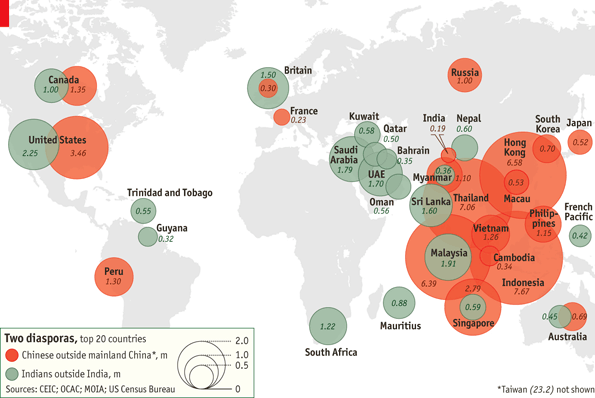
Where are the world’s biggest Chinese and Indian immigrant communities?

The Economist published a mind-blowing graphic depicting the migration of Chinese and Indian people around the world. The asses that “more Chinese people live outside mainland China than French people live in France, with some to be found in almost every country. Some 22m ethnic Indians are scattered across every continent.” More so, they emphasize that even though Diasporas have been a part of the world for millennia; their size and the ease of staying in touch with those at home are making them matter much more with the emergence of social network online technologies.

World's top 20 destinations for Chinese and Indian migrants

Now, this is once again part o the large “discourse of newness” that embeds great part of current mainstream history.  This is something that has been denied and discussed by Prof. Adam McKeown in the article “Article: Global Migration, 1846–1940” who claims after doing a extensive research of migration from China and India during the 19th Century that the amount of immigrants and the global effect it had is comparable (and at some points superior) to the more known Atlantic migration from Europe to America. I strongly suggest you checking the Article by Prof. McKeown an check also Dr. Dirk Hoerder great book titled: Cultures in Contact in case you are interested in this subject.

Article: Global Migration, 1846–1940 by Prof. Adam McKeown

via Flickr”]Port

Rudolph Vecoli introduced his edited volume A Century of European Migrations, 1830–1930 with the statement “[w]e need to move beyond the framework of the ‘Atlantic Migration’ . . . It [has] blinkered us to the global nature of [migration].”

And indeed, that is what Prof. Adam McKeown planned to demonstrate in the article “Global Migration, 1846–1940”.  The article is a great tool to understand the role that global interconnectedness, industrialization and increase in trade meant for the world. McKeown explains how was it that millions of migrants during the period of his study enabled for the population of America, Southeast Asia and Manchuria to increased more quickly than world population.

Read it:Global Migration 1846-1940. McKeown, Adam, Ph.D. Journal of World History, Volume 15, Number 2, June 2004, pp. 155-189 (Article)

Full Access HTML Version | Full Access PDF Version (421k)

China Is Asked for Investment in Euro Rescue

Euro
Image by Images_of_Money via Flickr

A new chapter is being written in the History of Money, Bank and Credit as news of how European leaders are asking for China to rescue them from the chaos they created. I wish this guys reconsidered before continue acting some of the most important principles of Deficit Financing, Freedom, Inflation, Money, Property Rights, Savings, Welfare State, Consumption, Credit; Gold Standard, Market Value, Objective Theory of Values, Production, Purchasing Power, Sanction of the Victim, Selfishness and the Trader Principle just to mention a few before going on making more business that en debts their country’s economy while make their citizens poorer.

And as Ayn Rand cleverly mentioned in regard to Deficit Financing,

The government has no source of revenue, except the taxes paid by the producers. To free itself—for a while—from the limits set by reality, the government initiates a credit con game on a scale which the private manipulator could not dream of. It borrows money from you today, which is to be repaid with money it will borrow from you tomorrow, which is to be repaid with money it will borrow from you day after tomorrow, and so on. This is known as “deficit financing.” It is made possible by the fact that the government cuts the connection between goods and money. It issues paper money, which is used as a claim check on actually existing goods—but that money is not backed by any goods, it is not backed by gold, it is backed by nothing. It is a promissory note issued to you in exchange for your goods, to be paid by you (in the form of taxes) out of your future production.

“Egalitarianism and Inflation,”
Philosophy: Who Needs It, 133

Read more of this news:

PARIS — A day after European leaders unveiled their latest plan to save the euro, top officials opened talks with China in an effort to lure tens of billions of dollars in additional cash, giving China perhaps its biggest opportunity yet to exercise financial clout in the Western world.

China is expected to demand significant concessions, including financial guarantees and limits on what Beijing sees as discriminatory trade policies, in exchange for any investment in Europe’s emergency stability fund. The head of the rescue fund, Klaus Regling, got a cautious reply from Chinese officials Friday during a visit to Beijing, where he said he did not expect to reach an investment deal with China anytime soon.

A senior Chinese official, Vice Finance Minister Zhu Guangyao, said China — like the rest of the world — was still waiting for the Europeans to deliver crucial details on how the rescue fund, the European Financial Stability Facility, would operate and be profitable before deciding on whether to participate. via: China Is Asked for Investment in Euro Rescue by Liz Alderman and David Barboza.

Finally, we are 7 Billion

Video: 7 Billion,National Geographic Magazine

The human population on planet Earth has reached for the first time in history 7 billion  as reported by the United Nations[1]. As of today, October 28, 2011 at  16:44 (GMT+1) it was estimated to be 6.92 billion by the United States Census Bureau[2] and you can check their World Population Clock.  and 7 billion by .  But also, we can also acknowledge that this is also the first time in human history in which most humans have access to medical services, potable water, electricity.

As Susa Lewis from Nova acknowledges, “For most of human existence our ancestors led precarious lives as scavengers, hunters, and gatherers, and there were fewer than 10 million human beings on Earth at any one time. Today, many cities have more than 10 million inhabitants each, and populations continue to skyrocket.”

Largest Urban Agglomerations, 1975, 2000, 2025

Source: United Nations, World Urbanization Prospects: The 2007 Revision.

Also, the UN World Urbanizaiton Prospects reviewed that “Through most of history, the human population has lived a rural lifestyle, dependent on agriculture and hunting for survival. In 1800, only 3 percent of the world’s population lived in urban areas. By 1900, almost 14 percent were urbanites, although only 12 cities had 1 million or more inhabitants. In 1950, 30 percent of the world’s population resided in urban centers. In 2008, for the first time, the world’s population was evenly split between urban and rural areas. There were more than 400 cities over 1 million and 19 over 10 million. More developed nations were about 74 percent urban, while 44 percent of residents of less developed countries lived in urban areas.”

World Population Cartogram

Nova has the following interactive map in which you can trace the dramatic growth of human populations over recent centuries, and see where on Earth as many as three billion more people may live by 2050.

Launch InteractivePrintable Map Version

New challenges for humans will continue appearing with so many of us living here.  However, it is not the number what really matters but how we are all going to live here.  Currently, Thomas Malthus famous argument from 1798 in which he said “that population growth was a critical problem, reasoning that because human population grows exponentially while our food supplies grow linearly, that our growth would lead to massive problems” has already been proven wrong.

But what has still not being solved is the current philosophical crisis in which we live.  For a great part of human history, the world has been ruled by a collectivist philosophy of life that in the words of Ayn Rand “promoted the subjugation of the individual to a group (kings, oligarchs, nobility, religions, patrimonialists, corporations, parties, communities)—whether to a race, class or state does not matter. Collectivism holds that man must be chained to collective action and collective thought for the sake of what is called “the common good.” The previous sentences are very important and cannot be passed without understanding its historical results.  You can further explore them in the work of Leonard Peikoff titled “The Ominous Parallels“.

For more information regarding human population check the following links: