Today January 27 is International Holocaust Memorial Day

Let us never forget,

“Selektion” on the Judenrampe, Auschwitz, May/June 1944. To be sent to the right meant slave labor; to the left, the gas chamber. This image shows the arrival of Hungarian Jews from Carpatho-Ruthenia, many of them from the Berehov ghetto. The photographer was Ernst Hofmann or Bernhard Walter of the SS. Image by Yad Vashem.

Holocaust Memorial Day Documentary

Tribute to holocaust victims – We shall never forget!

Two historical references for a discussion on the right to keep and bear arms

Battle  of Courcelette
Battle of Courcelette
Like the observer in the tree in the right foreground, painter Louis Weirter witnessed this Somme battle as a soldier. His painting depicts the chaos and complexity of fighting on the Western Front, and the use of combined arms tactics. The capture of the ruined town of Courcelette, France on 15 September 1916 was a significant Canadian victory. It was also the first time tanks (left foreground) were used in battle.
Painted by Louis Alexander Weirter
Beaverbrook Collection of War Art

One of the most controversial discussions in the last few weeks has been the one around guns, its regulation and controls, its production, on the rights to use guns, on private gun ownership and the arguments of those in favor/against the Right to keep and bear arms in the United States of America.  The right to keep and bear arms in that country has a historical significance rooted in a long standing common law, prior even to the existence of their Constitution.  In England, a similar legal wording can be found in the Bill of Rights 1689 which states “Subjects which are Protestants may have Arms for their Defense”.

The historical significance of this argument is long standing and varies from country to country (specially those with a common law system).  The principle behind this topic is the relation of the private ownership (historically contextualized of course) of the “means of force” versus the monopoly of the use of force by government.  Today I have two recommendations on this topic for those of you looking for essays and books to read:

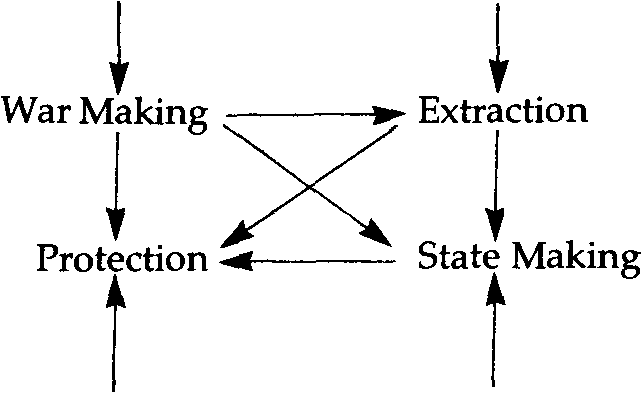
tilly-diagram

The monopoly of the use of force is claimed to be the reason behind why some kings in Europe succeed in wining wars and enriching their countries; and also the reason why others were subjugated and conquered (see the work of War Making and State Making as Organized Crime by Charles Tilly for a complete picture on this topic (online pdf) a Chapter from Bringing the State Back In (1985), edited by Peter Evans, Dietrich Rueschemeyer, and Theda Skocpol).  But also, in a longer historical perspective it has been the monopoly of the use of force by specific authorities which for other authors built/destroyed entire civilizations (see the work of The Shield of Achilles: War, Peace and the Course of History (2002) by Philip Bobbitt).

Have a happy reading!

Dec. 8, 1941. War on Japan Declared

Video of original footage of the Declaration of War to Japan

Dec. 8, 1941: President Franklin D. Roosevelt asks Congress for a declaration of war on Japan. One of the gloomiest days on History.

Dec. 7, 1941. Pearl Harbor Attack Footage

Video of original footage of the Declaration of War to Japan

This footage of the Japanese attack on Pearl Harbor was shot by CWO4 Clyde Daughtry. The attack occured at exactly 7:55 a.m. Hawaii Time. The original footage has since been lost, and the poor quality of this footage is due to the fact that it is a copy, and believed to be the best remaining version of this film in existence. Among the many valuable portions of this footage are shots of USS Nevada (BB-36) underway and firing back at Japanese aircraft, USS Oglala (CM-4) rolling over and sinking, and USS St. Louis underway (CL-4). Naval History and Heritage Command, Photographic Section, UM-10.

The Lord’s Resistance Army: End Game?

Ugandan districts affected by Lords Resistance...
Image via Wikipedia

Nairobi/Brussels, 17 November 2011 (via International Crisis Group): Insufficient political will has thwarted regional efforts to stop the murderous Lord’s Resistance Army (LRA) but vigorous diplomacy led by the African Union (AU), an immediate military push and complementary civilian initiatives could end the misery of thousands.

The Lord’s Resistance Army: End Game?, the latest report from the International Crisis Group, explains why Uganda’s half-hearted three-year offensive has failed to eliminate Joseph Kony‘s guerrilla band and why there is now a new window of opportunity. Since peace talks with the erstwhile northern Ugandan insurgency collapsed and a first assault on Kony’s camps was botched in late 2008, the Ugandan army has been trying to catch scattered groups of fighters along the borders of DR Congo (DRC), the Central African Republic (CAR) and South Sudan. In that period, the LRA, now only a small but deadly criminal and terror band, has killed some 2,400 civilians, abducted some 3,400 and caused 440,000 to flee homes.

“The reasons for the military failure are at root political; Ugandan President Museveni scaled down the anti-LRA mission to pursue other ventures that would win him greater political capital at home and abroad”, says Ned Dalby, Crisis Group’s Central Africa Analyst. “Since the LRA no longer poses a threat to northern Uganda, few opposition politicians or community leaders there demand Museveni finish it off”.

Uganda’s efforts to pursue combatants in DRC have been dogged by the host army’s refusal to cooperate and grant access to LRA-affected areas. Uganda invaded DRC in the late 1990s, plundered its natural resources and earned President Joseph Kabila‘s lasting mistrust. CAR President François Bozizé, equally suspicious, has insisted the Ugandans leave diamond mining areas in his country.

At the request of some members, the AU stepped forward and said it would authorise a counter-LRA mission. It plans to appoint a special envoy to smooth relations between Kinshasa and Kampala and create new military structures to improve coordination between the armies. However, planning has foundered due to political constraints and the African body’s limited capacity.

The Ugandan army, with its record of abuse and failure to protect civilians is an imperfect vehicle, distrusted in the area. Kampala’s commitment now that the LRA no longer directly endangers its interests is reason for scepticism it has the will to see the job through. But a military operation combined with civilian efforts to entice surrenders remains the most feasible solution, and the Ugandans are the only troops at hand for this. The U.S. is strengthening its political and military engagement, including by sending several score advisers to help them in the field on a short-term basis. Kony is believed to be in the CAR. Before he crosses back into DRC and while U.S. support is strong, the Ugandan army should make an urgent military push, prioritising civilian protection, humanitarian access, better coordination and strict accountability.

To ensure dividends, the AU must live up to its responsibilities as guarantor of continental security and oversee a multi-dimensional regional initiative, continuing after Kony’s death or capture. It should appoint quickly a special envoy to rally the political commitment of Uganda and the three affected states and introduce a common operational and legal framework for the military operation, keyed to civilian protection, thus giving continent-wide legitimacy. Uganda and the U.S. should fold their efforts into the initiative.

“The LRA issue illustrates the desperate need for African and international actors to fulfil their responsibility to protect”, says Thierry Vircoulon, Crisis Group’s Central Africa Project Director. “Ensuring complementarity between the political and military actions of all stakeholders is key to their success and to ending a 24-year-long history of violence”.

Executive Summary | Full PDF report |