
Let us never forget,

Let us never forget,
Interesting! After Democrats in New York rammed a sweeping assault on the right to keep and bear arms through the legislature that failed to exempt police officers from the draconian restrictions, gun owners and even some lawmakers are planning what has been dubbed potentially the largest act of civil disobedience in state history.
Via 
One upstate Republican AKA RINO voted with Cuomo and all upstate dwmocraps. Split NY into 2 states. Mid Hudson, Upstate NY vs. NYC, downstate on NY Gun Control Law


With emotions running high in the aftermath of the Newtown Sandy Hook shooting, politicians on the State and Federal level have begun introducing legislative actions to curtail access to firearms protected by the Second Amendment. In Missouri, parents may soon be forced to register firearms with their child’s school under threat of criminal penalties. In Massachusetts, another proposal would require storage of semi-automatic rifles at government approved storage depots. And, in the State of New York, congressional representatives have already passed legislation that requires registration of every semi-automatic rifle and reduces maximum magazine capacity to 7 rounds of ammunition, and Governor Cuomo has floated the idea of gun confiscation.
Now, in what is sure to be a growing…
View original post 460 more words

One of the most controversial discussions in the last few weeks has been the one around guns, its regulation and controls, its production, on the rights to use guns, on private gun ownership and the arguments of those in favor/against the Right to keep and bear arms in the United States of America. The right to keep and bear arms in that country has a historical significance rooted in a long standing common law, prior even to the existence of their Constitution. In England, a similar legal wording can be found in the Bill of Rights 1689 which states “Subjects which are Protestants may have Arms for their Defense”.
The historical significance of this argument is long standing and varies from country to country (specially those with a common law system). The principle behind this topic is the relation of the private ownership (historically contextualized of course) of the “means of force” versus the monopoly of the use of force by government. Today I have two recommendations on this topic for those of you looking for essays and books to read:
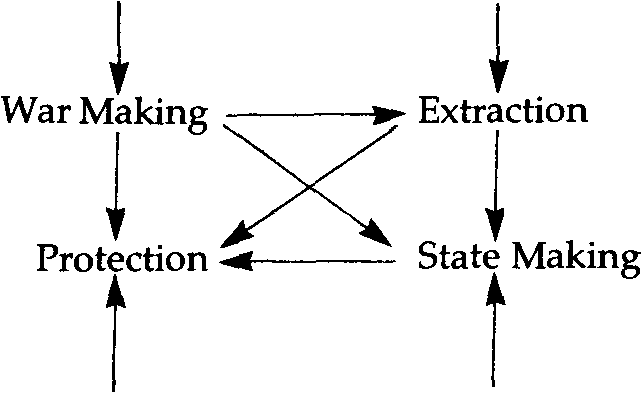
The monopoly of the use of force is claimed to be the reason behind why some kings in Europe succeed in wining wars and enriching their countries; and also the reason why others were subjugated and conquered (see the work of War Making and State Making as Organized Crime by Charles Tilly for a complete picture on this topic (online pdf) a Chapter from Bringing the State Back In (1985), edited by Peter Evans, Dietrich Rueschemeyer, and Theda Skocpol). But also, in a longer historical perspective it has been the monopoly of the use of force by specific authorities which for other authors built/destroyed entire civilizations (see the work of The Shield of Achilles: War, Peace and the Course of History (2002) by Philip Bobbitt).
Have a happy reading!
In a new 538 post, the author Nate Silver spends a lot of energy proving the unsurprising: that presidents who serve longer, and win larger re-electoral margins, are better regarded by history—or at least by historians. If this is truth I suppose that the reelection of Barack Obama will confirm it. The President of the U.S. is about one of the most loved Presidents we have had in the last decades and its correlated hate is also one of the highest. In the time previous to his election I read hundreds of comments in my Facebook profile explaining how the “World as we know it was going to end if he got the reelection”. Luckily, the world is still going on and chances are that the ideas of Obama & Co. will continue reigning and being popular.
Contemporary History (specially if read through the American lenses) is quite ridiculous. Their exceptional-ism is impressive and how they read and understand history is also ludicrous.
More interesting is to read the article by Mr. Silver (whom many consider to be THE professional in his field). Feel free to continue reading it and prepare yourself to laugh. The world may not end with Barack Obama… it will just get a little sadder…
”

The rankings I will refer to here come from a composite of the four most recent surveys in which presidential scholars were asked to rank the presidents. (The surveys were conducted between 2008 and 2011). I’ve averaged the rankings among the four surveys and then re-ranked the presidents from 1 to 43 accordingly. (Ties are broken by the best median ranking; Cleveland is counted only once for these purposes.)

We might divide the presidents into three basic groups: good (those who rank in the top 15), poor (those in the bottom 15) and average (everyone in between).
I republish information of interest from Blog de la AMHE by Itzayana Gutiérrez
Dear colleagues:
As member of the International Committee of the American Studies Association, I am soliciting panels or individual papers for our upcoming conference (http://www.theasa.net/). Picking up on a now accepted move that transnationalizes the study of the United States, we would encourage analyses of U. S.-Mexican relations (broadly conceived) or that situate an analysis of Mexico in a wider North American perspective using a cultural approach. Among possible topics are those papers examining: how American Studies is approached from outside the United States; whether the current transnational moment in culture study gives us a special purchase on the United States and North America that may not have existed before; how the hardening of borders in politics is matched by a concern for border studies within our academic field. The deadline is Jan 26. See the webpage for more information.
More info (in Spanish): http://www.h-mexico.unam.mx/taxonomy/term/63

 Globalization & Capitalism