Executive master’s in European Journalism, IHECS Brussels

Recent economic and political turmoil has shaken the European Union to its foundations and at the same time has demonstrated how the EU has grown in importance, and how its politics affect so many aspects of the daily lives of its citizens. But for many of those citizens, the EU remains remote. The way it works is often difficult to grasp, and the interactions between its institutions, with their different roles and powers, are not immediately apparent. The complexities are increased by the fact that the EU is evolving all the time.
Journalists have a major role in boosting EU’s citizens understanding of what is at stake – despite all the intricacies. They can:

– help citizens understand the EU’s integration and decision making processes;
– empower them to exert influence on European affairs
– provide information on what the EU does, and how it affects citizens’ lives
– explain complex debates and conflicting opinions

To equip journalists with the tools for these tasks, IHECS, an official Brussels-based high school, runs a pioneering executive Master in European Journalism. This is a one-year full-time daytime course, beginning in September. The course is structured around project learning and multiple partnerships with European bodies. The teaching component runs from September through to April. In April, May and June students complete their end-of-course assignments.

The highlights of the Master are:

– Workshops led by recognised professional journalists from across Europe who combine first-class teaching with practical experience in the field.
– Small class size (maximum 20 students)
– In the heart of Europe, close to the EU institutions
– Contacts with stakeholders
– Numerous media projects
– In- the-field investigations
– Constant contact with professionals

http://www.ihecs.be/masters-europeens/european-journalism/

CONTACT Person:
Laure Englebert
laure.englebert@ galilee.be
+32 2 549 55 37

via: Executive master’s in European Journalism, IHECS Brussels
Hayek’s Spontaneous Order Goes Global with Instagram

Instagram user diegotrial

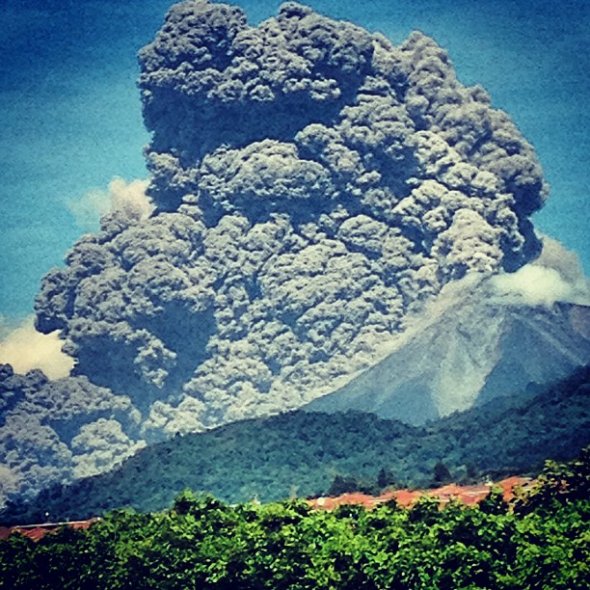
Several months ago when I heard the news about Facebook paying $1 Billion for Instagram I thought ‘the world was going crazy’.  My first impression was to think that the ruling scale of values was mistaken.  That people was giving value to unimportant things while the rest of the world was still trying to manage to survive the day.  I couldn’t understand Why would a company pay such a huge amount of money for a software application for smartphones and iPhone that is only used for procrastination and doesn’t create any value for the world? Last week’s volcanic eruption of Fuego Volcano in Guatemala made me change my mind.

The entrepreneurs behind Instagram,  Kevin Systrom and Michel “Mike” Krieger, created an application that was not only user-friendly but that enabled users to share images from anywhere in the world immediately.  Such an application was created (maybe unintentionally) to become one of the fastest image reservoirs of instant news and global interconnection.  When Facebook bought this photo-sharing app and paid $1 Billion they had not only bought the access to an essential function in millions of smartphones around the world but also connected visually the planet as we had never seen before.  Last week’s event in Guatemala was the first time in my life when I could see through my phone in Denmark high quality images of events that were taking place in real-time more than 5,843 miles.  Indeed, Hayek’s ideas of how an spontaneous order works was going global!

“Spontaneous order is what happens when you leave people alone—when entrepreneurs… see the desires of people… and then provide for them. They respond to market signals, to prices. Prices tell them what’s needed and how urgently and where. And it’s infinitely better and more productive than relying on a handful of elites in some distant bureaucracy.” Leonard Reed

To say that the world is interconnected and interdependent means to say that we are able now able of bypassing normal newsbroadcasters around the world.  No longer will be that easy for anyone to control what  the world would see and what the world wouldn’t see (as critized when News corporations around the world have been used to show a biased reservoir of images and videos during the Gulf War, or in the war in Iraq to mention some examples).  Now, with access to photo-sharing applications such as Instagram the world not only has access to interconnection of real-time events but also has what Hayek explained as “a more efficient allocation of societal resources than any design could achieve.”  Instagram is one more societal tool that enables us to achieve the best of humanity if used for the right purposes.  Because of this reasons the founders of Instagram earned  that billion dollars and the world is wealthier today.

We Are Now One Year Away From Global Riots, Complex Systems Theorists Say

Remember 1989?  Well, as argued by many scholars, that years was the culmination of global interactions that “dynamized in many places of the world crisis phenomena and synchronized, the resulting transformation processes Had they been previously locates primarily in a national framework, now its global dimension is obvious. Thus began both reflect on the established order of the world is understood relationship with their respective areas of sovereignty in the resolution, as well, should be designed as the new world order.” (Read more on 1989 in a Global Perspective).

“The MIT Technology Review explains how CSI’s model works: “The evidence comes from two sources. The first is data gathered by the United Nations that plots the price of food against time, the so-called food price index of the Food and Agriculture Organisation of the UN. The second is the date of riots around the world, whatever their cause.” Plot the data, and it looks like this:……”

Read more…

The Global Politics of the Diaoyu Islands

By Bryant Arnold. via:http://www.cartoonaday.com/china-vs-japan-at-sea/

As The Japanese government’s moved to purchase the Diaoyu Islands (also known as Senkaku Islands) three days ago the government of the People’s Republic of China reacted energetically.  Initially, Chinese media reporters influenced mediatic understanding of the situation by emphasizing the nationalization of the islands by Japan (ringing the history bells to Chinese people on how Japan had previously nationalized Manchuria and renamed it as the puppet state of Manchukuo during the WW2 period).  And later, by making strong diplomatic statements on how Chinese sovereignty and control of the islands had been violated by the Japanese purchase.

The purchase of the islands is of relevance regionally and globally.  Why China, Japan, and S. Korea aren’t backing down on this islands should be understood by taking a look at the map and see how the position of the islands is central for the passage of containers and oil that comes all the way from Middle East via the Strait of Malacca.  A route that is of priority importance for China and which I explored in the essay “The Strait of Malacca as one of the most important geopolitical regions for the People’s Republic of China” which ca be read in pdf at Academia.edu for free.

Locally, the geography of the islands is meaningless. The island group consists of five uninhabited islets and three barren rocks which zooming out are located approximately 120 nautical miles northeast of Taiwan, 200 nautical miles east of the Chinese mainland and 200 nautical miles southwest of the Japanese island of Okinawa. And which zooming out are in the center of the route of all the containers that go to the ports of East and North East China, of which the most important is Shangai.

The Japanese central government formally annexed the islets on 14 January 1895. And after WW2 they were occupied by the United States. The islets were later returned to Japan during the 70s and it was only until the last two decades that they became of relevance as the People’s Republic of China started to project is New Economic and Global Plans for economic sustainable expansion.  Plans in which they have invested billions of  dollars in military expansion, naval trade/military shipbuilding, regional economic investment via state-owned companies and diplomatic sovereignty claims all over the region.

The islands are officially Japanese territory, but as Chinese official statements continue being broadcasted they claim a violation of sovereignty that could takes decades to be resolved via a diplomatic arbitrage and/or scalate to more direct military statements and naval occupations of the beaches of the islets.

Whoever said that trade is the most (or only) pacific way of organizing society should reconsider this evaluations when thinking about how global trade works and on how diplomatic and economic control of trade routes is sometimes more powerful and dangerous than a bunch of battleships.

The Book WE have been waiting for is finally here!!!

I have GREAT NEWS for all Philosophy fans! One of the books I have been awaiting for is finally published!

The first time I heard about this book was in a conference I attended by Dr. Peikoff’s  at OCON 2010 in which he identified three different modes of integration, i.e., of interrelating concretes, such as individual percepts, facts, choices, story events, etc. As Dr. Peikoff explained:

“My thesis is that the dominant trends in every key area can be defined by their leaders’ policy toward integration. They are against it (Disintegration, D); they are for it, if it conforms to Nature (Integration, I); they are for it, if it conforms to a Super-Nature (Misintegration, M).” The book—focusing on literature, physics, education and politics—demonstrates the power of these three modes in shaping Western culture and history.

Here is more information about how to get the book,

In what some critics are calling his masterpiece, Leonard Peikoff, renowned philosopher and author of Objectivism: The Philosophy of Ayn Rand, argues that it is the human mind that makes all the difference—specifically, the ways we are taught to process and integrate information. He finds three and only three processes at work, each dominant in different periods, and each paving the way for the next.

From this perspective, The DIM Hypothesis: Why the Lights of the West Are Going Out surveys, from Greece to the present, four broad fields of human culture—literature, physics, education, and politics—and develops his strikingly original interpretation of the nature and history of the West.

Extrapolating from the historical pattern he identifies, Peikoff is able to explain why the lights of the West are going out—and to predict the most likely future for the United States.

Read more about Dr. Peikoff’s The DIM Hypothesis, or buy the book now.