Article recommendation: Twentieth Century Flick: Business History in the Age of Extremes

I apologize for posting much these last weeks.  I have been quite busy reading journals on Global Value Chains, Deviant Capitalism, Black Market Trade and theories on Global Political Economy.  While this has driven me nuts… it has also made me pay attention to the field of Business History.

Business history is not the history of Capitalism and it is also not the history of entrepreneurship.  The research in this field is mostly controlled by an European institutionalist approach.  And in the latest decades, it has gained more insights from economic and business studies that are highly afflicted by neo-marxist approaches of the 20th Century.  So, if you are interested in learning about this particular area of research here is the info for a good article on the topic that may get you also interested, and provide you with further bibliography.

Twentieth Century Flick: Business History in the Age of Extremes
Priemel, Kim Christian (2012)
Journal of Contemporary History vol. 47 (4) p. 754-772

.Full Text (PDF)

Conference: Global History of Agrarian Labor Regimes, 1750 to 2000 (Harvard University)

My interest in Agrarian Labor Regimes was first awaken in my research on Opium trade in India. Since then, more readings have made me realize the complex structures behind the history of agrarian labor in a global context.

If you are also interested in the topic, the *Weatherhead Initiative on Global History (WIGH)* at Harvard University is planning a conference for *April 2013* that is focusing on changing labor regimes within global agriculture.

As posted by Blog de la AMHE by Manuel Bautista, they are interested in exploring the diversity of labor regimes, the paths along which they changed, and—most especially—the connections between these changes in different parts of the world. We are interested in work that explores the connected histories of propertied farming, sharecropping, wage labor, slavery, *cultures obligatoires*, and other such forms of labor, and how they have been connected to the spatial and social spread of capitalism.We are seeking proposals from historians, political scientists, economists, sociologists, and anthropologists at all stages of their academic career, including graduate students. We encourage proposals from those in relevant career paths or institutions outside the university. We are particularly interested in forging a global discussion of these topics, and therefore welcome especially contributions from outside North America and Europe.

The conference will try to balance broad comparative papers and revealing case studies. The Weatherhead Initiative on Global History is a newly created center that responds to the growing interest at Harvard in the encompassing study of global history. The Initiative is committed to the systematic scrutiny of developments that have unfolded across national, regional, and continental boundaries as well as to analysis of the interconnections—cultural, economic, ecological and demographic—among world societies. For further information about WIGH as well as the conference, please consult our website at http://wigh.wcfia.harvard.edu.

Proposals should include an abstract of no more than two pages and a brief curriculum vita. Please email your submissions to Jessica Barnard ( jbarnard @ wcfia.harvard.edu ) before *November 30, 2012*. Travel expenses as well as accommodation will be covered.

Holger Droessler hdroessl @ fas.harvard.edu

Poor Haitians Reading #FirstWorldProblems Tweets Might Be The Best Ad Of The Year

I was just told about this ad campaign and I couldn’t more than agree.  Because #FirstWorldProblems are not real problems when understood in a global context,

DDB New York has created an ad for the Haitian charity “Water Is Life” that humiliates whiners on Twitter who use the “#Firstworldproblems” hashtag to complain about life’s trivial challenges.

In the video (below), ordinary Haitians — standing amid shanty huts, broken school buses and wrecked buildings — read the inane tweets of self-entitled idiots who complain about phone cords that won’t reach their beds, and leather car seats that aren’t heated.

Hayek’s Spontaneous Order Goes Global with Instagram

Instagram user diegotrial

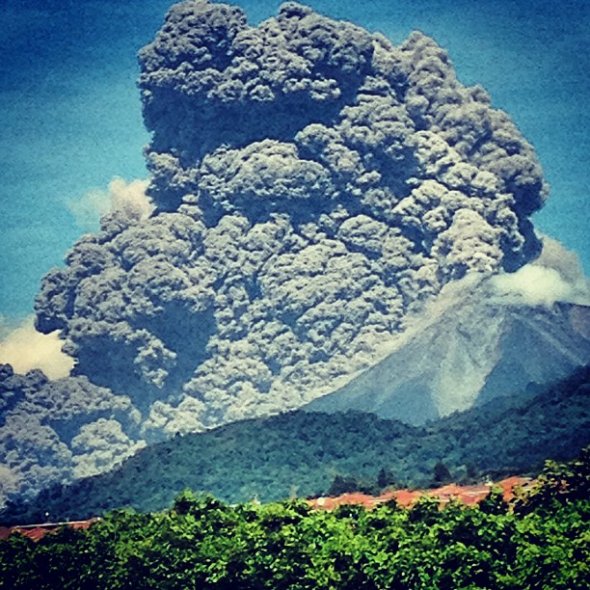
Several months ago when I heard the news about Facebook paying $1 Billion for Instagram I thought ‘the world was going crazy’.  My first impression was to think that the ruling scale of values was mistaken.  That people was giving value to unimportant things while the rest of the world was still trying to manage to survive the day.  I couldn’t understand Why would a company pay such a huge amount of money for a software application for smartphones and iPhone that is only used for procrastination and doesn’t create any value for the world? Last week’s volcanic eruption of Fuego Volcano in Guatemala made me change my mind.

The entrepreneurs behind Instagram,  Kevin Systrom and Michel “Mike” Krieger, created an application that was not only user-friendly but that enabled users to share images from anywhere in the world immediately.  Such an application was created (maybe unintentionally) to become one of the fastest image reservoirs of instant news and global interconnection.  When Facebook bought this photo-sharing app and paid $1 Billion they had not only bought the access to an essential function in millions of smartphones around the world but also connected visually the planet as we had never seen before.  Last week’s event in Guatemala was the first time in my life when I could see through my phone in Denmark high quality images of events that were taking place in real-time more than 5,843 miles.  Indeed, Hayek’s ideas of how an spontaneous order works was going global!

“Spontaneous order is what happens when you leave people alone—when entrepreneurs… see the desires of people… and then provide for them. They respond to market signals, to prices. Prices tell them what’s needed and how urgently and where. And it’s infinitely better and more productive than relying on a handful of elites in some distant bureaucracy.” Leonard Reed

To say that the world is interconnected and interdependent means to say that we are able now able of bypassing normal newsbroadcasters around the world.  No longer will be that easy for anyone to control what  the world would see and what the world wouldn’t see (as critized when News corporations around the world have been used to show a biased reservoir of images and videos during the Gulf War, or in the war in Iraq to mention some examples).  Now, with access to photo-sharing applications such as Instagram the world not only has access to interconnection of real-time events but also has what Hayek explained as “a more efficient allocation of societal resources than any design could achieve.”  Instagram is one more societal tool that enables us to achieve the best of humanity if used for the right purposes.  Because of this reasons the founders of Instagram earned  that billion dollars and the world is wealthier today.

We Are Now One Year Away From Global Riots, Complex Systems Theorists Say

Remember 1989?  Well, as argued by many scholars, that years was the culmination of global interactions that “dynamized in many places of the world crisis phenomena and synchronized, the resulting transformation processes Had they been previously locates primarily in a national framework, now its global dimension is obvious. Thus began both reflect on the established order of the world is understood relationship with their respective areas of sovereignty in the resolution, as well, should be designed as the new world order.” (Read more on 1989 in a Global Perspective).

“The MIT Technology Review explains how CSI’s model works: “The evidence comes from two sources. The first is data gathered by the United Nations that plots the price of food against time, the so-called food price index of the Food and Agriculture Organisation of the UN. The second is the date of riots around the world, whatever their cause.” Plot the data, and it looks like this:……”

Read more…