Making a Moral Revolution. From 1773 to 2011.

The protests of the groups named 99% seem to continue igniting fury all over the world since they occupied Wall Street at Liberty Square in Manhattan’s financial district. By now, they claim at OccupywallSt.org that the protests are being held in more than 1500 cities around the world (virtual map). In all those cities the protests have taken different shapes and discourses. They seem to cry for different things. Their leaders emphasize their own agendas and it has been hard for me to identify a common single demand.

Curiously, most of these protesters most surely do not recall that on a day like today more than 200 years ago a public meeting similar to theirs was first organized.  It was in October 16, 1773 that the First public meeting of protest against the Tea Act took place in Philadelphia.  These protesters demanded from their rulers (The British Parliament) a respect of their rights to property and individual rights.  They asked for the Parliament to respect their right to elect their own Representatives and to be taxed by those representatives only.

Three years later, after their demands were not listened by the British government the United States Declaration of Independence was signed by the representatives of thirteen American colonies then at war with Great Britain. It was the first Declaration ever written in history that considered as its core that all men had unalienable Rights and that among these rights are Life, Liberty and the pursuit of Happiness.

Since then, these rights were slowly forgotten and captured by government. Slowly, the sons and daughters of these revolutionary protesters forgot the reasons that created such a wonderful Declaration.  Now, the protests of the Occupy movements face a similar contradiction.  As The Ayn Rand Center for Individual Rights argued in their article What the Tea Party Movement Must Stand For, it is necessary for them to organize against one single claim: They should demand for a Moral Revolution in which their government returns to them their rights to Life, Liberty and the pursuit of Happiness.

It is until now Ayn Rand the only philosopher who has provided a moral defense for these revolutionaries.  As she wrote in Capitalism: the Unknown Ideal,

“The world crisis of today is a moral crisis–and nothing less than a moral revolution can resolve it: a moral revolution to sanction and complete the political achievement of the American Revolution. . . . [YOU] must fight for capitalism, not as a “practical’ issue, not as an economic issue, but, with the most righteous pride, as a moral issue. That is what capitalism deserves, and nothing less will save it.”

Occupying Wall Street for the wrong reasons

The group “The 99 percenters” (also known as the 99%) assembled in Wall Street to protest against the corporations of the United States that have benefited from the privileges granted from government through lobbying. They say to be tired of the social and economic inequality in their country.  Somehow, they consider Corporations to be the one’s to blame for this inequalities.

Now, lets hold on for a second and consider what are they protesting against and who’s to blame. Then, lets try to explain what and whom should be really blamed before continuing this protests.

What they say to be protesting against:

What are the really protesting against:

  • Social inequality: Is in fact the cultural and educational differences of those who know more than others.
  • Economic inequality: Is the result of those men who earn a salary that is higher than others; or of those who own a business and make more earnings than others.
  • Lobbying: Is the act of influencing decisions made by officials in the government in favor of some industries, unions, or groups of society.
  • Corporate greed: Is not to be confused with the profit that an entrepreneur earns in his ventures.  Greed should better be understood as the result of living and satisfying one’s wants wants by seizing and consuming the products of the labor of others. Corporations that profit with the privileges granted by government are the only ones to be attacked and denounced; not those entrepreneurs who took risks and invest their savings.

These “99 percenters” are confused.  They think that Corporations are to be blamed for the economic and financial crisis that started in 2008 in the U.S.  However, it is their government and their bureaucrats that through Congress ad the FED enabled for the crisis to happen.  This protests should have been taking place in front of the White House and the Senate instead of Wall Street. (Check this video of some of the protests in Wall Street agains the FED)

It is not all the rich and wealthy who benefit from government privileges.  The ones who did are to be blamed. But more so, the one’s to be blamed and taken to justice are the the government officials who created the legislation that ensures that corruption and impunity continue without being punished.

As Fréderic Bastiat, the journalist and philosopher from the 19th. Century, once said:

The law has placed the collective force at the disposal of the unscrupulous who wish, without risk, to exploit the person, liberty, and property of others. It has converted plunder into a right, in order to protect plunder. And it has converted lawful defense into a crime, in order to punish lawful defense.

How has this perversion of the law been accomplished? And what have been the results?

The law has been perverted by the influence of two entirely different causes: stupid greed and false philanthropy. (…)

But, generally, the law is made by one man or one class of men. And since law cannot operate without the sanction and support of a dominating force, this force must be entrusted to those who make the laws.

This fact, combined with the fatal tendency that exists in the heart of man to satisfy his wants with the least possible effort, explains the almost universal perversion of the law. Thus it is easy to understand how law, instead of checking injustice, becomes the invincible weapon of injustice. It is easy to understand why the law is used by the legislator to destroy in varying degrees among the rest of the people, their personal independence by slavery, their liberty by oppression, and their property by plunder. This is done for the benefit of the person who makes the law, and in proportion to the power that he holds.

I invite you to continue reading Bastiat’s wonderful book “The Law” online. I am myself, have read it for dozens of times and consider it one of the most enlightening works ever written. Spanish versión: La ley por Frédéric Bastiat [PDF¨]

Friday Book Review: “1493” by Charles C. Mann

Reviewed by Marek Kohn, Financial Times

“In hindsight, 1492 might have been a good point at which to reset the calendar. Traditionally, the year in which Columbus discovered America is seen as the moment Europe began to shape a New World. Today it looks more like the start of a process that has stitched the drifting continents back together: 1492 was the Year Zero of globalisation, and 1493 was Year One.”

Read More: “1493” – book review at FT.com

Syria on the road to chaos?

Last night I attended a lecture titled “Syria on the Road to Democracy or Chaos?” by Ph.D. Candidate Mohammad Maghout hosted by the Institute of Oriental Studies in Leipzig University.  The lecture was an overview of the last 20 years of political oppression and autocrat government in Syria.  The speaker emphasized how Bashar al-Asad was an exact continuation of the government his father, Hafiz al-Asad held in Syria from 1970 to 2001.
Maghout explained that in Syria the government was not only feared but that a cult of reverence toward the al-Asad regime had being built.  He explained that in the 40 years of autocratic regime the regime had amassed its power upon a pyramidal network of tribal, religious and economic leaders that belonged to different ethnic groups and tribes.  In Maghout’s reasoning, it was these ethnic and tribal differences one of the key elements that allowed for the Syrian government to control the population while confronting them every time political tensions appeared.  Indeed, these confrontations were evident after the the 2011 Syrian uprising (from January 26th to March 15th of 2011) and as Salman Shaikh wrote yesterday in the NYTimes (Preventing a Syrian Civil War. NYT. October 12th, 2011), it is these ethnic confrontations and sectarianism that could bring Syria into chaos.

One thing was left without a clear answer from Maghout’s lecture.  It was the question on “why didn’t Syrians react to all the lies, political oppression and corruption of the al-Asad regime previously”.  Maghout explained that Syrians were not only divided in ethnic groups that conflicted within their understanding on “Who Syrians really are”, but that it had passed already too many years of fear for government’s power that brought the population to fear political activity and the use of freedom of speech to protest against government.  While this is true, I consider it not to be sufficient reason.

It may be necessary to understand which was the role (or lack of it) of the economic leaders during the unrest.  I am sure that understanding how crony capitalism works could bring some interesting tools to understand what is the effect of privileges in a society. And as such, could be a valuable tool to understand how can the results of these social movements be differentiated.  The participation of crony capitalists protecting corrupt governments and the participation of entrepreneurs is psycho-epistemological different because of the goals they aim to achieve.  It is entrepreneurs who most often support (economically and logistically) social movements that demand freedom of speech, equality of rights, an end to corruption and the respect of private property.

Photograph: AFP/Getty Images

Columbus Day

“Columbus was searching for hardware — precious metals, silk, and spices — the sources of wealth in his day. I was searching for software, brainpower, complex algorithms, knowledge workers, call centers, transmission protocols, breakthroughs in optical engineering — the sources of wealth in our day.”
Thomas Friedman,
The World Is Flat

Choosing the right topic to start a blog is difficult. As a previous owner and contributor of blogs (Homo Homini Lupus RIP, Libro Libertate and Capitalismo) I’ve found that my interests were always linked to one idea: Wealth.  Indeed, Wealth has played a role in every single decision I’ve made. From choosing which book to read, starting a business or planning for my career development I’ve always been interested in a difficult topic: Wealth creation.

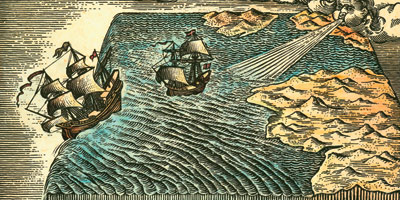
As such, I have decided to start my last blog in the celebration of Columbus Day.  A day like today on October 12th, 1492 the three ships leaded by the Italian sailor Christopher Columbus “discovered” America.  It is important to note that America was not discovered by Columbus, the Continent was already inhabited by millions of humans that had developed some of the richest and most educated civilizations on Earth.  However, the impact of his discovery amounted less than 50 years later to one of the major transfers of technology, institutions, crops, diseases and commerce than the world had ever seen.

The effects of Columbus discovery are still now evident and engineered one of the largest path-dependencies on history.  American soil (it started to be recognized as America until 15 years later) and its biological life was to transform forever.  Millions of humans were conquered and ruled by the Spanish, English, Dutch and French Crowns and millions of them died because of diseases transferred from Europe, Africa and Asia. Hundreds of different plants and animals were introduced and exported to and from the continent modifying forever the ecosystems of a large part of the planet.

Today, Columbus Day should represent for us that singular moment of globalization in which an infinite amount of transfers occurred.  These transfers reshaped the globe into a realm of interconnectedness never seen before.  Finally, in 1492 the six continents of the world were connected for the first time.  Today, we have benefited and suffered many changes that resulted from that historical moment.

It shall be the aim of this blog to study, discuss and identify those events that modified the course of history and emphasize which were those principles, decisions and achievements that enabled for more men to pursue happiness.  Lets us learn from the past!