Journal Reco: Globalization and Global History in Toynbee

ArnoldToynbee1961
Image by cesarharada.com via Flickr

Abstract

This article traces the intellectual history of Arnold J. Toynbee. It centers on early twentieth-century British social thought and its synthesis of idealism and evolution. Toynbee used this framework to interpret imperial and international affairs, and, like his mentors, he focused especially on the unprecedented, progressive possibilities of global integration. With the failure of the Paris Peace Conference, however, Toynbee began to regard globalization as a contradiction between social unity and spiritual disjuncture. A Study of History, his endeavor to bring historical writing into its global present, followed from this opposition, which he sought to explain and hoped to resolve. By the mid 1930s, world events finally overwhelmed Toynbee’s commitment to the old conceptual synthesis. He returned to such thinking after World War II, but his brief declaration of methodological limitations illuminated for historical study the antinomy of the global scale.

Universal history must be construed and denied.

To many world historians today, Arnold J. Toynbee is regarded like an embarrassing uncle at a house party. He gets a requisite introduction by virtue of his place on the family tree, but he is quickly passed over for other friends and relatives. For much of the twentieth century though, Toynbee was perhaps the world’s most read, translated, and discussed living scholar. His output was enormous, hundreds of books, pamphlets, and articles. Of these, scores were translated into thirty different languages. In 1947, Time magazine considered his historical significance to be on par with Marx.2 Among intellectuals, response to his work was de rigueur. Indeed, the critical reaction to Toynbee constitutes a veritable intellectual history of the midcentury: we find, for example, Aron, Frye, Huxley, Kennan, Kracauer, Kroeber, Morgenthau, Mumford, Niebuhr, Ortega y Gasset, Popper, Ricouer, [End Page 747] and Sweezy, as well as a long list of the period’s most important historians, Beard, Braudel, Collingwood, and so on.

A survey of these responses consistently reveals odd contradictions between positions. In recent historical work, for example, Reba Soffer aligns 1930s-era Toynbee with Britain’s “radical right,” while Christopher Brewin describes his politics of the same period as “progressive liberal.”3 In Toynbee’s own time, two of the most sustained attacks came from E. H. Carr and Pieter Geyl, each in a certain way the inverse of the other. Carr translated the Marxist critique of bourgeois moralism into his study of international relations; he assailed Toynbee’s “utopian prescriptions” as so many alibis for British national interest. And as in Marxism, spotlight on the furtive particular in turn revealed a sturdier universal, in this case, what Carr called “the nature of politics.” Geyl, on the other hand, read Toynbee’s “impossibly universalist system” not as façade for a specific concern, but as its disintegration; he deemed Toynbee’s world history as an attempt to “escape” the uniqueness of the West. Toynbee’s “passion for unity,” Geyl wrote, was “fundamentally antagonistic to history, the guardian of the particular.”4 So which was it: the camouflage of self-interest or an ecumenical hallucination? And which was the corrective to Toynbee’s grand failure? Naturalism or historicism? Siegfried Kracauer shook his head: “There is something schizophrenic about Toynbee.”5

One approach toward understanding this contradiction can be found in Karl Löwith‘s brief comments on Toynbee in Meaning in History. All modern temporality, according to Löwith, was an “inconsistent compound” of ancient Greek cyclicality and a Christian theology of history. In addition, the latter’s eschatology endowed the historical process with “universality,” evoking above every smaller narrative the single, imagined identity of “mankind.” With this broad phrasing, Löwith fittingly characterized the two-sidedness of Toynbee’s thinking,[End Page 748] but he left unattended Toynbee’s struggle against a categorical universalism.6 Löwith’s high degree of abstraction offers little to the historiographer assessing world history and the varied circumstances that have contributed to its diverse formulations. My own reading stays considerably closer to the text. For in understanding Toynbee, philosophical generalization, like a quick dismissal, misses the struggles and contradictions in his attempt at world history. These break points help elucidate the history of the field, as well as the history of global thought and twentieth-century intellectual currents more generally. Perhaps too, they present to contemporary world-historical thinking an insight of value, even as Toynbee’s system has long stood in ruins.

The basis for Toynbee’s historical logic, and the source of its core difficulty, derived from a set of ideas which are best described as “evolutionary idealism.” One of the dominant trends in early twentieth-century British social thought, evolutionary idealism sought to combine Darwinian naturalism and teleological purpose, two positions hitherto locked in debate. Writers applied this synthesis to questions of imperial affairs, and it underscored much of the era’s thinking on the globe and its history. From this conceptual framework, Toynbee reckoned that the single most significant feature of his age was world integration, a “unification [that] . . . has caught in its meshes the whole living generation of mankind and all the habitable lands and navigable seas on the face of the Planet.”7 Indeed, Toynbee’s entire career as historian and political analyst can be read as a massive reflection on what came to be called globalization. His earliest such writings fully mirrored the evolutionary idealism of his educators. Yet this outlook faced a serious challenge in the immediate aftermath of World War I. The strains of colonial violence and worldwide turmoil fragmented teleology into a multiplicity of beliefs and interests. Toynbee persistently and loudly emphasized this problem of difference. At the same time, and throughout the interwar years, he remained committed to evolutionary idealism and strained to refashion it for the new, polycentric world. Both his rationale and his method for a history of the globe followed from that effort. The contradictions, however, could not be contained, and by the late 1930s, internal adjustments appeared inadequate. With the Italian invasion of Ethiopia and the attendant fiasco at the League of [End Page 749] Nations, Toynbee renounced his previous position. For a brief but significant moment, he neither synthesized nor hybridized the unity of the globe and its diversity of ideals. World integration rendered the universal and the particular into categories at once interdependent and irreconcilable, at once complementary and contradictory. After World War II he returned to the principle of synthesis with ever new and ever unsatisfactory attempts at reconciliation. Across Toynbee’s reception then, as in Carr and Geyl, his key concepts hopelessly chased each other in circles. Yet this indetermination anticipated in a uniquely interrelated way some of the major philosophical and historiographical currents of later years, expressing the irresolvability of postmodernism, the renewed interest in religion, and world history itself.

Read more: Michael Lang. “Globalization and Global History in Toynbee.” Journal of World History 22.4 (2011): 747-783. Project MUSE. Web. 25 Nov. 2011. <http://muse.jhu.edu/journals/journal_of_world_history/v022/22.4.lang.html&gt;.

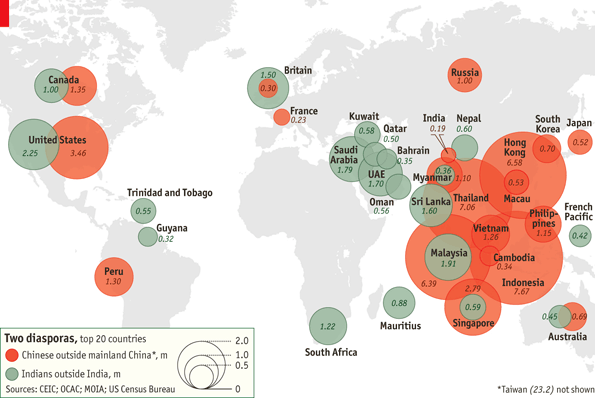
Where are the world’s biggest Chinese and Indian immigrant communities?

The Economist published a mind-blowing graphic depicting the migration of Chinese and Indian people around the world. The asses that “more Chinese people live outside mainland China than French people live in France, with some to be found in almost every country. Some 22m ethnic Indians are scattered across every continent.” More so, they emphasize that even though Diasporas have been a part of the world for millennia; their size and the ease of staying in touch with those at home are making them matter much more with the emergence of social network online technologies.

World's top 20 destinations for Chinese and Indian migrants

Now, this is once again part o the large “discourse of newness” that embeds great part of current mainstream history.  This is something that has been denied and discussed by Prof. Adam McKeown in the article “Article: Global Migration, 1846–1940” who claims after doing a extensive research of migration from China and India during the 19th Century that the amount of immigrants and the global effect it had is comparable (and at some points superior) to the more known Atlantic migration from Europe to America. I strongly suggest you checking the Article by Prof. McKeown an check also Dr. Dirk Hoerder great book titled: Cultures in Contact in case you are interested in this subject.

Celebrating the 1st. Month of Globalization & Capitalism

del.icio.us millionth user + birthday bash
Image by Laughing Squid via Flickr

I am very happy to celebrate the first month of life of this blog! The blog has already received 1,700 unique visitors and many comments have been left in the posts I have published.  I am very thankful for your comments since they have helped me (and my readers) to learn more!

Thank you very much for your support!

NEW PhD in Global Studies, Roskilde University

Roskilde, a detail of the University Library
Image via Wikipedia

I am currently enrolled in the MA in Global Studies 2013 at Roskilde University and I am very happy to share this news with you;  Roskilde University is a very new (founded in 1972) and leading University in a new focus on Education that is hard to find in Europe.  The focus of the courses in the University is not based upon traditional lectures but in group orientated methods and projects. It currently has more than 8,000 students and offers BA, MA and PhD degrees.  Now, they are offering a new PhD scholarship in Global Studies at the Department for Society and Globalisation: http://www.ruc.dk/en/jobs/phd/

The research topic is within Global Studies and the focus of the proposed research projectshould fall within one of the following themes:1. New actors and alliances in North-South relations
2. The Arab Uprisings and the global changes
3. The squeezed middle classes: Europe and Asia compared

All the best,
Kennet Lynggaard
Associate Professor, PhD.
Department of Society and Globalisation
Roskilde University, Bld. 25.1
Universitetsvej 1
P.O. Box 260
DK-4000 Roskilde
Denmark

Joel Cohen: Top 10 key population trends on Earth with 7 billion

Joel Cohen is the author of the 1996’s bestseller on Population studies titled “How Many People Can the Earth Support?“. I remember some of its content and that it was one of the first book acquisitions I did from Barnes & Noble (from those times in which you actually went to the bookstore!).  Now, 15 years later we are confronted with his favorite topic: overpopulation and his fetish with calculations for possible saturation points.  Here’s what he thinks even though so many people has been born since he wrote his book doing numbers of saturation points of the world:

Humanity took until year 1800 to reach its first billion people. We added 1 billion people in just the past 12 years. October 31, 2011 marks a milestone in global population: 7 billion humans. That’s according to projections by the United Nations. EarthSky interviewed demographer Joel Cohen, professor of populations and head of the Laboratory of Populations at the Rockefeller University and Columbia University in New York. He explained the top 10 population trends in a world with 7 billion inhabitants.

1. One billion people are hungry, and 1 billion are obese. Cohen said this is the most important thing people should know about the population milestone of 7 billion. Too too many people on Earth today live without knowing where their next meal will come from.

A billion people are chronically hungry. That means they wake up every day hungry. They don’t get enough calories to get through the day and do a day’s work like you and me. And many of them have been hungry since they were born. And their brains aren’t fully nourished, fully developed. And they’re having a very hard time learning and coping with life’s problems.

At the other extreme there are about a billion people that are really, seriously obese. And that’s partly a matter of not getting a good food supply also — not a food supply that’s balanced for their needs. Roughly two or three billion people — we don’t know precisely — are malnourished as opposed to undernourished. That means they’re not getting the trace vitamins that they need to have a balanced diet.

For world's seven billion, one billion hungry, one billion obese. (UN)

In a world with 7 billion, 1 billion are hungry, 1 billion are obese. (UN)

2. Three billion people live on two dollars a day. Cohen said:

That is abject poverty. You try to live on two dollars a day for long and you’ll start losing weight pretty fast. So roughly half the world is in desperate poverty.

3. One billion people live in slums. Cohen said:

Right now, about half the world lives in cities — let’s say 3.5 billion, slightly more. And of those, a billion are living in slums without adequate sanitation, electricity, water, security, legal protection, transport, and inadequate housing conditions. When it rains, it leaks. Maybe a mud floor. So we, the world, have not provided home or food, have not reached minimum standards that we ought to be providing for people.

One billion people today live in slums. (UN)

One billion people today live in slums. Image Credit: United Nations

4. Over 200 million woman have unmet needs for contraception. He said:

That means that they don’t want to have an additional child, and yet they’re not able to use modern means of contraception. These problems are not only abroad. We have, I would say, a very serious population problem in the United States. According to the United States Centers for Disease Control, in 2001, approximately half of the pregnancies in the United States were unintended. That means that the woman, or the couple either did not want a pregnancy at that time or did not want a pregnancy at any time. And that is a very serious problem of human well-being related to the lack of control over people’s own reproduction.


5. Today, 1.5 billion people live in rich countries.
 Cohen explained:

That’s Europe, Western Europe mainly, the United States and Canada, the overseas English-speaking countries of Australia and New Zealand, Japan, and some of the Asian tigers.

6. Four billion people live in middle-income countries. Said Cohen:

These are the countries that have recently emerged from poverty with fast-growing economies. And I would put China, India, Brazil, many countries in Latin America in that realm of the middle-income. And that means on the order of Chile — let’s say 5,000 dollars a year income. That’s tremendous progress when you remember how recently China and India were really in desperate poverty. And many in those countries still are.

Four billion people live in middle-income countries like China. Image Credit: weirdchina

7. Economically at the bottom are 1.5 billion people. Cohen said:

Those people are living largely in sub-Saharan Africa, but in the new world also in Haiti, and in many of the provinces of South Asia in both Pakistan, Afghanistan, India, Bangladesh. There are hundreds of millions of people in dire poverty — the bottom billion as one Oxford economist calls them. So that gives you sort of a geographical picture of where these 7 billion people are.

Seniors now outnumber toddlers.

Seniors now outnumber toddlers.

8. Seniors now outnumber toddlers, and this trend will continue to increase. Cohen explained:

In the last decade, the world passed a very major milestone. And that is that for the first time in history, the number of people 60 years old or more exceeded the number of people 0-4 years old. Basically, for the first time, the grandparents outnumber the grandchildren. In the year 2000, there were about 10 percent of the world’s people were age 0-4, and about 10 percent were age 60+.

What we’re going into now is the era of aging. And by 2050, we anticipate that the number of people 60+ will be about 3.5 times the number of people age 0-4.

In the richer countries, like the United States and Europe, this process of aging is already pretty far advanced and will pose some serious questions and challenges for our retirement systems. In the poorer countries, which have a younger population because they’ve been growing faster — that means more children, so higher proportion of young people — aging will increase even faster than in the richer countries, which have already made a transition in part, the beginning of a transition to aging. So aging is one big thing that’s happened.

Two-thirds of people worldwide will live in cities by 2030, experts predict.

Two-thirds of people worldwide will live in cities by 2030, experts predict.

9. More than half of Earth’s inhabitants today live in cities, and two-thirds will live in cities by 2050. Cohen said:

In 2000, a little less than half of the world’s people lived in cities. Somewhere around 2007-2008, it became about 50-50. And by 2050, we expect about two-thirds of the world’s people to be living in cities. Now the increase in the number of city dwellers, between 2000 and 2050 is expected to be about three billion people, which was the total population of the Earth in 1960.

Virtually all of that additional three billion people will be added in the cities of the developing countries, not the rich countries. The rich cities will grow somewhat, but the really rapid growth will be in the poor or developing countries.

And if you do the arithmetic, 50 years between 2000 and 2050, roughly 50 weeks per year, 50 times 50 is 2500 weeks in that half century. And yet we’re going to add three billion people in the cities. Three billion is 3,000 million. It means that developing countries have to add urban infrastructure for a million people every five days from now to 2050. Now if that isn’t a building job, I don’t know what is. And hardly anybody is thinking about the design of the cities so that they can accommodate those additional three billion people in a constructive and useful way.

More than half of women today have fewer children needed to replace themselves. (UN)More than half of women today have fewer children than the number needed to replace themselves and their partner. Image Credit: United Nations

10. More than half of women today have fewer children than the number needed to replace themselves and their partner. Cohen said:

In 2003, for the first time in human history, more than half the women in the world lived in countries or provinces where the rate of reproduction was below the replacement level. That is, they were having fewer children than required to replace themselves in the next generation. This represents a tremendous change over the previous half century. The rate of growth of the world population fell by almost half, from 2.1 percent per year in 1950 to 1.1 percent per year in 2000. And we expect it to continue to decline if we continue to educate women, to provide modern contraception, and to improve the status of nutrition and education.

Bottom Line: Humanity took until year 1800 to reach its first billion people. We added 1 billion people in just the past 12 years. October 31, 2011 marks a milestone in global population: 7 billion humans. That’s according to projections by the United Nations. EarthSky interviewed demographer Joel Cohen, professor of populations and head of the Laboratory of Populations at the Rockefeller University and Columbia University in New York. He explained the top 10 population trends in a world with 7 billion inhabitants. Many continue to face issues of dire poverty. The population is aging. For the first time, more than half the world’s women live in countries or provinces where the rate of reproduction was below the replacement level.

professor of populations and head of the Laboratory of Populations at the Rockefeller University and Columbia University in New York.

via: Joel Cohen: Top 10 key population trends on Earth with 7 billion