Finding the secret of the Prince of Persia in Weimar

Video: Placido Domingo interprets “Nessun Dorma” from Puccini’s opera Turandot

One of the most wonderful events that a human being could get to see in his lifetime is the opera Turandot. And for the first time in History, in October 14, 2011, the Middle Eastern citizens had the opportunity to attend to a presentation of Turandot at the Royal Opera House Muscaz; Oman‘s premier venue for musical arts and culture last  with a production by Spanish tenor Plácido Domingo1

The decision of choosing Turandot was also specially significant to the history of such a wonderful region because the opera tells a story from the famous Persian collection of stories know as The Book of One Thousand and One Days in which the character of the princess of “Turandokht” was found.This princess was to marry the prince who would solve her three riddles; failing was to result in the death penalty.  First, The Prince of Persia tried to win Turandot, and failing he was going to be executed. in his way to Death he gets to meet Princess Turandot and falls profoundly in love who manages to free himself and make evident his intentions to take Turandot’s challenge. He wins her challenge by answering her riddle but Turandot doesn’t wants to marry him.  In exchange, the prince says to the princess that he doesn’t wants to force the prince to marry him; and that, if she guesses his name before sunrise, he will let her kill him.

In this part, the opera takes you to the most wonderful scenes on Earth while Turandot is trying to guess the Prince’s first name. The Prince manages to kiss princess Turandot she realizes that she also loves The Persian Prince. In an emotional act he tells her his first name is Calaf waiting for her to love him more; however, she is full of anger and arrogance and thinks that he had just revealed the secret she so eagerly looked for. She goes to her father and addresses the Imperial Court; she reveals that the name of his lover is: love.

I remembered this story today while walking alone in the beautiful streets of Weimar seeking for an epiphany. I found it and cried in front of a copy of Auguste Rodin‘s sculpture L’âge d’airain (The Age of Bronze). And just as the Princess Turandot did, I found love today.
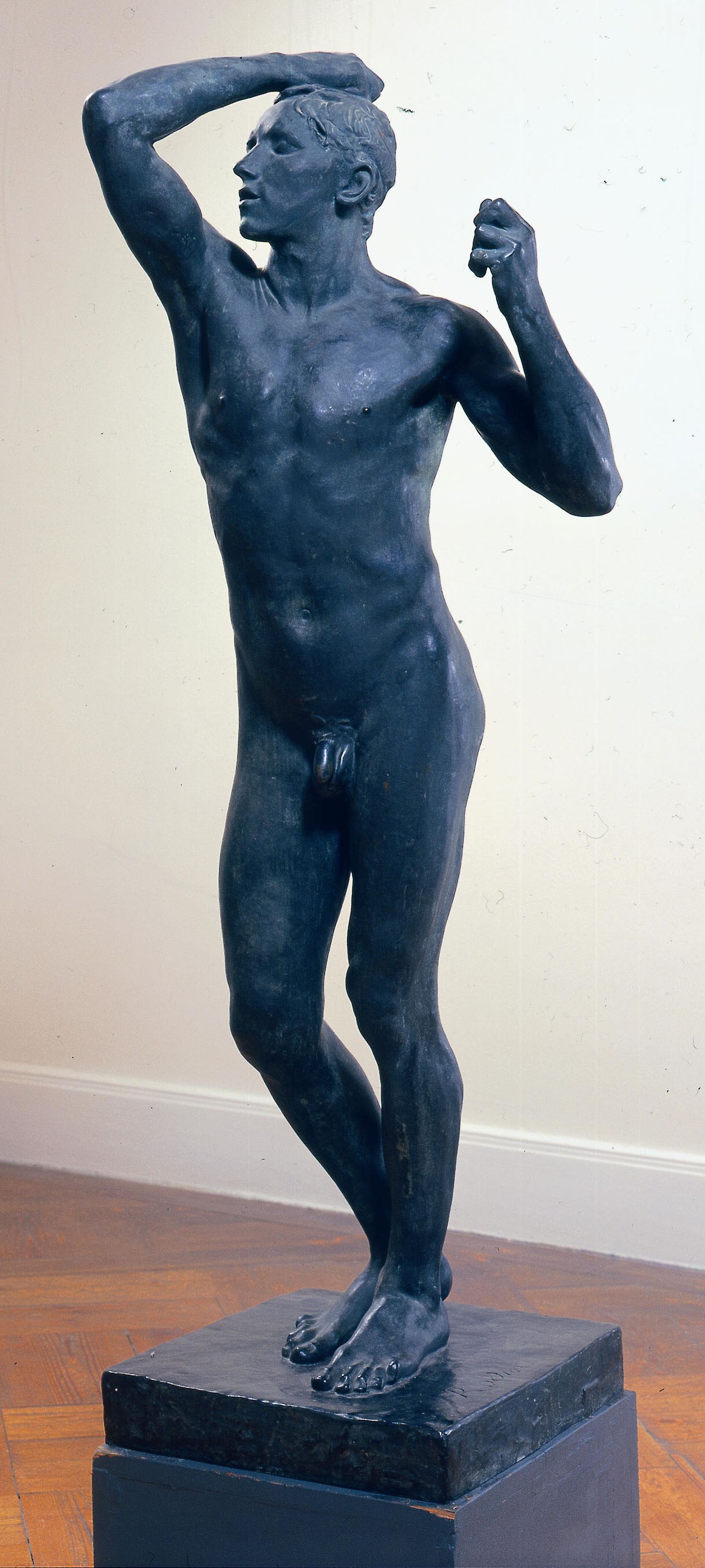
Auguste Rodin - The Age of Bronze

Recommended links:

Analysis and Background
Libretto, Discography, and Listenable Media

1 Check the list of all the performances of the Royal Opera House Muscat. Performances

Egypt and the first modern factories

Today I had an epiphany in Economic History thanks to Ph.D. Isa Blumi who gave a lecture on “The Ottoman Legacy: Socio-Economic Dynamics and the Origins of Modern Politics” emphasizing the economic history of Egypt and The Ottoman Empire during the 18th. and 19th Centuries.

The first great argument was rooted in how Egypt had been already transforming its economy and society long before The Napoleonic French Campaign (1798-1801).  As well, he made very clear how Napoleon’s interest in acquiring Egypt’s wheat was much more important than posing for a picture in front of the Sphinx. He explained the consequences of this invasion and the resulting liberation of Egypt by the genious of Muhammad Ali Pasha.

The epiphany to my research interest came when he localized the first modern factory 2,500 miles away from the cities of Derby, Birmingham and Manchester. Most surely, researching this argument would surely enlighten the current historiography of Economic History and establish more roots of entrepreneurial activity, innovation and mass production in the Middle East.  Doing this will also disentail the roots of the creation of Wealth from the Eurocentric historigraphy that has been in fact characterized by its antipodes: mercantilism, patrimonialism and altruism.

If you are interested in learning more of this subjects here are recommended readings that Professor Blumi shared with me:

Syria on the road to chaos?

Last night I attended a lecture titled “Syria on the Road to Democracy or Chaos?” by Ph.D. Candidate Mohammad Maghout hosted by the Institute of Oriental Studies in Leipzig University.  The lecture was an overview of the last 20 years of political oppression and autocrat government in Syria.  The speaker emphasized how Bashar al-Asad was an exact continuation of the government his father, Hafiz al-Asad held in Syria from 1970 to 2001.

Maghout explained that in Syria the government was not only feared but that a cult of reverence toward the al-Asad regime had being built.  He explained that in the 40 years of autocratic regime the regime had amassed its power upon a pyramidal network of tribal, religious and economic leaders that belonged to different ethnic groups and tribes.  In Maghout’s reasoning, it was these ethnic and tribal differences one of the key elements that allowed for the Syrian government to control the population while confronting them every time political tensions appeared.  Indeed, these confrontations were evident after the the 2011 Syrian uprising (from January 26th to March 15th of 2011) and as Salman Shaikh wrote yesterday in the NYTimes (Preventing a Syrian Civil War. NYT. October 12th, 2011), it is these ethnic confrontations and sectarianism that could bring Syria into chaos.

One thing was left without a clear answer from Maghout’s lecture.  It was the question on “why didn’t Syrians react to all the lies, political oppression and corruption of the al-Asad regime previously”.  Maghout explained that Syrians were not only divided in ethnic groups that conflicted within their understanding on “Who Syrians really are”, but that it had passed already too many years of fear for government’s power that brought the population to fear political activity and the use of freedom of speech to protest against government.  While this is true, I consider it not to be sufficient reason.

It may be necessary to understand which was the role (or lack of it) of the economic leaders during the unrest.  I am sure that understanding how crony capitalism works could bring some interesting tools to understand what is the effect of privileges in a society. And as such, could be a valuable tool to understand how can the results of these social movements be differentiated.  The participation of crony capitalists protecting corrupt governments and the participation of entrepreneurs is psycho-epistemological different because of the goals they aim to achieve.  It is entrepreneurs who most often support (economically and logistically) social movements that demand freedom of speech, equality of rights, an end to corruption and the respect of private property.

Photograph: AFP/Getty Images