U.S. Gun Murders in 2010: an Alternative View

us_gun_murders.jpgHow many gun murder victims in the U.S. are black? How many were killed with hand guns (and not with the now fiercely debated assault rifles)? U.S. Gun Murders in 2010 [periscopic.com] by Periscopic combines function and beauty to examine the data retrieved from the U.S. Federal Bureau of Investigation‘s Uniform Crime Report. Its main goal consist of encouraging people to consider individual lives instead of just the statistic

Each arc represents a unique person, where the yellow color denotes how long they lived before being shot, and the white color how long they could have lived. Each arc is clickable and reveals more detailed information about that casualty.

A relatively hidden button at X-axis origin shows a cumulative graph of this data, revealing the relative peaks of age of the victims of gun crimes. Additionally, at the bottom of the page, a small collection of insights is provided.

Via: information aesthetics

Remembering J’accuse

“It is a crime to poison the small and the humble,

to exasperate passions of reaction and intolerance,

while taking shelter behind the odious antisemitism…”

J'accuse

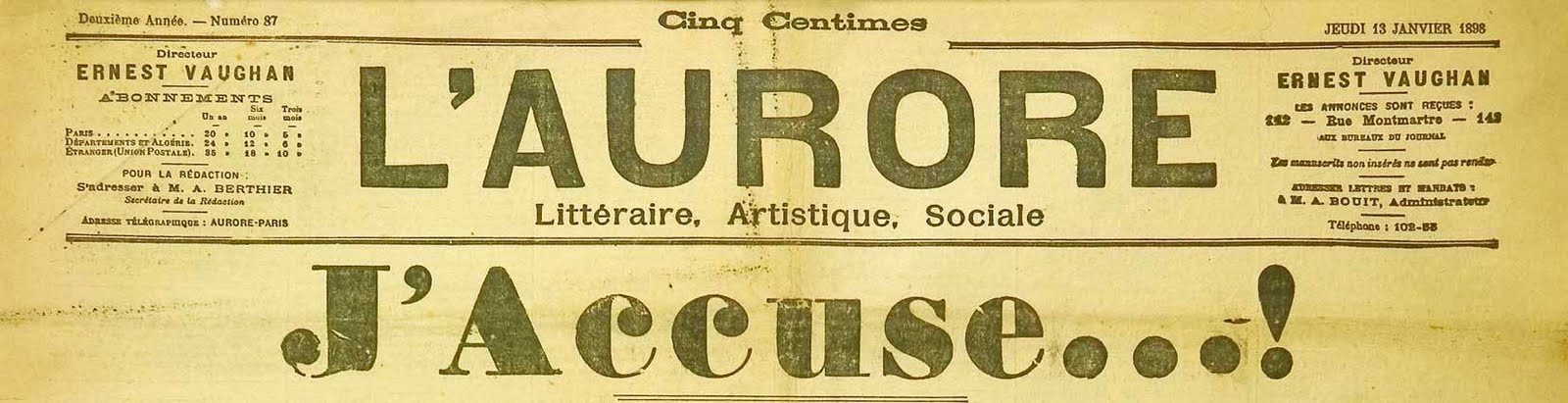
A day like today in February 07 1898 the Émile Zola was brought to trial for libel for publishing J’Accuse in the L’Aurore a literary, liberal, and socialist newspaper published in Paris, France   J’accuse is in my opinion one of the most important historical essays ever written because it brought to public opinion an honest and objective critic against the ruling elite’s injustices.

In his letter, Zola addressed President of France Félix Faure, and accused the government of antisemitism and the unlawful jailing of Alfred Dreyfus, a French Army General Staff officer sentenced to penal servitude for life for espionage.  Further, “Zola pointed out judicial errors and lack of serious evidence. The letter was printed on the front page of the newspaper, and caused a stir in France and abroad. Zola was prosecuted and found guilty of libel on 23 February 1898. To avoid imprisonment, he fled to England, returning home in June 1899.”

Zola’s intention was that he be prosecuted for libel so that the new evidence in support of Dreyfus would be made public (“Correspondence Between Emile Zola and Imprisoned Alfred Dreyfus”. Shapell Manuscript Foundation.) The case divided France deeply between the reactionary army and church and the more liberal commercial society and its ramifications continued for many years. On the 100th anniversary of Zola’s article, France’s Roman Catholic daily paper, La Croix, apologized for its antisemitic editorials during the Dreyfus Affair. As Zola was a leading French thinker, his letter formed a major turning-point in the affair.

Zola’s powerful letter included a direct conversation to the President of France to whom he address as a honorable and rightful man,

And it is to you, Mr. President, that I will proclaim it, this truth, with all the force of the revulsion of an honest man. For your honor, I am convinced that you are unaware of it. And with whom will I thus denounce the criminal foundation of these guilty truths, if not with you, the first magistrate of the country?

And by doing this, he requested the President to be truthful to Justice.

Lets have this letter as a memory of which is our truthful right and obligation as citizens of our States.  Let us remember that We MUST always Accuse the wrongdoers and Demand justice to prevail.

Audio (French) – J’Accuse – Lettre ouverte d’Emile Zola

Access to the French Original version available here via Archive.org

Here you can find the English translation of the letter: “I Accuse…!” By Émile Zola

Satellite images of negative externalities caused by Globalization

I always keep track of the images from space taken by NASA.  They usually have impressive “natural hazards” photographed with the highest technology available.  However, sometimes the natural hazards to humanity are not caused by the natural cycles of Earth.  In those cases, it is humans who have created hazards for themselves and people die.  Now, why would we create things that harm us so much? Why would we support and contribute to such terrible things?  A good explanation is the one given by economists with the complex and difficult term negative externalities.

A negative externality is a spillover of an economic transaction that negatively impacts a party that is not directly involved in the transaction. The first party bears no costs for their impact on society while the second party receives no benefits from being impacted. This occurs when marginal social cost is greater than marginal private cost (MSC > MPC).

The case of pollution in China elucidates very well how the market-driven approach to correcting externalities by “internalizing” third party costs and benefits fails to work in a globalized economy.  For example, by requiring a polluter to repair any damage caused. But, in many cases internalizing costs or benefits is not feasible, especially if the true monetary values cannot be determined.  In fact, our technological gadgets and thousands of products imported from China are the cause of the hazardous health conditions in that country.  We as consumers are part of this chain by buying the products. How can we do something?

I would suggest that the best way to participate in a positive way is to continue creating awareness of the failure of the government of China to protect the lives of the Chinese people.  It is at the end of the day the responsibility of that government to protect the life and property of its citizens, not ours.  We as consumers can only morally sanction them and stop consuming their products whenever possible.

This is a good (and very unfortunate) example of how globalization without an objective code of values becomes a zero sum game.  I share with you the information regarding how dangerous has become the air in the surroundings of Beijing and Tianjin,

—-

Air Quality Suffering in China

acquired January 14, 2013download large image (7 MB, JPEG, 5000×6400)
acquired January 14, 2013download GeoTIFF file (47 MB, TIFF)
Air Quality Suffering in China

acquired January 3, 2013download large image (8 MB, JPEG, 5000×6400)
acquired January 3, 2013download GeoTIFF file (51 MB, TIFF)
acquired January 3 – 14, 2013download Google Earth file (KMZ)

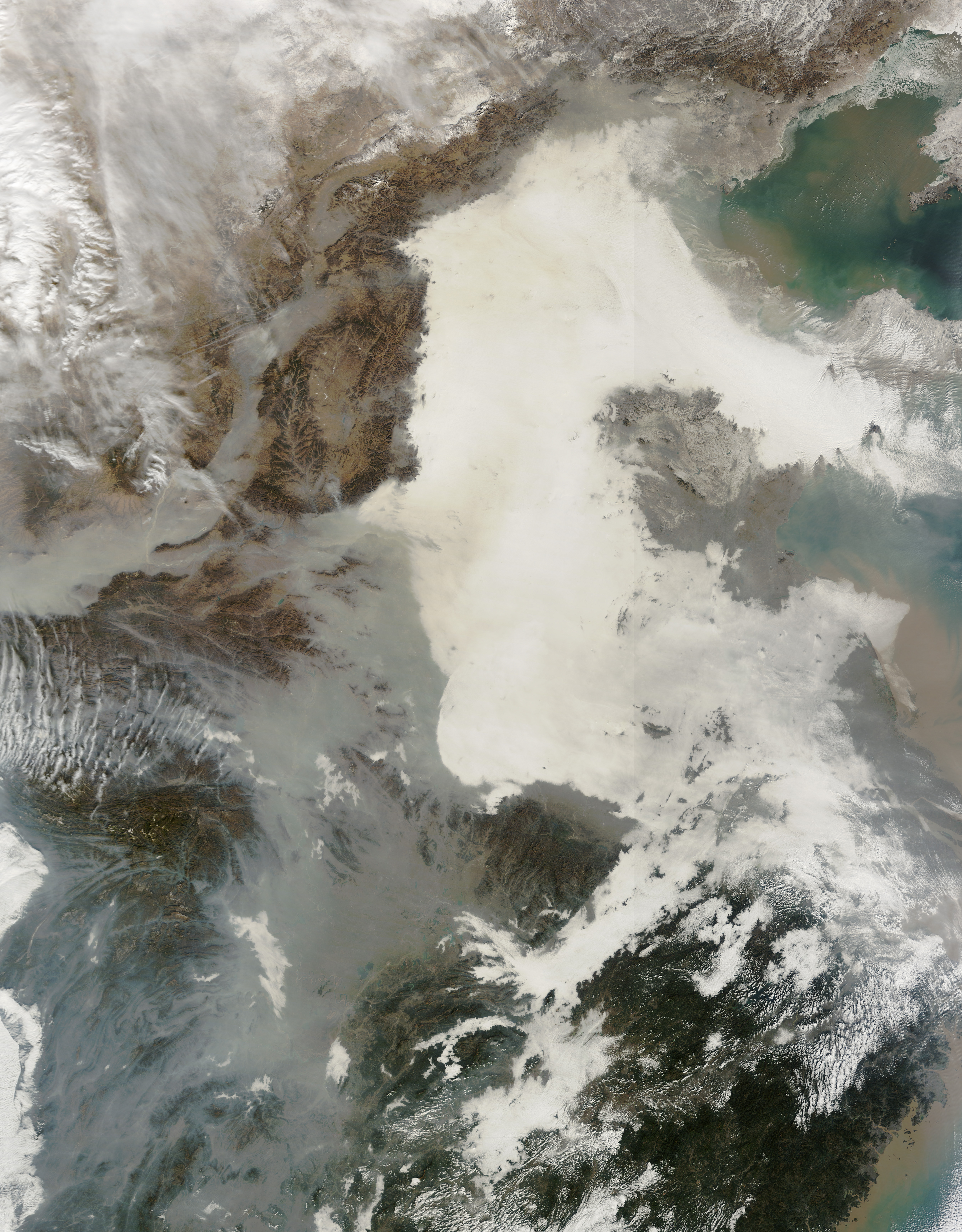
Residents of Beijing and many other cities in China were warned to stay inside in mid-January 2013 as the nation faced one of the worst periods of air quality in recent history. The Chinese government ordered factories to scale back emissions, while hospitals saw spikes of more than 20 to 30 percent in patients complaining of respiratory issues, according to news reports.

The Moderate Resolution Imaging Spectroradiometer (MODIS) on NASA’s Terra satellite acquired these natural-color images of northeastern China on January 14 (top) and January 3, 2013. The top image shows extensive haze, low clouds, and fog over the region. The brightest areas tend to be clouds or fog, which have a tinge of gray or yellow from the air pollution. Other cloud-free areas have a pall of gray and brown smog that mostly blots out the cities below. In areas where the ground is visible, some of the landscape is covered with lingering snow from storms in recent weeks. (Snow is more prominent in the January 3 image.)

At the time that the January 14 image was taken by satellite, ground-based sensors at the U.S. Embassy in Beijingreported PM2.5 measurements of 291 micrograms per cubic meter of air. Fine, airborne particulate matter (PM) that is smaller than 2.5 microns (about one thirtieth the width of a human hair) is considered dangerous because it is small enough to enter the passages of the human lungs. Most PM2.5 aerosol particles come from the burning of fossil fuels and biomass (wood fires and agricultural burning). The World Health Organization considers PM2.5to be safe when it is below 25.

Also at the time of the image, the air quality index (AQI) in Beijing was 341. An AQI above 300 is considered hazardous to all humans, not just those with heart or lung ailments. AQI below 50 is considered good. On January 12, the peak of the current air crisis, AQI was 775 the U.S Embassy Beijing Air Quality Monitor—off the U.S. Environmental Protection Agency scale—and PM2.5 was 886 micrograms per cubic meter.

  1. Resources

  2. Air Pollution in China: Real-time Air Quality Index Visual Map. Accessed January 14, 2013.
  3. China Air Daily. Accessed January 14, 2013.
  4. U.S Embassy Beijing Air Quality Monitor. Accessed January 14, 2013.
  1. References

  2. Associated Press, via Yahoo News (2013, January 14) Beijing warns residents after off-the-charts smog . Accessed January 14, 2013.
  3. NASA (2010, September 22) New Map Offers a Global View of Health-Sapping Air Pollution.Accessed January 14, 2013.
  4. NASA Earth Observatory (2012, March 23) Satellites Map Fine Aerosol Pollution Over China.
  5. The New York Times (2013, January 14) China allows media to report alarming air pollution crisis. Accessed January 14, 2013.
  6. Yahoo News (2013, January 14) China’s air pollution problem slideshow. Accessed January 14, 2013.

NASA image courtesy Jeff Schmaltz, LANCE MODIS Rapid Response. Caption by Mike Carlowicz.

Interesting! After Democrats in New York rammed a sweeping assault on the right to keep and bear arms through the legislature that failed to exempt police officers from the draconian restrictions, gun owners and even some lawmakers are planning what has been dubbed potentially the largest act of civil disobedience in state history.

boudicabpi's avatarBoudica BPI Weblog

Via SHTF Plan - When The Shit Hits the Fan, Don't Say We Didn't Warn You - Preparedness, Planning, News, and Commentary

One upstate Republican AKA RINO voted with Cuomo and all upstate dwmocraps. Split NY into 2 states. Mid Hudson, Upstate NY vs. NYC, downstate on NY Gun Control Law

Resistance Begins

With emotions running high in the aftermath of the Newtown Sandy Hook shooting, politicians on the State and Federal level have begun introducing legislative actions to curtail access to firearms protected by the Second Amendment. In Missouri, parents may soon be forced to register firearms with their child’s school under threat of criminal penalties. In Massachusetts, another proposal would require storage of semi-automatic rifles at government approved storage depots. And, in the State of New York, congressional representatives have already passed legislation that requires registration of every semi-automatic rifle and reduces maximum magazine capacity to 7 rounds of ammunition, and Governor Cuomo has floated the idea of gun confiscation.

Now, in what is sure to be a growing…

View original post 460 more words

Two historical references for a discussion on the right to keep and bear arms

Battle  of Courcelette
Battle of Courcelette
Like the observer in the tree in the right foreground, painter Louis Weirter witnessed this Somme battle as a soldier. His painting depicts the chaos and complexity of fighting on the Western Front, and the use of combined arms tactics. The capture of the ruined town of Courcelette, France on 15 September 1916 was a significant Canadian victory. It was also the first time tanks (left foreground) were used in battle.
Painted by Louis Alexander Weirter
Beaverbrook Collection of War Art

One of the most controversial discussions in the last few weeks has been the one around guns, its regulation and controls, its production, on the rights to use guns, on private gun ownership and the arguments of those in favor/against the Right to keep and bear arms in the United States of America.  The right to keep and bear arms in that country has a historical significance rooted in a long standing common law, prior even to the existence of their Constitution.  In England, a similar legal wording can be found in the Bill of Rights 1689 which states “Subjects which are Protestants may have Arms for their Defense”.

The historical significance of this argument is long standing and varies from country to country (specially those with a common law system).  The principle behind this topic is the relation of the private ownership (historically contextualized of course) of the “means of force” versus the monopoly of the use of force by government.  Today I have two recommendations on this topic for those of you looking for essays and books to read:

tilly-diagram

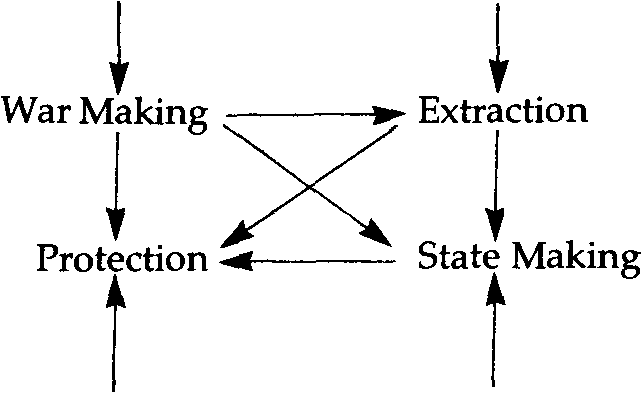
The monopoly of the use of force is claimed to be the reason behind why some kings in Europe succeed in wining wars and enriching their countries; and also the reason why others were subjugated and conquered (see the work of War Making and State Making as Organized Crime by Charles Tilly for a complete picture on this topic (online pdf) a Chapter from Bringing the State Back In (1985), edited by Peter Evans, Dietrich Rueschemeyer, and Theda Skocpol).  But also, in a longer historical perspective it has been the monopoly of the use of force by specific authorities which for other authors built/destroyed entire civilizations (see the work of The Shield of Achilles: War, Peace and the Course of History (2002) by Philip Bobbitt).

Have a happy reading!