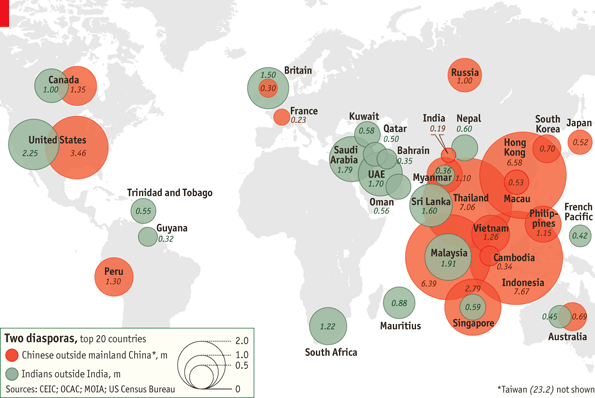
Where are the world’s biggest Chinese and Indian immigrant communities?

The Economist published a mind-blowing graphic depicting the migration of Chinese and Indian people around the world. The asses that “more Chinese people live outside mainland China than French people live in France, with some to be found in almost every country. Some 22m ethnic Indians are scattered across every continent.” More so, they emphasize that even though Diasporas have been a part of the world for millennia; their size and the ease of staying in touch with those at home are making them matter much more with the emergence of social network online technologies.

World's top 20 destinations for Chinese and Indian migrants

Now, this is once again part o the large “discourse of newness” that embeds great part of current mainstream history.  This is something that has been denied and discussed by Prof. Adam McKeown in the article “Article: Global Migration, 1846–1940” who claims after doing a extensive research of migration from China and India during the 19th Century that the amount of immigrants and the global effect it had is comparable (and at some points superior) to the more known Atlantic migration from Europe to America. I strongly suggest you checking the Article by Prof. McKeown an check also Dr. Dirk Hoerder great book titled: Cultures in Contact in case you are interested in this subject.

Free Webinar: Is there a moral way to go to war or fight a war?

  • When: Thursday, November 17th
  • Time: 1 PM Eastern (7 pm +1GMT)
  • Hosted by: Atlas Society
Standing by on a hilltop, Soldiers with the 10...
Image via Wikipedia

The Iraq war is winding down, but NATO remains heavily engaged in an ugly guerrilla war in Afghanistan. And the U.S. launches drone strikes against civilians world-wide as part of the “War on Terror.”

In this webinar, William R Thomas will discuss justice in the context of war-fighting.

  • Should there be restrictions on weapons or tactics?
  • Is there a workable distinction between combatants and non-combatants?

To answer these questions we need to ask what the goals of war-fighting are and how justice in wartime differs from justice in the normal context of life.

This interactive webinar will consist in a live slide-show with audio presentation that will run about 30 minutes. Then William Thomas will discuss questions from the audience. There’s time for everyone’s questions to be answered.

Space is allocated first-come, first-served.
Reserve your Webinar seat now at: www3.gotomeeting.com/register/199696406

Protect IP Act and Internet

A copyright protects a men’s mind contribution in The purest form: ie. in the the origination of ideas. This protection allows for men to freely decide what to do with his creation: give it for free, authorize some uses of it (Creative Commons), prohibit any use of it, sell the rights to the use of the idea.

Now, this recognition of Intellectual Property automatically gives to the owner a value that he can exchange for a specific amount of money and/or recognition. To the owner, this may be the stimulus for which he made the effort of creating and innovating. Also, there are many other retributions and stimulus for men to create. F.A. Hayek mentions that it is for the sake of creation that some intellectuals work and not only for the $. He made a valid point and usually this creator give for free or with some free of charge rights the use of their ideas (via CC like in this blog).

I was shared a video that claims that,

“PROTECT-IP is a bill that has been introduced in the Senate and the House and is moving quickly through Congress. It gives the government and corporations the ability to censor the net, in the name of protecting “creativity”. The law would let the government or corporations censor entire sites– they just have to convince a judge that the site is “dedicated to copyright infringement.”

The government has already wrongly shut down sites without any recourse to the site owner. Under this bill, sharing a video with anything copyrighted in it, or what sites like Youtube and Twitter do, would be considered illegal behavior according to this bill.”

Now, censorship is “the suppression of speech or other public communication which may be considered objectionable, harmful, sensitive, or inconvenient to the general body of people as determined by a government, media outlet, or other controlling body.” You could argue that it is censorship what government officials do when they put fines or take to jail those who are violating copyright rights. But also, you can argue in a higher hierarchy that yes, the officials are taking your right to “disseminate” speech and knowledge because you are violating the rights to property of other members of society. (Remember that private property is stil one of the rights that Americans haven’t managed to completely destroy… but after Patriot Act passed, anything is now possible and the socialization of Property is soon to happen there if nothing changes.)

Now the fallacious error of this video and of the claim of those who consider that Acts like this are violating men’s right to Speech can be found in the initial argument: “PROTECT IP Act is breaking internet”

Why is this fallacious?

It is a false argument because it starts by considering “Property as a non essential characteristic of the entity “Internet“. ie. They start by giving for granted that Internet lacks property rights and that it is only “Internet” when access is collective and a so called public good”. Now, the property rights or non property rights of internet are accessorial characteristics that are determined in context. For example, a chair could have different colors and still be a chair; internet could have private rights in some things and lack property rights in others but still be Internet.

Just as in radio-telecommunication spectrum legislation; If someone (a company) pays the rights of use of internet from other company or government grant and this company decides to restricts the access to the network, connections, websites, etc they have acquired a right to do so.

This private right to do whatever you please in your website enables you to do anything except violating other people’s rights. Since we still consider IP to be an inalienable right, those websites that violate it should be held responsible. That would not be censorship but the recognition of a violation of rights done by a website. That is what the PROTECT IP Act aims to do.

On Consumerism, Sex, Advertising, and Human Nature

Peacock (Pavo cristatus), displaying his tail,...

“The Ferrari is exactly the same in the human context,” says evolutionary psychologistGad Saad, “as the peacock‘s tail is on the peacock.”

Saad is an evolutionary behavioral scientist at Concordia University and author of the book The Consuming Instinct: What Juicy Burgers, Ferraris, Pornography, and Gift Giving Reveal about Human Nature, in which he argues that most consumer behavior can be explained by evolutionary psychology.  Watch his interview,

Reason.tv‘s Zach Weissmueller sat down with Saad to discuss why most Ferrari owners are men, whether or not advertising executives manipulate our minds, the strong political opposition to the evolutionary sciences from across the spectrum, and the evolutionary significance of Sir Mix-a-lot‘s “Baby Got Back.”

About 10 minutes. Interview by Zach Weissmueller. Shot by Sharif Matar; edited by Weissmueller.

Visit Reason.tv for downloadable versions and subscribe to Reason.tv’s YouTube Channel to receive automatic notifications when new material goes live.

Video: Larry H. White talks about his upcoming book “The Clash of Economic Ideas”


Lawrence H. White is professor of economics at George Mason University and the F. A. Hayek Professor of Economic History in the department of economics at University of Missouri — St. Louis. His teaching and research areas include economic history, monetary theory, money and banking, and history of economic thought. White holds a PhD and a MA in economics from University of California at Los Angeles; he also received his AB in the same area from Harvard University. He is visiting professor at Universidad Francisco Marroquín.

Visit “The Clash of Economic Ideas” video collection
http://newmedia.ufm.edu/gsm/index.php/The_Clash_of_Economic_Ideas

Produced by New Media / UFM 2011
http://www.newmedia.ufm.edu
http://www.ufm.edu More