Walmart’s Irrational “buy American” Campaign

Walmart-Stores-home-offic-007

Walmart‘s latest push to Buy American and Hire Veterans is irrational.  In a world of interconnectedness in which products from pencils to airplanes are produced with parts and components made all over the world the “buy American” argument falls into pieces.

In today’s world mass consumption economy there is not a single product that can be claimed to be “national” or “unique” without ignoring the intertwined network of global production.  If your argument is “yes” there is such a thing as “100% national” or “100% American” then I will still be able of arguing against your position.  Why?  Because the economy of the United States of America is not only part but dependent on the global economy.

By 2012, only about 32 cents for every dollar of U.S. debt, or $4.6 trillion, was owned by the federal government in trust funds, for Social Security and other programs such as retirement accounts, according to the U.S. Department of Treasury.

The largest portion of U.S. debt, 68 cents for every dollar or about $10 trillion, is owned by individual investors, corporations, state and local governments and, yes, even foreign governments such as China that hold Treasury bills, notes and bonds.

Foreign governments hold about 46 percent of all U.S. debt held by the public, more than $4.5 trillion. The largest foreign holder of U.S. debt is China, which owns more about $1.2 trillion in bills, notes and bonds, according to the Treasury.

In total, China owns about 8 percent of publicly held U.S. debt. Of all the holders of U.S. debt China is the third-largest, behind only the Social Security Trust Fund‘s holdings of nearly $3 trillion and the Federal Reserve‘s nearly $2 trillion holdings in Treasury investments, purchased as part of its quantitative easing program to boost the economy. (Data via: How Much U.S. Debt Does China Really Own?)

So, the next time you think you are “Buying American“, I invite you to reconsider how irrational such an argument is.

The Global Politics of the Diaoyu Islands

By Bryant Arnold. via:http://www.cartoonaday.com/china-vs-japan-at-sea/

As The Japanese government’s moved to purchase the Diaoyu Islands (also known as Senkaku Islands) three days ago the government of the People’s Republic of China reacted energetically.  Initially, Chinese media reporters influenced mediatic understanding of the situation by emphasizing the nationalization of the islands by Japan (ringing the history bells to Chinese people on how Japan had previously nationalized Manchuria and renamed it as the puppet state of Manchukuo during the WW2 period).  And later, by making strong diplomatic statements on how Chinese sovereignty and control of the islands had been violated by the Japanese purchase.

The purchase of the islands is of relevance regionally and globally.  Why China, Japan, and S. Korea aren’t backing down on this islands should be understood by taking a look at the map and see how the position of the islands is central for the passage of containers and oil that comes all the way from Middle East via the Strait of Malacca.  A route that is of priority importance for China and which I explored in the essay “The Strait of Malacca as one of the most important geopolitical regions for the People’s Republic of China” which ca be read in pdf at Academia.edu for free.

Locally, the geography of the islands is meaningless. The island group consists of five uninhabited islets and three barren rocks which zooming out are located approximately 120 nautical miles northeast of Taiwan, 200 nautical miles east of the Chinese mainland and 200 nautical miles southwest of the Japanese island of Okinawa. And which zooming out are in the center of the route of all the containers that go to the ports of East and North East China, of which the most important is Shangai.

The Japanese central government formally annexed the islets on 14 January 1895. And after WW2 they were occupied by the United States. The islets were later returned to Japan during the 70s and it was only until the last two decades that they became of relevance as the People’s Republic of China started to project is New Economic and Global Plans for economic sustainable expansion.  Plans in which they have invested billions of  dollars in military expansion, naval trade/military shipbuilding, regional economic investment via state-owned companies and diplomatic sovereignty claims all over the region.

The islands are officially Japanese territory, but as Chinese official statements continue being broadcasted they claim a violation of sovereignty that could takes decades to be resolved via a diplomatic arbitrage and/or scalate to more direct military statements and naval occupations of the beaches of the islets.

Whoever said that trade is the most (or only) pacific way of organizing society should reconsider this evaluations when thinking about how global trade works and on how diplomatic and economic control of trade routes is sometimes more powerful and dangerous than a bunch of battleships.

China & Global Oil

I am currently enrolled in the course “Oil, Power and Climate – A Global Perspective” with Dr. habil. Peter Gärtner who is an specialist in Global Studies, North-South relations, democratization, development theory and policy, law and globalization with a regional focus in Latin America.

As part of our initial discussions we were required to present a review of the current status of the main importers and exporters of oil.  My selection was China and its raising demand of energy resources in order to continue providing for the world the largest amount of goods ever made in history.  Indeed, the numbers I found of China were astounding and the forecast of its increase for the next ten years is even more astonishing.    As forecasts show, the United States is soon to lose its hegemonic position in the world as the largest economy due to the fact that since 2010 it was China the world’s largest energy consumer (and its growth continues to further grow).

For the last six months I have been paying much attention to literature in the Asia region and I have started to draw a new world map that has South East Asia and the Pacific at its core. I foresee a semester full of Asia related topics and I will most certainly enjoy focusing in that area.

I share with you the handout with the latest figures and updates on China that I prepared for a discussion.  The file is accessible online and can be downloaded as a PDF: http://issuu.com/condottiero/docs/oil-china-lgpr

Journal Reco. “Sino-Pacifica”: Conceptualizing Greater Southeast Asia as a Sub-Arena of World History

Map of Southeast Asia
Image via Wikipedia

I just got my hands in a great article on Southeast Asia issues.  Here’s the abstract for the article (via Project MUSE) and I hope you’ll get to enjoy it too,

Conventional geography’s boundary line between a “Southeast Asia” and an “East Asia,” following a “civilizational” divide between a “Confucian” sphere and a “Viet­nam aside, everything but Confucian” zone, obscures the essential unity of the two regions. This article argues the coherence of a macroregion “Sino-Pacifica” encom­passing both and explores this new framework’s implications: the Yangzi River basin, rather than the Yellow River basin, pioneered the developments that led to the rise of Chinese civilization, and the eventual prominence of the Yellow River basin came not from centrality but rather from its liminality—its position as the contact zone between Inner Eurasia and Southeast Asia.

In a sense . . . the frontier of Southeast Asia has retreated slowly from the line of the Yangzi (in what is now central China) to the Mekong delta (in what is now southern Vietnam).

—Charles Holcombe, The Genesis of East Asia

[T]he Vietnamese-Lao wars of the seventeenth century were resolved wisely when the Le rulers in Vietnam and the Lao monarch agreed that every inhabitant in the upper Mekong valley who lived in a house built on stilts owed allegiance to Laos, while those whose homes had earth floors owed allegiance to Vietnam.

—The Emergence of Modern Southeast Asia: A New History [End Page 659]

The question of boundaries is the first to be encountered; from it all others flow.

Fernand Braudel, The Mediterranean World in the Age of Philip II

In conventional geography, the largest division of the human community is the continental or subcontinental scale “world region.” World regions are the most useful as concepts when their boundaries can be seen as enduring, immobile, and, above all, easy to map. Yet, in the first quotation above, we see a border between two world regions, Southeast and East Asia, that rolls southward thousands of miles over thousands of years. In the second quotation, we see a border between two kingdoms within the same world region, Southeast Asia, that cannot be traced as a simple line on the ground, being created by the contrasting cultural preferences of inextricably mixed populations. The moving boundary and the undrawable boundary are actually the same, the frontiers between Sinified Vietnam and its un-Sinified neighbors.

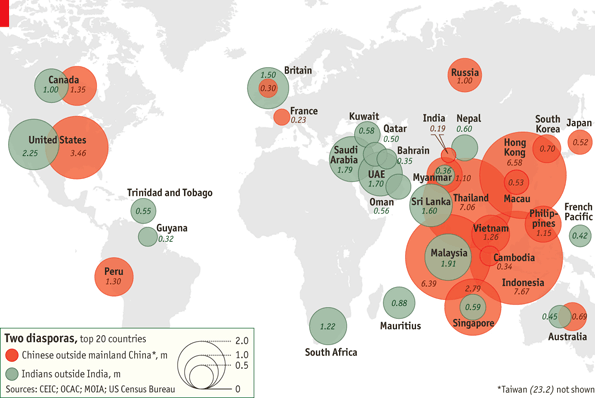
Where are the world’s biggest Chinese and Indian immigrant communities?

The Economist published a mind-blowing graphic depicting the migration of Chinese and Indian people around the world. The asses that “more Chinese people live outside mainland China than French people live in France, with some to be found in almost every country. Some 22m ethnic Indians are scattered across every continent.” More so, they emphasize that even though Diasporas have been a part of the world for millennia; their size and the ease of staying in touch with those at home are making them matter much more with the emergence of social network online technologies.

World's top 20 destinations for Chinese and Indian migrants

Now, this is once again part o the large “discourse of newness” that embeds great part of current mainstream history.  This is something that has been denied and discussed by Prof. Adam McKeown in the article “Article: Global Migration, 1846–1940” who claims after doing a extensive research of migration from China and India during the 19th Century that the amount of immigrants and the global effect it had is comparable (and at some points superior) to the more known Atlantic migration from Europe to America. I strongly suggest you checking the Article by Prof. McKeown an check also Dr. Dirk Hoerder great book titled: Cultures in Contact in case you are interested in this subject.