

By: Alfredo Gálvez Suárez.
A depiction of the battle of 1524 in which the Spanish conquistadores defeated the Army leaded by Tecum Umam.
The term Globalization refers to what many different historians considered a process of interrelation (or unification) of the world. It was a process of cultural, political and economic relations that for the first time in history united all mankind. One of these critical events of unification and clash of cultural and political relations took place in February 20 1524. This day is commemorated by Guatemalans to remember the leaders and events of the “The battle of Llanos del Pinal“ ((The Society of Geography and History of Guatemala documented that this battle actually took place on February 12 1524) which took place in the vicinity of the K’iche’ Mayan city of Xelajú (located in today’s mountainous area of Guatemala in Central America).
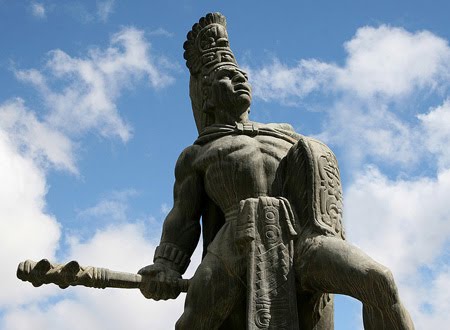
In this battle, the K’iche’ Rajpop Achij Tecum Umam (Guatemala’s National Hero and K’iche’ Mayan Captain of the army) commanded an army of 72,000 warriors (as narrated by the Chronicler Francisco de Fuentes y Guzmán) that fought against the invading hordes of the conquistador Pedro de Alvarado and his indigenous allies from the territories that are today the South of Mexico. While the invaders defeated the K’iche’ army, the chroniclers of this battle remembered Tecum Umam as the glorious warrior and miraculous hero that started to be referred in the narrations with epic roles and anthropomorphic abilities.
After this battle that “tainted all the neighbouring rivers red of blood” the Spanish conquistadores continued their invasion in the following month of the city of Q’umarkaj (also known as Utatlán). This secured for them the hegemony over the other less powerful cities of Iximche, Mixco Viejo, and Zaculeu that were located in the Southernmost part of the Sierra Madre mountain range.
The aftermath of this battle concluded six years later with the Quauhquechollan alliance of the conquistador Jorge de Alvarado (brother of Pedro de Alvarado) and their Nahuatl allies from the city of Quauhquechollan that gave the Spanish and absolute control of large part of Mesoamerica.
By the beginning of the Spanish conquest the territory of Mesoamerica the Mayan Civilisation was already extinguished and dozens of different indigenous tribes leaded by caciques, warriors and priests controlled weaker and less advanced forced-labor societies. This enabled the conquest of the territories to be fast and easy.
Just a decade later, by the 1540s, the new elite that ruled this forced-labor societies had already established itself with a mixed Spanish-Indigenous head in control and started the process of acculturation, integration, evangelisation, assimilation and reeducation of a society that went from a tribalist type of life into a mercantilist economy ruled from a metropolitan and global Empire with its head 5,400 miles away in the city of Madrid.
Since 1524, Mesoamerica joined the global community of trade, commerce, acculturation and universalisation of traditions and costumes. This is an important junction that should be remembered by all of us.

 Globalization & Capitalism