Is Globalization finally saying “STOP!” to the Catholic Church?

https://i0.wp.com/www.catholicworldreport.com/Content/Site140/Articles/05_01_2009/724PopeBenedict_00000000427.jpgAfter only seven years as Head of the Catholic Church, the resignation of Pope Benedict XVI is an astonishing news.  This may be a message on how Globalization affects such global organization.  The election of Pope Benedict XVI followed all the rules of the Church but did not listen to the “new” rules imposed by globalization: which include good advertisement, global awareness, and above all intercultural appealing to standards of ‘universal friendliness and empathy’, among others.  I wrote an article titled “Parishes Fail to Market Catholicism to Hispanics (pdf available here)” (National Catholic Reporter, Vol. 43, No. 12 2007) discussing how the Catholic Church has failed to Market Catholicism among Hispanics.

Benedict XVI was elected on 19 April 2005 in a papal conclave, celebrated his Papal Inauguration Mass on 24 April 2005, and took possession of his cathedral, the Archbasilica of St. John Lateran, on 7 May 2005. Today, February 11, 2013, Benedict announced that he would resign the papacy, effective February 28, due to age and ill health.

His health may be have been an issue.  However, it seems to me that the real problem started when the Papal conclave of 2005 elected him above the other contestants for the Pope position without taking notice of all the changes that institution has gone through centuries.

Currently, Catholics are 17.77% of the total population in Africa, 63.10% in the Americas, 3.05% in Asia, 39.97% in Europe, 26.21% in Oceania and 17.09% of the world population. (Further information: Catholicism by country)

Distribution of Catholics by World Region, 2004, 2025, and 2050
Note: Percentages may not add to 100% due to rounding.
Source: Author’s calculations based on data from PRB’s World Population Data Sheet 2004 and accessed at http://www.catholic-hierarchy.org.

Globalization is slowly forcing them to adapt to this new demographics and the election of a Latin American (a Mediterranean look would suffice) or African Pope could bring some new Fresh air to this archaic institution.  The Latin America region already represents 42 percent of the world’s 1.2 billion-strong Catholic population, the largest single block in the Church, compared to 25 percent in its European heartland.

In 2005 among the “popeable” (one who might become pope) where also the cardinals Carlo Maria Martini, who died last year and obtained 40 votes in the first ballot versus the popular Italian cardinal Camillo Ruini who also was a contestant for the position in that initial ballot.  Cardinal Ruini has been very active in the mass media and was one of the cardinals who most often appeared on Italian television, newspapers and magazines.  I would suppose that his election as a new Pope in the Conclave of cardinals that will choose the next pope in mid-March is very high.  Camilo Ruini is very popular among the “Reformer” side of the Catholic Church as the news inform (he is also more photogenic and could appeal to the Hispanic followers easily).

Lets see what happens in March, 2013 with the new Papal Conclave.  Meanwhile, I share with you a documentary on the new face of this Eurocentric organization that is finally (slowly) changing its own look!
The Catholic Church and Africa

A Satellite’s View of Ship Pollution and globalization

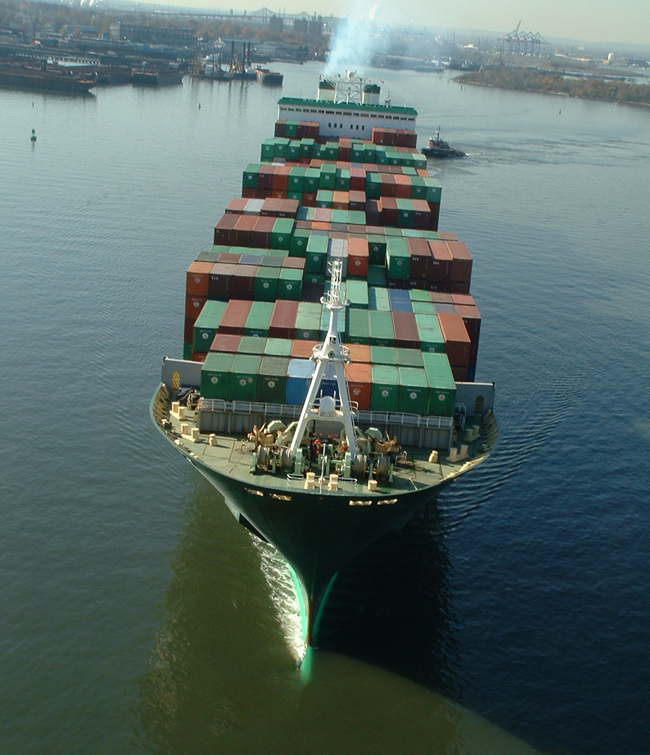
Cargo-Ship650The geographical hotspots of the world are all related to economic trade and global exchange of political interests. Places such as the Panama and Suez Canals have always been in the Western media. However, from an economic and strategic perspective, the Strait of Malacca is one of the most important shipping lanes in the world in the 21st Century. The history of this Strait’s geopolitical relevance goes as back as 400 years of history.

For centuries the strait has been the main shipping channel between the Indian Ocean and the Pacific Ocean. It has been controlled by the major regional powers and also by the mayor global power during different historical periods. In 2011 hundreds of thousands of containers in more than 60,000 vessels crossed its waters carrying about one-quarter of the world’s traded goods including oil, Chinese manufactures, and Indonesian coffee.

In order to understand which is the geopolitical importance of the Strait of Malacca for the Chinese government we need to overview the current geopolitical dynamics and economic investments in the region.

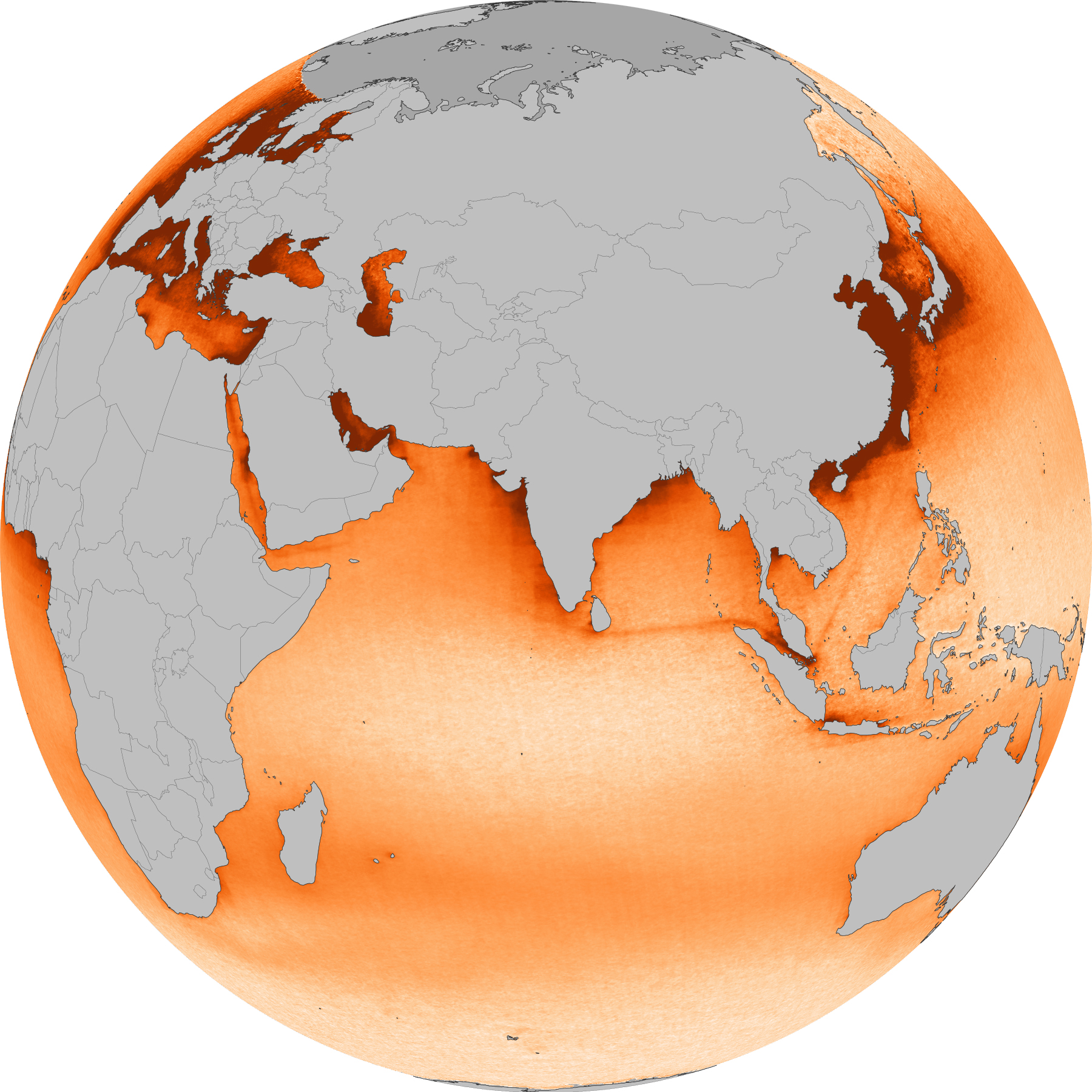
The following image from NASA clearly depicts what are some of the IMPRESSIVE negative externalities caused by the transport of global goods in the region and opens the door for discussing

  • How can we fix this?
  • Who should fix it?
  • Can it be fixed?
  • Can we reduce the future impacts in the area?
  • What solutions are available?
A Satellite’s View of Ship Pollution

Color bar for A Satellite’s View of Ship Pollution
acquired 2005 – 2012 download large image (2 MB, JPEG, 1800×1800)

Elevated levels of nitrogen dioxide pop out over certain shipping lanes in observations made by the Aura satellite between 2005-2012. The signal was the strongest over the northeastern Indian Ocean.

Data from the Dutch and Finnish-built Ozone Monitoring Instrument (OMI) on NASA’s Aura satellite show long tracks of elevated nitrogen dioxide (NO2) levels along certain shipping routes. NO2, is among a group of highly-reactive oxides of nitrogen, known as NOx, that can lead to the production of fine particles and ozone that damage the human cardiovascular and respiratory systems. Combustion engines, such as those that propel ships and motor vehicles, are a major source of NO2 pollution.

To learn some more on the importance of the Strait of Malacca and the value of this shipping lane you can read the essay I wrote titled “The Strait of Malacca as one of the most important geopolitical regions for the People’s Republic of China. Download (.pdf)

U.S. Gun Murders in 2010: an Alternative View

us_gun_murders.jpgHow many gun murder victims in the U.S. are black? How many were killed with hand guns (and not with the now fiercely debated assault rifles)? U.S. Gun Murders in 2010 [periscopic.com] by Periscopic combines function and beauty to examine the data retrieved from the U.S. Federal Bureau of Investigation‘s Uniform Crime Report. Its main goal consist of encouraging people to consider individual lives instead of just the statistic
Each arc represents a unique person, where the yellow color denotes how long they lived before being shot, and the white color how long they could have lived. Each arc is clickable and reveals more detailed information about that casualty.

A relatively hidden button at X-axis origin shows a cumulative graph of this data, revealing the relative peaks of age of the victims of gun crimes. Additionally, at the bottom of the page, a small collection of insights is provided.

Via: information aesthetics

Remembering J’accuse

“It is a crime to poison the small and the humble,

to exasperate passions of reaction and intolerance,

while taking shelter behind the odious antisemitism…”

J'accuse

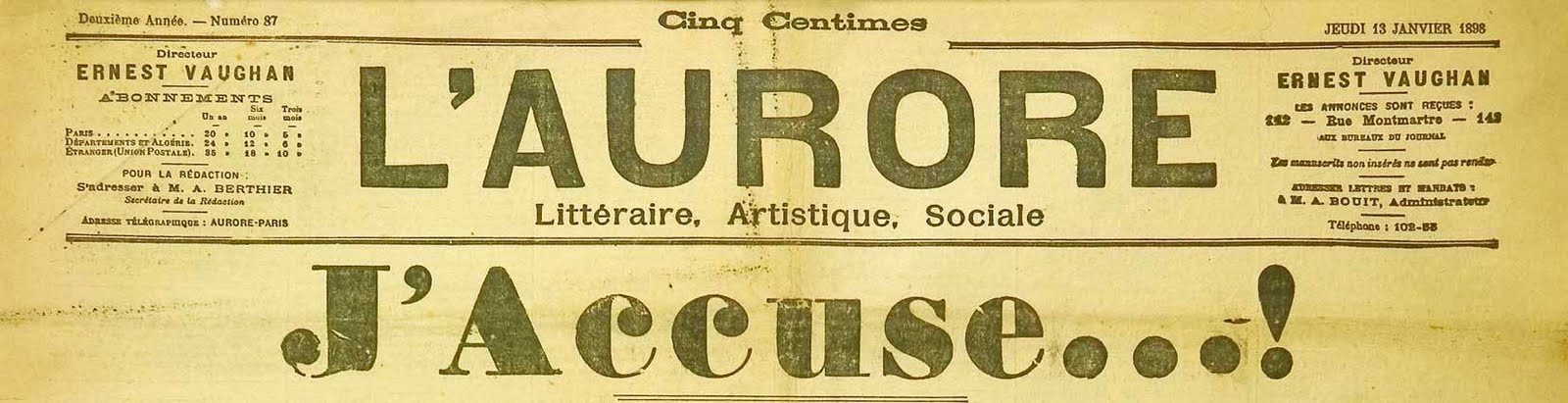
A day like today in February 07 1898 the Émile Zola was brought to trial for libel for publishing J’Accuse in the L’Aurore a literary, liberal, and socialist newspaper published in Paris, France   J’accuse is in my opinion one of the most important historical essays ever written because it brought to public opinion an honest and objective critic against the ruling elite’s injustices.

In his letter, Zola addressed President of France Félix Faure, and accused the government of antisemitism and the unlawful jailing of Alfred Dreyfus, a French Army General Staff officer sentenced to penal servitude for life for espionage.  Further, “Zola pointed out judicial errors and lack of serious evidence. The letter was printed on the front page of the newspaper, and caused a stir in France and abroad. Zola was prosecuted and found guilty of libel on 23 February 1898. To avoid imprisonment, he fled to England, returning home in June 1899.”

Zola’s intention was that he be prosecuted for libel so that the new evidence in support of Dreyfus would be made public (“Correspondence Between Emile Zola and Imprisoned Alfred Dreyfus”. Shapell Manuscript Foundation.) The case divided France deeply between the reactionary army and church and the more liberal commercial society and its ramifications continued for many years. On the 100th anniversary of Zola’s article, France’s Roman Catholic daily paper, La Croix, apologized for its antisemitic editorials during the Dreyfus Affair. As Zola was a leading French thinker, his letter formed a major turning-point in the affair.

Zola’s powerful letter included a direct conversation to the President of France to whom he address as a honorable and rightful man,

And it is to you, Mr. President, that I will proclaim it, this truth, with all the force of the revulsion of an honest man. For your honor, I am convinced that you are unaware of it. And with whom will I thus denounce the criminal foundation of these guilty truths, if not with you, the first magistrate of the country?

And by doing this, he requested the President to be truthful to Justice.

Lets have this letter as a memory of which is our truthful right and obligation as citizens of our States.  Let us remember that We MUST always Accuse the wrongdoers and Demand justice to prevail.

Audio (French) – J’Accuse – Lettre ouverte d’Emile Zola

Access to the French Original version available here via Archive.org

Here you can find the English translation of the letter: “I Accuse…!” By Émile Zola

Terracotta vase in the form of a lobster claw

Visiting history museums is one of my favorite activities.  There, one of the things that I appreciate the most is learning about the paintings they have in vases and other pottery utensils from Ancient Greece. Why? Because of its relative durability, pottery comprises a large part of the archaeological record of Ancient Greece, and since there is so much of it (some 100,000 vases are recorded in the Corpus vasorum antiquorum), it has exerted a disproportionately large influence on our understanding of Greek society.

Take a look to this wooooonderful work that I found in the website of The Metropolitan Museum of Art.

Terracotta vase in the form of a lobster claw
Attributed to the Class of Seven Lobster-Claws

Period: Classical
Date: ca. 460 B.C.
Culture: Greek, Attic
Medium: Terracotta
Dimensions: Overall: 2 3/4 x 2 7/8 in. (7 x 7.3 cm)
Other: 6 1/4in. (15.9cm)
Classification: Vases
Credit Line: Rogers Fund, 1923
Accession Number: 23.160.57