February 20 1524. The Commemoration of the death and defeat of a Mayan Prince in a Critical Juncture of Globalization

Title: The Clash.<br /><br />By: Alfredo Gálvez Suárez.<br /><br />A depiction of the battle of 1524 in which the Spanish conquistadores defeated the Army leaded by Tecum Umam.
Title: The Clash.
By: Alfredo Gálvez Suárez.
A depiction of the battle of 1524 in which the Spanish conquistadores defeated the Army leaded by Tecum Umam.

The term Globalization refers to what many different historians considered a process of interrelation (or unification) of the world. It was a process of cultural, political and economic relations that for the first time in history united all mankind.  One of these critical events of unification and clash of cultural and political relations took place in  February 20 1524.  This day is commemorated by Guatemalans to remember the leaders and events of the “The battle of Llanos del Pinal  ((The Society of Geography and History of Guatemala documented that this battle actually took place on February 12 1524) which took place in the vicinity of the K’iche’ Mayan city of  Xelajú (located in today’s mountainous area of Guatemala in Central America).
tecun-uman

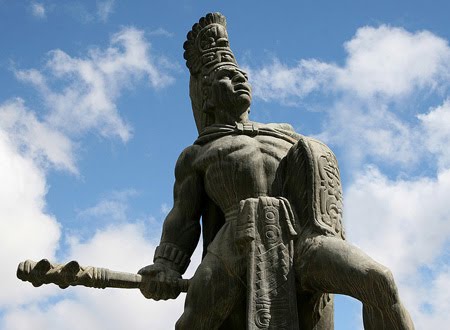
In this battle, the K’iche’ Rajpop Achij Tecum Umam (Guatemala’s National Hero and K’iche’ Mayan Captain of the army) commanded an army of 72,000 warriors (as narrated by the Chronicler Francisco de Fuentes y Guzmán) that fought against the invading hordes of the conquistador Pedro de Alvarado and his indigenous allies from the territories that are today the South of Mexico. While the invaders defeated the K’iche’ army, the chroniclers of this battle remembered Tecum Umam as the glorious warrior and miraculous hero that started to be referred in the narrations with epic roles and anthropomorphic abilities.

After this battle that “tainted all the neighbouring rivers red of blood” the Spanish conquistadores continued their invasion in the following month of the city of Q’umarkaj (also known as Utatlán). This secured for them the hegemony over the other less powerful cities of IximcheMixco Viejo, and Zaculeu that were located in the Southernmost part of the Sierra Madre mountain range.

The aftermath of this battle concluded six years later with the Quauhquechollan alliance of the conquistador Jorge de Alvarado (brother of Pedro de Alvarado) and their Nahuatl allies from the city of Quauhquechollan that gave the Spanish and absolute control of large part of Mesoamerica.

By the beginning of the Spanish conquest the territory of Mesoamerica the Mayan Civilisation was already extinguished and dozens of different indigenous tribes leaded by  caciques, warriors and priests controlled weaker and less advanced forced-labor societies.  This enabled the conquest of the territories to be fast and easy.

Just a decade later, by the 1540s, the new elite that ruled this forced-labor societies had already established itself with a mixed Spanish-Indigenous head in control and started the process of acculturation, integration, evangelisation, assimilation and reeducation of a society that went from a tribalist type of life into a mercantilist economy ruled from a metropolitan and global Empire with its head 5,400 miles away in the city of Madrid.

Since 1524, Mesoamerica joined the global community of trade, commerce, acculturation and universalisation of traditions and costumes.  This is an important junction that should be remembered by all of us.

The legacy of George Washington’s Postal Service Act of February 20, 1792

127304 600 End of Saturday Mail Delivery cartoons

WASHINGTON — Faced with billions of dollars in losses, the Postal Service announced on Wednesday (Feb. 06 2013) that it would seek to stop Saturday delivery of letters, a sweeping change in mail delivery that immediately drew criticism from postal unions, some businesses and lawmakers.

What went wrong I wonder?  Would it had been better if George Washington had never passed the Postal Service Act of 1792? How many billions would taxpayers have saved since then?  Would private companies like the  American Letter Mail Company of Lysander Spooner have served better the market? Or would the system have collapsed without government intervention?

In February 20, 1792 the Postal Service Act, establishing the United States Post Office Department was signed by President George Washington.  An interesting date to remember in these days in which the Postal Service made it to the news with their Losses and their controversial solution by ending Saturday Letter Delivery.

We know for certain that in a free market no company would survive if they had kept losses as huge as the one USPS has had over all these years. They had losses of   $15.9 billion only last year.  A principle of free market transactions is that in competing  there appears a beneficial rivalry among sellers trying to achieve goals as increasing profits, market share, and sales volume by varying the elements of the marketing mix: price, product, distribution, and promotion.  Thus, enabling for those companies which succeed in growing larger and for those companies which fail to disappear.  With the existence of monopolistic services (like the Postal Service in the US) industries and business sponsored by government disrupted market transactions (bureaucratically made) and thus enabled for failing companies to continue existing even though they were not beneficial for society in the long-term.

126863 600 going postal cartoons

This reminds me to the company founded Lysander Spooner whom “being an advocate of self-employment and opponent of government regulation of business, Spooner started his own business called American Letter Mail Company which competed with the U.S. Post Office. Postal rates were notoriously high in the 1840s,[7] and in 1844, Spooner founded the American Letter Mail Company, which had offices in various cities, including Baltimore, Philadelphia, and New York.[8] Stamps could be purchased and then attached to letters which could be sent to any of its offices. From here agents were dispatched who traveled on railroads and steamboats, and carried the letters in hand bags. Letters were transferred to messengers in the cities along the routes who then delivered the letters to the addressees. This was a challenge to the United States Post Office’s monopoly.[7][9] As he had done when challenging the rules of the Massachusetts bar, he published a pamphlet titled “The Unconstitutionality of the Laws of Congress Prohibiting Private Mails.” Although Spooner had finally found commercial success with his mail company, legal challenges by the government eventually exhausted his financial resources. He closed up shop without ever having had the opportunity to fully litigate his constitutional claims. The lasting legacy of Spooner’s challenge to the postal service was the 3-cent stamp, adopted in response to the competition his company provided.[10]

Lets have this as food for thought…

Why is Copernicus relevant to our understanding of Globalization?

192207_337884092969813_1647955587_o

We are constantly bombarded with media reports on globalization in terms of its increasing process and potential effects on our lives. What is meant by this concept and why should we be concerned with its impact? The developing countries of sub-Saharan Africa, Latin America and Asia should be interested in it because of the opportunities and threats offered by globalization (also known as globalisation).

The mother of this globalization is Science and the activator is her daughter Technology (both affectionately called science and technology). The most visible manifestations of “globalization” are in the economic and communications spheres. And one of the fathers of Science is our friend Copernicus.

In two sentences his contribution to Science and Globalization is:

  • Copernicus broke open the medieval idea of an enclosed, Earth-centered universe.
  • He set the stage for all of modern astronomy.

And why does this matter?

He lived at a time when people believed Earth lay enclosed within crystal spheres at the center of the universe. Can you picture the leap of imagination required for him to conceive of a sun-centered universe? The publication of Copernicus’ book – De revolutionibus orbium coelestium (On the Revolutions of the Celestial Spheres) – just before his death in 1543, set the stage for all of modern astronomy. Today, people speak of his work as the Copernican Revolution.

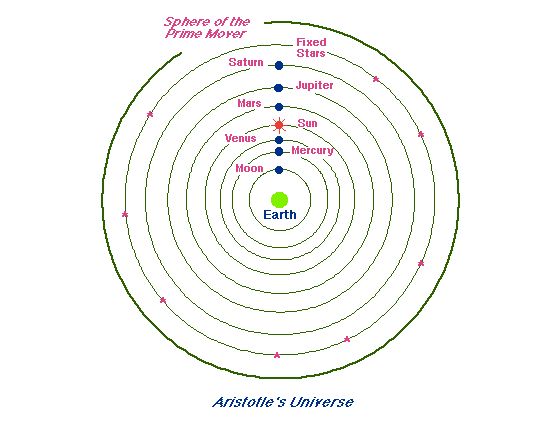
Post-data: Copernicus wasn’t the first to conceive of a sun-centered universe. Early Greek philosophers also spoke of it. It was the Greek philosopher Aristotle, however, who proposed that the heavens were literally composed of 55 concentric, crystalline spheres to which the celestial objects were attached. In Aristole’s model, Earth lay at the center of these spheres. Thus Earth lay – fixed and enclosed – until Copernicus published his version of a heliocentric universe.

Remembering the wise Talleyrand

Political Cartoon of Napoleon I and TalleyrandNapoleon I, originally Napolean Bonaparte, was the emperor of France. He seized power in 1799 in a coup d'etat, crowned himself emperor in 1804, and attempted to conquer Europe. He abdicated in 1815 after several military defeats.
Political Cartoon of Napoleon I and Talleyrand
Napoleon I, originally Napolean Bonaparte, was the emperor of France. He seized power in 1799 in a coup d’etat, crowned himself emperor in 1804, and attempted to conquer Europe. He abdicated in 1815 after several military defeats.

Je connais quelqu’un qui a plus d’esprit que Napoléon, que Voltaire, que tous les ministres présents et futurs: c’est l’opinion.

I know where there is more wisdom than is found in Napoleon, Voltaire, or all the ministers present and to come — in public opinion.

Charles Maurice de Talleyrand was born a day like today on February 13, 1754.  He is one of the smartest and more prolific politicians and diplomats of  modern times (and one of my favourites).  Born and well educated in the arts, letters and ideas into an aristocratic family in Paris he quickly became a wise men by a young age.  He worked, survived and taught successfully for and against the regimes of Louis XVI, participated actively through the French Revolution and then under Napoleon ILouis XVIIICharles X, and Louis-Philippe.

The Dutch historian, Pieter Geyl, said once that, “in the purely political arena” the only figure to have held on to his rank in history during the Napoleonic era, apart from Napoleon himself of course, was Charles-Maurice de Talleyrand-Périgord and he intended to include a chapter on the prince in his famous work Napoleon For and Against (Harmondsworth, 1949).(1)

Talleyrand was, without a doubt, one of the most remarkable figures in the history of the late eighteenth and early nineteenth century, and certainly one of the most controversial. He was one of a rare breed capable of occupying a wide range of positions in politics and society, both in his public and private life. To a certain extent, he was representative of his era, whether taking on the mantel of the Ancien Régime, as an aristocrat working for the Revolution, or as lord of the Château de Valençay during the Restoration. However, it is the most important of these roles, Minister of Foreign Affairs during the Directoire, the Consulate, the Empire and the Restoration, for which he is of course remembered.

To learn more about his life, works and ideas I invite you to read the following biography (one of my favourite books too) which I am sure you will all enjoy: Talleyrand by Duff Cooper

Celebrating Charles Darwin Day

8467356955_da01abd2ac_b
Tattoo inspired from Darwin’s notebook around July 1837 that showed his first sketch of an evolutionary tree.

Today people around the world celebrates the 204 Anniversary of Charles Darwin birth.  To me this day is special and I celebrate the life and work of this great man by sharing with you the WHY he is history’s most important thinker.

Throughout his life, Darwin’s work resulted in the most enormous benefits that scientific knowledge, acquired through human curiosity and ingenuity, ever contributed to the advancement of humanity.  Darwin gave us the research and opened the doors for human inquiry by founding the unifying theory of Biology: Evolution. He was the first to present convincing evidence of it and its major driving force – natural selection.

The general idea of evolution preceded Darwin, and he shied away from making the explicit and incendiary claim that even humans were evolved from other creatures. But his explanation of natural selection as a mechanism that made evolution plausibly able to explain the origin of species without reference to a creator up-ended the contemporary orthodoxy. It set a new course that no subsequent scientific work could ignore. And according to the eminent late evolutionary biologist Ernst Mayr, “Eliminating God from science made room for strictly scientific explanations of all natural phenomena; it gave rise to positivism; it produced a powerful intellectual and spiritual revolution, the effects of which have lasted to this day.”

Eugene Byrne and Simon Gurr wanted to celebrate Darwin’s lifelong spirit of curiosity and bring the message to kids with their new graphic novel.