One of my favourite museums is The Met and one of my favourite paintings is also there. I was just impressed and happy to see that a new video cured by the art historian and curator George Goldner depicted and explained that painting.
In this painting, El Greco, “portrays the city he lived and worked in for most of his life. The painting belongs to the tradition of emblematic city views, rather than a faithful documentary description. The view of the eastern section of Toledo from the north would have excluded the cathedral, which the artist therefore imaginatively moved to the left of the Alcázar (the royal palace). Other buildings represented in the painting include the ancient Alcántara Bridge, and on the other side of the river Tagus, the Castle of San Servando.”
I invite you to watch the video interview behind this painting and Goldner’s commentary. I am sure you will love it.
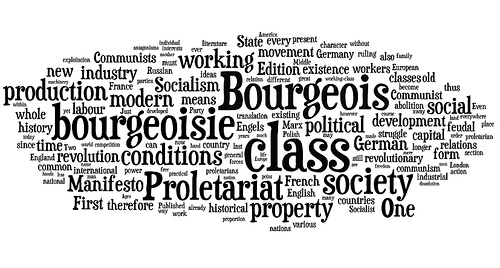
The Communist Manifesto changed the face of the twentieth century beyond recognition, inspiring millions to revolution became an ideological source for millions of deaths (at least 94 million people according to Werth et al. Margolin‘s The Black Book of Communism). This book has become the basis of political systems that dominate countless lives and continues to ignite violent debate about class and mixed systems of economic and political government today.
If you have never read this book (as most of its advocates have surely not done so) I encourage you to read it and study it attentively.
“In countries where modern civilisation has become fully developed, a new class of petty bourgeois has been formed, fluctuating between proletariat and bourgeoisie, and ever renewing itself as a supplementary part of bourgeois society. The individual members of this class, however, are being constantly hurled down into the proletariat by the action of competition, and, as modern industry develops, they even see the moment approaching when they will completely disappear as an independent section of modern society, to be replaced …” – Manifesto
Table of Online Contents for the Communist Manifesto:
“The United States believes that the establishment of diplomatic relations with the People’s Republic will contribute to the welfare of the American people, to the stability of Asia where the United States has major security and economic interest, and to the peace of the entire world.”
The American Presidency Project. December 15, 1978
Unfortunately, this is not a conspiracy theory. 2013 is a decisive year to deter the escalation of a war between Japan & the People’s Republic of China. Who can stop it? According to this impressive video, the United States of America has a decisive role to play in this global arena.
A major conflict between the region’s two largest economies would not only impose a harsh dilemma on U.S. diplomats, but also have a significant impact on the entire global economy. It is in every nation’s best interest that the Chinese and Japanese settle their territorial dispute peacefully.
The team at One Minute MBA explains that
“The conflict between China and Japan has put the United States in a precarious position: if a full-scale war were to erupt, the U.S. would be forced to choose between a long-time ally (Japan) and its largest economic lender (China). Last year, China’s holdings in U.S. securities reached $1.73 trillion and goods exported from the U.S. to China exceeded $100 billion. The two countries also share strong economic ties due to the large number of American companies that outsource jobs to China.
However, the U.S. government may be legally obligated to defend Japan. In November, the U.S. Senate added an amendment to the National Defense Authorization Act that officially recognizes Japan’s claims to the disputed islands; the U.S. and Japan are also committed to a mutual defense treaty that requires either country to step in and defend the other when international disputes occur. Not honoring this treaty could very easily tarnish America’s diplomatic image.
The countries of the Asia-Pacific region are collectively responsible for 55 percent of the global GDP and 44 percent of the world’s trade. A major conflict between the region’s two largest economies would not only impose a harsh dilemma on U.S. diplomats, but also have a significant impact on the entire global economy. It is in every nation’s best interest that the Chinese and Japanese settle their territorial dispute peacefully.”
22 February, 1784: The first American trade ship to China weighs anchor in New York City. The history of trade between China and the West is fraught with conflict and cultural complications, as demonstrated by the audacious 19th-century attempt by the British to steal China’s tea crop and transplant it to its own plantations in India. The caper is recounted in Sarah Rose‘s FOR ALL THE TEA IN CHINA.
In the dramatic story of one of the greatest acts of corporate espionage ever committed, Sarah Rose recounts the fascinating, unlikely circumstances surrounding a turning point in economic history. By the middle of the nineteenth century, the British East India Company faced the loss of its monopoly on the fantastically lucrative tea trade with China, forcing it to make the drastic decision of sending Scottish botanist Robert Fortune to steal the crop from deep within China and bring it back to British plantations in India. Fortune’s danger-filled odyssey, magnificently recounted here, reads like adventure fiction, revealing a long-forgotten chapter of the past and the wondrous origins of a seemingly ordinary beverage.
Title: The Clash. By: Alfredo Gálvez Suárez. A depiction of the battle of 1524 in which the Spanish conquistadores defeated the Army leaded by Tecum Umam.
The term Globalization refers to what many different historians considered a process of interrelation (or unification) of the world. It was a process of cultural, political and economic relations that for the first time in history united all mankind. One of these critical events of unification and clash of cultural and political relations took place in February 20 1524. This day is commemorated by Guatemalans to remember the leaders and events of the “The battle of Llanos del Pinal“ ((The Society of Geography and History of Guatemala documented that this battle actually took place on February 12 1524) which took place in the vicinity of the K’iche’ Mayan city of Xelajú (located in today’s mountainous area of Guatemala in Central America).
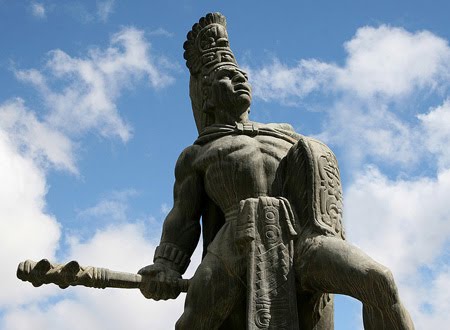
In this battle, the K’iche’ Rajpop Achij Tecum Umam (Guatemala’s National Hero and K’iche’ Mayan Captain of the army) commanded an army of 72,000 warriors (as narrated by the Chronicler Francisco de Fuentes y Guzmán) that fought against the invading hordes of the conquistador Pedro de Alvarado and his indigenous allies from the territories that are today the South of Mexico. While the invaders defeated the K’iche’ army, the chroniclers of this battle remembered Tecum Umam as the glorious warrior and miraculous hero that started to be referred in the narrations with epic roles and anthropomorphic abilities.
After this battle that “tainted all the neighbouring rivers red of blood” the Spanish conquistadores continued their invasion in the following month of the city of Q’umarkaj (also known as Utatlán). This secured for them the hegemony over the other less powerful cities of Iximche, Mixco Viejo, and Zaculeu that were located in the Southernmost part of the Sierra Madre mountain range.
By the beginning of the Spanish conquest the territory of Mesoamerica the Mayan Civilisation was already extinguished and dozens of different indigenous tribes leaded by caciques, warriors and priests controlled weaker and less advanced forced-labor societies. This enabled the conquest of the territories to be fast and easy.
Just a decade later, by the 1540s, the new elite that ruled this forced-labor societies had already established itself with a mixed Spanish-Indigenous head in control and started the process of acculturation, integration, evangelisation, assimilation and reeducation of a society that went from a tribalist type of life into a mercantilist economy ruled from a metropolitan and global Empire with its head 5,400 miles away in the city of Madrid.
Since 1524, Mesoamerica joined the global community of trade, commerce, acculturation and universalisation of traditions and costumes. This is an important junction that should be remembered by all of us.




 Globalization & Capitalism