We are constantly bombarded with media reports on globalization in terms of its increasing process and potential effects on our lives. What is meant by this concept and why should we be concerned with its impact? The developing countries of sub-Saharan Africa, Latin America and Asia should be interested in it because of the opportunities and threats offered by globalization (also known as globalisation).
The mother of this globalization is Science and the activator is her daughter Technology (both affectionately called science and technology). The most visible manifestations of “globalization” are in the economic and communications spheres. And one of the fathers of Science is our friend Copernicus.
In two sentences his contribution to Science and Globalization is:
Copernicus broke open the medieval idea of an enclosed, Earth-centered universe.
He set the stage for all of modern astronomy.
And why does this matter?
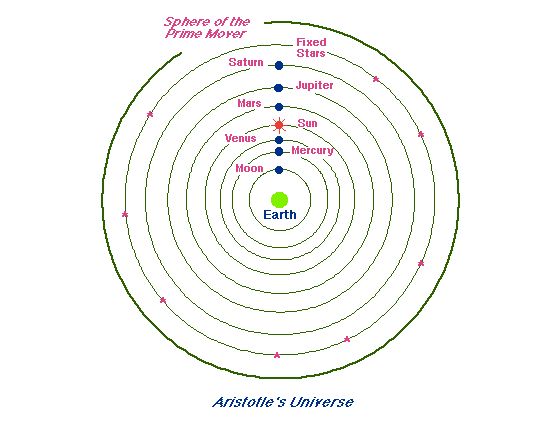
He lived at a time when people believed Earth lay enclosed within crystal spheres at the center of the universe. Can you picture the leap of imagination required for him to conceive of a sun-centered universe? The publication of Copernicus’ book – De revolutionibus orbium coelestium (On the Revolutions of the Celestial Spheres) – just before his death in 1543, set the stage for all of modern astronomy. Today, people speak of his work as the Copernican Revolution.
Post-data: Copernicus wasn’t the first to conceive of a sun-centered universe. Early Greek philosophers also spoke of it. It was the Greek philosopher Aristotle, however, who proposed that the heavens were literally composed of 55 concentric, crystalline spheres to which the celestial objects were attached. In Aristole’s model, Earth lay at the center of these spheres. Thus Earth lay – fixed and enclosed – until Copernicus published his version of a heliocentric universe.
After only seven years as Head of the Catholic Church, the resignation of Pope Benedict XVI is an astonishing news. This may be a message on how Globalization affects such global organization. The election of Pope Benedict XVI followed all the rules of the Church but did not listen to the “new” rules imposed by globalization: which include good advertisement, global awareness, and above all intercultural appealing to standards of ‘universal friendliness and empathy’, among others. I wrote an article titled “Parishes Fail to Market Catholicism to Hispanics (pdf available here)” (National Catholic Reporter, Vol. 43, No. 12 2007) discussing how the Catholic Church has failed to Market Catholicism among Hispanics.
Benedict XVI was elected on 19 April 2005 in a papal conclave, celebrated his Papal InaugurationMass on 24 April 2005, and took possession of his cathedral, the Archbasilica of St. John Lateran, on 7 May 2005. Today, February 11, 2013, Benedict announced that he would resign the papacy, effective February 28, due to age and ill health.
His health may be have been an issue. However, it seems to me that the real problem started when the Papal conclave of 2005 elected him above the other contestants for the Pope position without taking notice of all the changes that institution has gone through centuries.
Currently, Catholics are 17.77% of the total population in Africa, 63.10% in the Americas, 3.05% in Asia, 39.97% in Europe, 26.21% in Oceania and 17.09% of the world population. (Further information: Catholicism by country)
Distribution of Catholics by World Region, 2004, 2025, and 2050 Note: Percentages may not add to 100% due to rounding. Source: Author’s calculations based on data from PRB’s World Population Data Sheet 2004 and accessed at http://www.catholic-hierarchy.org.
Globalization is slowly forcing them to adapt to this new demographics and the election of a Latin American (a Mediterranean look would suffice) or African Pope could bring some new Fresh air to this archaic institution. The Latin America region already represents 42 percent of the world’s 1.2 billion-strong Catholic population, the largest single block in the Church, compared to 25 percent in its European heartland.
In 2005 among the “popeable” (one who might become pope) where also the cardinals Carlo Maria Martini, who died last year and obtained 40 votes in the first ballot versus the popular Italian cardinal Camillo Ruini who also was a contestant for the position in that initial ballot. Cardinal Ruini has been very active in the mass media and was one of the cardinals who most often appeared on Italian television, newspapers and magazines. I would suppose that his election as a new Pope in the Conclave of cardinals that will choose the next pope in mid-March is very high. Camilo Ruini is very popular among the “Reformer” side of the Catholic Church as the news inform (he is also more photogenic and could appeal to the Hispanic followers easily).
Lets see what happens in March, 2013 with the new Papal Conclave. Meanwhile, I share with you a documentary on the new face of this Eurocentric organization that is finally (slowly) changing its own look!
I always keep track of the images from space taken by NASA. They usually have impressive “natural hazards” photographed with the highest technology available. However, sometimes the natural hazards to humanity are not caused by the natural cycles of Earth. In those cases, it is humans who have created hazards for themselves and people die. Now, why would we create things that harm us so much? Why would we support and contribute to such terrible things? A good explanation is the one given by economists with the complex and difficult term negative externalities.
A negative externality is a spillover of an economic transaction that negatively impacts a party that is not directly involved in the transaction. The first party bears no costs for their impact on society while the second party receives no benefits from being impacted. This occurs when marginal social cost is greater than marginal private cost (MSC > MPC).
The case of pollution in China elucidates very well how the market-driven approach to correcting externalities by “internalizing” third party costs and benefits fails to work in a globalized economy. For example, by requiring a polluter to repair any damage caused. But, in many cases internalizing costs or benefits is not feasible, especially if the true monetary values cannot be determined. In fact, our technological gadgets and thousands of products imported from China are the cause of the hazardous health conditions in that country. We as consumers are part of this chain by buying the products. How can we do something?
I would suggest that the best way to participate in a positive way is to continue creating awareness of the failure of the government of China to protect the lives of the Chinese people. It is at the end of the day the responsibility of that government to protect the life and property of its citizens, not ours. We as consumers can only morally sanction them and stop consuming their products whenever possible.
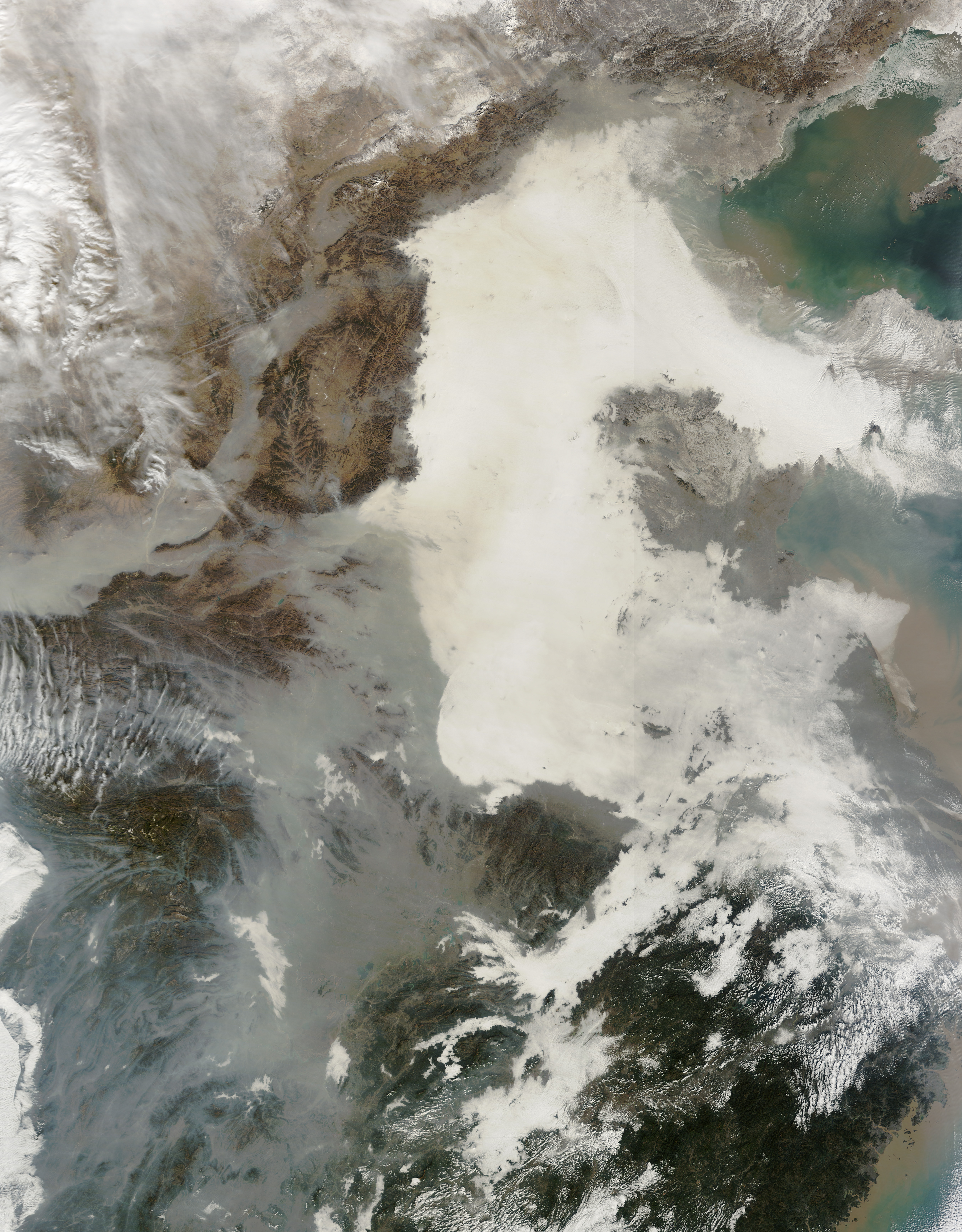
This is a good (and very unfortunate) example of how globalization without an objective code of values becomes a zero sum game. I share with you the information regarding how dangerous has become the air in the surroundings of Beijing and Tianjin,
—-
acquired January 14, 2013download large image (7 MB, JPEG, 5000×6400)
acquired January 14, 2013download GeoTIFF file (47 MB, TIFF)
acquired January 3, 2013download large image (8 MB, JPEG, 5000×6400)
acquired January 3, 2013download GeoTIFF file (51 MB, TIFF)
acquired January 3 – 14, 2013download Google Earth file (KMZ)
Residents of Beijing and many other cities in China were warned to stay inside in mid-January 2013 as the nation faced one of the worst periods of air quality in recent history. The Chinese government ordered factories to scale back emissions, while hospitals saw spikes of more than 20 to 30 percent in patients complaining of respiratory issues, according to news reports.
The Moderate Resolution Imaging Spectroradiometer (MODIS) on NASA’s Terra satellite acquired these natural-color images of northeastern China on January 14 (top) and January 3, 2013. The top image shows extensive haze, low clouds, and fog over the region. The brightest areas tend to be clouds or fog, which have a tinge of gray or yellow from the air pollution. Other cloud-free areas have a pall of gray and brown smog that mostly blots out the cities below. In areas where the ground is visible, some of the landscape is covered with lingering snow from storms in recent weeks. (Snow is more prominent in the January 3 image.)
At the time that the January 14 image was taken by satellite, ground-based sensors at the U.S. Embassy in Beijingreported PM2.5 measurements of 291 micrograms per cubic meter of air. Fine, airborne particulate matter (PM) that is smaller than 2.5 microns (about one thirtieth the width of a human hair) is considered dangerous because it is small enough to enter the passages of the human lungs. Most PM2.5aerosol particles come from the burning of fossil fuels and biomass (wood fires and agricultural burning). The World Health Organization considers PM2.5to be safe when it is below 25.
Also at the time of the image, the air quality index (AQI) in Beijing was 341. An AQI above 300 is considered hazardous to all humans, not just those with heart or lung ailments. AQI below 50 is considered good. On January 12, the peak of the current air crisis, AQI was 775 the U.S Embassy Beijing Air Quality Monitor—off the U.S. Environmental Protection Agency scale—and PM2.5 was 886 micrograms per cubic meter.
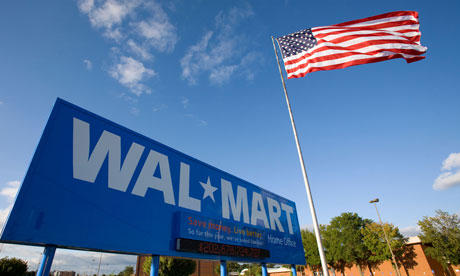
Walmart‘s latest push to Buy American and Hire Veterans is irrational. In a world of interconnectedness in which products from pencils to airplanes are produced with parts and components made all over the world the “buy American” argument falls into pieces.
In today’s world mass consumption economy there is not a single product that can be claimed to be “national” or “unique” without ignoring the intertwined network of global production. If your argument is “yes” there is such a thing as “100% national” or “100% American” then I will still be able of arguing against your position. Why? Because the economy of the United States of America is not only part but dependent on the global economy.
By 2012, only about 32 cents for every dollar of U.S. debt, or $4.6 trillion, was owned by the federal government in trust funds, for Social Security and other programs such as retirement accounts, according to the U.S. Department of Treasury.
The largest portion of U.S. debt, 68 cents for every dollar or about $10 trillion, is owned by individual investors, corporations, state and local governments and, yes, even foreign governments such as China that hold Treasury bills, notes and bonds.
Foreign governments hold about 46 percent of all U.S. debt held by the public, more than $4.5 trillion. The largest foreign holder of U.S. debt is China, which owns more about $1.2 trillion in bills, notes and bonds, according to the Treasury.
In total, China owns about 8 percent of publicly held U.S. debt. Of all the holders of U.S. debt China is the third-largest, behind only the Social Security Trust Fund‘s holdings of nearly $3 trillion and the Federal Reserve‘s nearly $2 trillion holdings in Treasury investments, purchased as part of its quantitative easing program to boost the economy. (Data via: How Much U.S. Debt Does China Really Own?)
So, the next time you think you are “Buying American“, I invite you to reconsider how irrational such an argument is.
A month ago the world’s richest woman made a comment that got everyone’s attention. Major sensationalist papers in the globe elaborated different arguments on Gina Rinehart case for a $2-a-day pay. But putting emotions aside, what was she really talking about? Well, she was explaining in very rough terms what globalization is about and what is the role of competition in the global political economy.
In order to understand what Ms. Rinehart referred to, it is necessary first to briefly evaluate the history of the word competitiveness. The term is historically rooted in the writings of classical economics. Its core is the theory of comparative advantage expressed by David Ricardo in 1819, in which he underlined how countries should/do compete. Later on, the term was used by Marxist economists starting with Marx’s “Capital: A Critique of Political Economy” where he emphasized the impact of the sociopolitical environment on economic development in a global perspective, and therefore the communist idea that changing the political context should precede economic performance. Later, in 1942 the term was integrated to the role played by capitalists and entrepreneurs in the writings of Joseph Schumpeter, who stressed their creative and economic (“economic” here refers to capital as a mean of production) role as a factor of competitiveness by underlining that progress is the result of disequilibrium, which favors innovation and technological improvement. Further, Israel Kirzner’s emphasis on the redefinition of entrepreneurship by highlighting how global competitiveness is more about the capitalist’s innovative abilities rather than just the capital accumulated and how he/she invests it.
Ms. Rinehart’s comment reflects both the impact she plays as an actor in the global sociopolitical environment and her role as a capitalist and entrepreneur capable of generating innovation and of inciting creative destruction.
A $2-a-day pay in Africa means that many capitalists and entrepreneurs as Gina Rinehart are considering the possibility of moving their investments from less competitive continents to places in which competitiveness allow them to produce at lower costs.
Unfortunately, the region Ms. Rinehart was referring to has disincentives to competitiveness and innovation. Competitiveness is more than just lower wages and a cheap offer of labor. By following Ricardo, Marx, Schumpeter and Kirzner in order for Africa to become competitive in global terms the regions will require also to achieve what Stéphane Garelli in the “IMD World Competitiveness Yearbook 2012” explains as the need to also A.) Create a stable and predictable legislative and administrative environment. B.) Ensure speed, transparency and accountability in the administration, as well as the ease of doing business. C.) Invest continually in developing and maintaining infrastructure both economic (road, air, telecom, etc.) and social (health, education, pension, etc.). And finally, D.) Strengthen the middle class: a key source of prosperity and long-term stability.
Ms. Rinehart’s comments were not a call for Australians to lower their wages to a $2-a-day pay since they have already achieved other of Garelli’s requirements for competitiveness. Her comments are a very clear example on how global economy works. If African governments manage to improve the rule of law in their territories, develop infrastructure and allow for a stronger middle class then the chances that investment will move to Africa are going to be higher. As such, economies as Australia’s should continue producing at the same efficiency rates or improve and innovate in order to avoid losing investors. Ms. Rinehart’s comment on how “her country’s mining industry couldn’t compete with nations that are willing to pay workers less than $2 a day for their sweat and labor” is as such partially truth. Australia’s economy has many other competitive assets to offer and as such do not require to compete by offering lower wages. The country has many other competitive assets to offer for investors. However, as time has passed since Australia’s boom in the last decades many other countries are also trying to spur competitiveness.
There is much more to be said about this topic and on how global competitiveness allows for rising standards of life and prosperity. Also there is much more to be said on how competitiveness in other regions of the world can destroy (remember Schumpeter’s work) the not-so efficient economies of other countries that have not managed to cope with a changing global economy.


 After only seven years as Head of the
  ” (
” (


 Globalization & Capitalism