Paper: Eugene Kulischer, Joseph Schechtman and the Historiography of European Forced Migrations

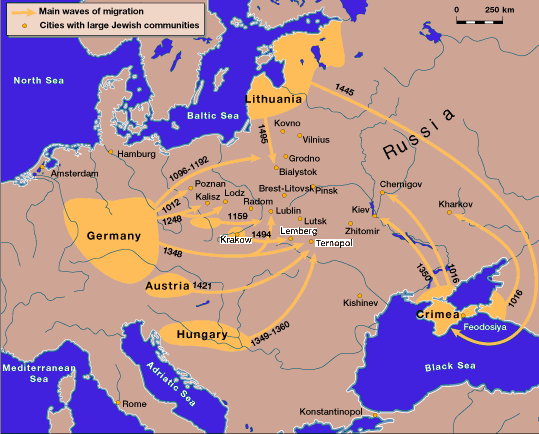
Map of Jewish Migrations

Yesterday I had the honor of attending a lecture organized by the Centre for Area Studies titled “Migration and Transnational History” with Prof. Dirk Hoerder as lecturer.

Prof. Hoerder is the author of one of my favorite books: Cultures in Contact: World Migrations in the Second Millennium (Comparative and International Working-Class History). The book is an encyclopedic historical treaty that reviews the story Global Migrations in the last 1,000 years.

Today’s paper is related to two other great specialists in Migrations: Eugene Kulischer and Joseph Schechtman whose works are among the most relevant for the study of Migrations and Globalization.

About the Article:

This article deals with two prominent figures in the historiography of twentieth-century European forced migrations: Eugene Kulischer and Joseph Schechtman. Their studies, although published between 1946 and 1962, are still among the standard works on the subject and are as yet unsurpassed in their scope and breadth of outlook, despite the flurry of new publications on the subject after the opening of East Central European archives after 1989. In this article I strive to explain how and why they were able to accomplish such a scholarly feat, paying special attention to their biographies which I have tried to reconstruct, using, for the first time, not only their own writings but also personal testimonies from their students and disparate archival sources located in the United States and Israel. I also discuss the strengths and weaknesses of their works by comparing them with more recent works on the same subject. This is, to my knowledge, the first attempt to reconstruct on the basis of archival evidence the lives and works of the two most important historians of a phenomenon whose impact on the overall history of Europe (and especially of its East Central part) is now generally recognized.

Continue reading: Eugene Kulischer, Joseph Schechtman and the Historiography of European Forced Migrations from Journal of Contemporary History recent issues by Ferrara, A.

Academic Article. French Intellectuals and Globalisation: A War of Worlds.

Alien tripod illustration by Alvim Corréa, fro...
Image via Wikipedia

Yesterday I posted the famous audio/story of Orson WellesOctober 30, 1938 broadcast titled “Space invaders” that scared thousands of people who believed that Martians were invading Earth.

Today’s Academic Article recommendation will continue in that tone. This time, it is the turn for French intellectuals to play the role of Martians. 😉 They have leaded the opposition to what they call neo-liberal globalization (a.k.a. Westernization by means of corporate capitalism). Hope you enjoy it and don’t get too scared!

“French intellectuals have been at the forefront of a national and international movement of opposition to neo-liberal globalisation. Drawing on Samuel Huntington’s controversial work, The Clash of Civilisations, I will argue that French intellectuals shared a civilisational perspective of globalisation, seeing it not as a piecemeal market process or economic reform, but as an all-encompassing external threat. This civilisational perspective had contradictory effects on the nature of their opposition. On the one hand, intellectuals were able to produce a radical critique that challenged neo-liberalism and reinscribed the market within a specific political and ideological context. On the other hand, they tended to perpetuate an essentialist view of globalisation that saw this not as an economic process but as an expression of a pre-determined Anglo-Saxontype.”

Waters, Sarah. 2011. “French Intellectuals and Globalisation: A War of Worlds.” French Cultural Studies 22, no. 4: 303-320.  Academic Search Complete, EBSCOhost (accessed October 31, 2011).

Finally, we are 7 Billion

Video: 7 Billion,National Geographic Magazine

The human population on planet Earth has reached for the first time in history 7 billion  as reported by the United Nations[1]. As of today, October 28, 2011 at  16:44 (GMT+1) it was estimated to be 6.92 billion by the United States Census Bureau[2] and you can check their World Population Clock.  and 7 billion by .  But also, we can also acknowledge that this is also the first time in human history in which most humans have access to medical services, potable water, electricity.

As Susa Lewis from Nova acknowledges, “For most of human existence our ancestors led precarious lives as scavengers, hunters, and gatherers, and there were fewer than 10 million human beings on Earth at any one time. Today, many cities have more than 10 million inhabitants each, and populations continue to skyrocket.”

Largest Urban Agglomerations, 1975, 2000, 2025

Source: United Nations, World Urbanization Prospects: The 2007 Revision.

Also, the UN World Urbanizaiton Prospects reviewed that “Through most of history, the human population has lived a rural lifestyle, dependent on agriculture and hunting for survival. In 1800, only 3 percent of the world’s population lived in urban areas. By 1900, almost 14 percent were urbanites, although only 12 cities had 1 million or more inhabitants. In 1950, 30 percent of the world’s population resided in urban centers. In 2008, for the first time, the world’s population was evenly split between urban and rural areas. There were more than 400 cities over 1 million and 19 over 10 million. More developed nations were about 74 percent urban, while 44 percent of residents of less developed countries lived in urban areas.”

World Population Cartogram

Nova has the following interactive map in which you can trace the dramatic growth of human populations over recent centuries, and see where on Earth as many as three billion more people may live by 2050.

Launch InteractivePrintable Map Version

New challenges for humans will continue appearing with so many of us living here.  However, it is not the number what really matters but how we are all going to live here.  Currently, Thomas Malthus famous argument from 1798 in which he said “that population growth was a critical problem, reasoning that because human population grows exponentially while our food supplies grow linearly, that our growth would lead to massive problems” has already been proven wrong.

But what has still not being solved is the current philosophical crisis in which we live.  For a great part of human history, the world has been ruled by a collectivist philosophy of life that in the words of Ayn Rand “promoted the subjugation of the individual to a group (kings, oligarchs, nobility, religions, patrimonialists, corporations, parties, communities)—whether to a race, class or state does not matter. Collectivism holds that man must be chained to collective action and collective thought for the sake of what is called “the common good.” The previous sentences are very important and cannot be passed without understanding its historical results.  You can further explore them in the work of Leonard Peikoff titled “The Ominous Parallels“.

For more information regarding human population check the following links:

Video: A History of Economic Booms and Busts

When an economy falls into a recession, we typically observe a cluster of people making similar investment mistakes.  According to historian Stephen Davies, these investment errors occur because governments or central banks manipulate the supply of money. These manipulations place artificial downward pleasure on interest rates, creating false signals that entice individuals to invest in what end up being unprofitable ventures. Booms and busts are not a new phenomenon of this century, but rather, have occurred throughout history both in America and around the globe.

via:

In the Shadow of Slavery: Africa’s Botanical Legacy in the Atlantic World

rice
Image by tamaki via Flickr
map: United States, 1860, percentage of the sl...
Image via Wikipedia

Today I finished reading the Kindle book In the Shadow of Slavery: Africa’s Botanical Legacy in the Atlantic World by Judith Carney and Richard Nicholas Rosomoff; and I have confirmed that the work of any historian cannot be done without the help of Geography and a Globalized view of the power behind migrations. In her book, the author made very clear the effects of this forced migration of black slaves to America and how they changed the botanical future of the whole American Continent.  Reading this also was a great way of remembering when I worked as Collection Developer of the Wilson Popenoe Library (2,300 items) at the Ludwig von Mises Library.  His was a fantastic bibliography and you could see in his books how he managed to be the first exporter of Avocados to The United States.


Now, I invite you to check the book review via Project MUSE® prepared by Brian Grabbatin,

Many geographers know Judith Carney from her award-winning book Black Rice: The African Origins of Rice Cultivation in the Americas (2001). There she explored the development of rice growing techniques in Africa and subsequent role of enslaved Africans in transferring those techniques to North American plantations, particularly in the South Carolina low-country. In the Shadow of Slavery, a new book coauthored by Carney and independent researcher Richard Nicholas Rosomoff, builds on these findings, examining how enslaved Africans participated in botanical exchanges that have shaped foodways in the Atlantic world. In contrast to Black Rice, this book focuses on a variety of subsistence crops instead of a single cash … Read More