Two historical references for a discussion on the right to keep and bear arms

Battle  of Courcelette
Battle of Courcelette
Like the observer in the tree in the right foreground, painter Louis Weirter witnessed this Somme battle as a soldier. His painting depicts the chaos and complexity of fighting on the Western Front, and the use of combined arms tactics. The capture of the ruined town of Courcelette, France on 15 September 1916 was a significant Canadian victory. It was also the first time tanks (left foreground) were used in battle.
Painted by Louis Alexander Weirter
Beaverbrook Collection of War Art

One of the most controversial discussions in the last few weeks has been the one around guns, its regulation and controls, its production, on the rights to use guns, on private gun ownership and the arguments of those in favor/against the Right to keep and bear arms in the United States of America.  The right to keep and bear arms in that country has a historical significance rooted in a long standing common law, prior even to the existence of their Constitution.  In England, a similar legal wording can be found in the Bill of Rights 1689 which states “Subjects which are Protestants may have Arms for their Defense”.

The historical significance of this argument is long standing and varies from country to country (specially those with a common law system).  The principle behind this topic is the relation of the private ownership (historically contextualized of course) of the “means of force” versus the monopoly of the use of force by government.  Today I have two recommendations on this topic for those of you looking for essays and books to read:

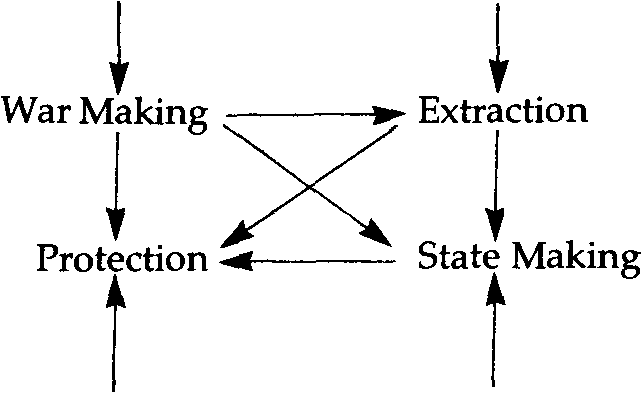
tilly-diagram

The monopoly of the use of force is claimed to be the reason behind why some kings in Europe succeed in wining wars and enriching their countries; and also the reason why others were subjugated and conquered (see the work of War Making and State Making as Organized Crime by Charles Tilly for a complete picture on this topic (online pdf) a Chapter from Bringing the State Back In (1985), edited by Peter Evans, Dietrich Rueschemeyer, and Theda Skocpol).  But also, in a longer historical perspective it has been the monopoly of the use of force by specific authorities which for other authors built/destroyed entire civilizations (see the work of The Shield of Achilles: War, Peace and the Course of History (2002) by Philip Bobbitt).

Have a happy reading!

Will History (and people) love Barack Obama?

In a new 538 post, the author Nate Silver spends a lot of energy proving the unsurprising: that presidents who serve longer, and win larger re-electoral margins, are better regarded by history—or at least by historians.  If this is truth I suppose that the reelection of Barack Obama will confirm it.  The President of the U.S. is about one of the most loved Presidents we have had in the last decades and its correlated hate is also one of the highest.  In the time previous to his election I read hundreds of comments in my Facebook profile explaining how the “World as we know it was going to end if he got the reelection”.  Luckily, the world is still going on and chances are that the ideas of Obama & Co. will continue reigning and being popular.

Contemporary History (specially if read through the American lenses) is quite ridiculous.  Their exceptional-ism is impressive and how they read and understand history is also ludicrous.

More interesting is to read the article by Mr. Silver (whom many consider to be THE professional in his field).  Feel free to continue reading it and prepare yourself to laugh.  The world may not end with Barack Obama… it will just get a little sadder…

The rankings I will refer to here come from a composite of the four most recent surveys in which presidential scholars were asked to rank the presidents. (The surveys were conducted between 2008 and 2011). I’ve averaged the rankings among the four surveys and then re-ranked the presidents from 1 to 43 accordingly. (Ties are broken by the best median ranking; Cleveland is counted only once for these purposes.)

We might divide the presidents into three basic groups: good (those who rank in the top 15), poor (those in the bottom 15) and average (everyone in between).

(Continue reading this article…)

Call for papers: American Studies Association Annual Meeting

I republish information of interest from Blog de la AMHE by Itzayana Gutiérrez

Dear colleagues:

As member of the International Committee of the American Studies Association, I am soliciting panels or individual papers for our upcoming conference (http://www.theasa.net/). Picking up on a now accepted move that transnationalizes the study of the United States, we would encourage analyses of U. S.-Mexican relations (broadly conceived) or that situate an analysis of Mexico in a wider North American perspective using a cultural approach. Among possible topics are those papers examining: how American Studies is approached from outside the United States; whether the current transnational moment in culture study gives us a special purchase on the United States and North America that may not have existed before; how the hardening of borders in politics is matched by a concern for border studies within our academic field. The deadline is Jan 26. See the webpage for more information.

More info (in Spanish): http://www.h-mexico.unam.mx/taxonomy/term/63

Walmart’s Irrational “buy American” Campaign

Walmart-Stores-home-offic-007

Walmart‘s latest push to Buy American and Hire Veterans is irrational.  In a world of interconnectedness in which products from pencils to airplanes are produced with parts and components made all over the world the “buy American” argument falls into pieces.

In today’s world mass consumption economy there is not a single product that can be claimed to be “national” or “unique” without ignoring the intertwined network of global production.  If your argument is “yes” there is such a thing as “100% national” or “100% American” then I will still be able of arguing against your position.  Why?  Because the economy of the United States of America is not only part but dependent on the global economy.

By 2012, only about 32 cents for every dollar of U.S. debt, or $4.6 trillion, was owned by the federal government in trust funds, for Social Security and other programs such as retirement accounts, according to the U.S. Department of Treasury.

The largest portion of U.S. debt, 68 cents for every dollar or about $10 trillion, is owned by individual investors, corporations, state and local governments and, yes, even foreign governments such as China that hold Treasury bills, notes and bonds.

Foreign governments hold about 46 percent of all U.S. debt held by the public, more than $4.5 trillion. The largest foreign holder of U.S. debt is China, which owns more about $1.2 trillion in bills, notes and bonds, according to the Treasury.

In total, China owns about 8 percent of publicly held U.S. debt. Of all the holders of U.S. debt China is the third-largest, behind only the Social Security Trust Fund‘s holdings of nearly $3 trillion and the Federal Reserve‘s nearly $2 trillion holdings in Treasury investments, purchased as part of its quantitative easing program to boost the economy. (Data via: How Much U.S. Debt Does China Really Own?)

So, the next time you think you are “Buying American“, I invite you to reconsider how irrational such an argument is.

RIP James M. Buchanan (October 3, 1919 – January 9, 2013)

Nobel laureate and Classical Liberal economist James M. Buchanan has died today.  He was one of the most important economist of the 20th. Century and will be long remembered for his work on the principles of economic self-interest and their use to understand why politicians do what they do.

He received a Doctor Honoris Causa Degree from my home university at Universidad Francisco Marroquin in 2001 (link to video of his visit to UFM) and his books were some of the most important ones in my education during my college years.  At UFM I learned about Buchanan with Carrol Rios de Rodriguez.  Prof. Rodriguez is one of my favorite teachers and she was the former Director of the a Center for the Study of Public Choice, where the ideas of Buchanan and Tullock first were taught to me.

Here are some interviews to remember the work of this great man and I invite you all to read his books and continue learning!

Hayek and Buchanan: Rawls, Egalitarianism and Social Justice

James Buchanan on Chicago School Thinking: Old and New

James M. Buchanan on Economists and the Great Recession

James M. Buchanan on “Institutional Sources of America’s Fiscal Tragedy”

buchanan521

Rest in Peace James M. Buchanan

(October 3, 1919 – January 9, 2013)