In the last few years I have found myself immersed traveling around different cultures. A trend I have observed is that the more educated people has been, the more they are healthy and the more they are cooperative towards the rest. Following Malow’s hierarchy of needs one can easily understand why is it that education is so important to help establishing a better society. My favourite philosophers agree that in order for a human to act rationally he/she needs to know clearly which is his/her code of values and their aim in life.
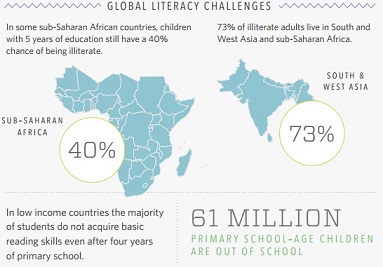
Today’s reality whoever is discouraging to many in regard to the Global Educational trends. The divergence between the Global North and South in terms of educational development is increasing:
Why is it that development has continued growing uneven in these regions is the field of study of global studies and it requires a long discussion. One thing is certain: in order for ignorance to be cured there is only one medicine: cheap or free good access to all knowledge. For this reason I support strongly projects like Google Books and many others in local areas. I contribute to this global project by donating printed books and providing access to an online ebook collection of Humanities. Now, how are you contributing to this project?
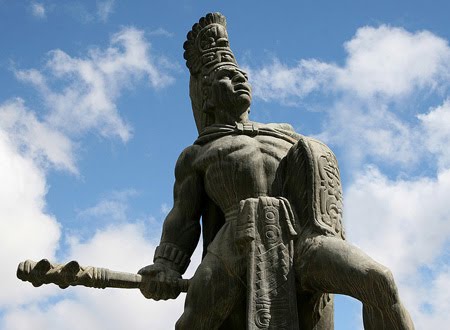
Title: The Clash. By: Alfredo Gálvez Suárez. A depiction of the battle of 1524 in which the Spanish conquistadores defeated the Army leaded by Tecum Umam.
The term Globalization refers to what many different historians considered a process of interrelation (or unification) of the world. It was a process of cultural, political and economic relations that for the first time in history united all mankind. One of these critical events of unification and clash of cultural and political relations took place in February 20 1524. This day is commemorated by Guatemalans to remember the leaders and events of the “The battle of Llanos del Pinal“ ((The Society of Geography and History of Guatemala documented that this battle actually took place on February 12 1524) which took place in the vicinity of the K’iche’ Mayan city of Xelajú (located in today’s mountainous area of Guatemala in Central America).
In this battle, the K’iche’ Rajpop Achij Tecum Umam (Guatemala’s National Hero and K’iche’ Mayan Captain of the army) commanded an army of 72,000 warriors (as narrated by the Chronicler Francisco de Fuentes y Guzmán) that fought against the invading hordes of the conquistador Pedro de Alvarado and his indigenous allies from the territories that are today the South of Mexico. While the invaders defeated the K’iche’ army, the chroniclers of this battle remembered Tecum Umam as the glorious warrior and miraculous hero that started to be referred in the narrations with epic roles and anthropomorphic abilities.
After this battle that “tainted all the neighbouring rivers red of blood” the Spanish conquistadores continued their invasion in the following month of the city of Q’umarkaj (also known as Utatlán). This secured for them the hegemony over the other less powerful cities of Iximche, Mixco Viejo, and Zaculeu that were located in the Southernmost part of the Sierra Madre mountain range.
By the beginning of the Spanish conquest the territory of Mesoamerica the Mayan Civilisation was already extinguished and dozens of different indigenous tribes leaded by caciques, warriors and priests controlled weaker and less advanced forced-labor societies. This enabled the conquest of the territories to be fast and easy.
Just a decade later, by the 1540s, the new elite that ruled this forced-labor societies had already established itself with a mixed Spanish-Indigenous head in control and started the process of acculturation, integration, evangelisation, assimilation and reeducation of a society that went from a tribalist type of life into a mercantilist economy ruled from a metropolitan and global Empire with its head 5,400 miles away in the city of Madrid.
Since 1524, Mesoamerica joined the global community of trade, commerce, acculturation and universalisation of traditions and costumes. This is an important junction that should be remembered by all of us.
The article is astonishingly confusing and misleading because the author arguments that it is more/less guns what results in more/less deaths. And as such, that only by decreasing the amount of available guns the deaths can be reduced. In order to defend this position she tries to defend her position by bringing a sometimes useful comparison of explaining local problems (those of the U.S.) by comparison to more global regions (in this case, Latin America).
Rosenthal does not propose a better solution than the one she is trying to question and which was proposed by the NRA (National Rifle Association) to President Obama. Truth, “A society that is relying on guys with guns to stop violence is a sign of a society where institutions have broken down”. Why? Because the bureaucrats and the NRA consider as she does that it are guns the ones that “kill” and as such, it are guns the ones that “give life“. Neither of the cases can be more false.
The parallels between the Latin American countries with high homicide rates and the US Massacre of schools kids cannot be correctly understood behind the “more guns/less-more deaths” causal relationship.
Then, how? As usual in this times of miss-integration of concepts. The events in Latin American countries with high homicide rates and the US Massacre of schools kids have no parallels. The high homicide rates in Latin America are the result of a failed War on Drugs and the institutional decay caused by corruption, state failure in providing rule of law and the reconfiguration of power relations amongst many other causes. In this case the guns are not a cause nor a solution. The massacres in U.S. schools are in my opinion the result of a decay of family values and a philosophical problem of identity that can only be solved behind an urgently much needed moral revolution. In this last case it is not guns or the state which can do much about to change things.
Future massacres in schools can only by stopped from happening when the roots of family decomposition are diminished (divorces, unemployment, family violence, alcoholism, drug addiction, among many others). The murderers in these schoolswere seeking for revenge from society and saw that killing kids was the perfect way of enacting revenge on those he was angry with. Until we understand this things I see no probable hope for future improvement of any of the cases. As well, for as long we have journalists with a philosophy of life that relies on the State as the “giver” or “healer” of society’s problems things are also going to continue going in the wrong direction…
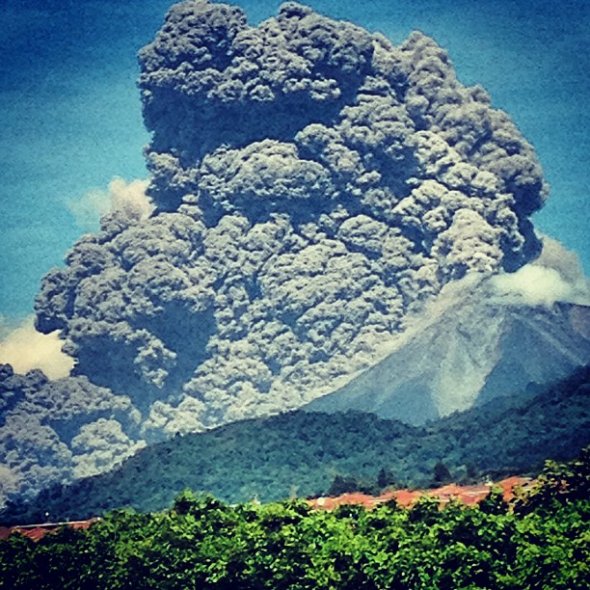
Several months ago when I heard the news about Facebook paying $1 Billion for Instagram I thought ‘the world was going crazy’. My first impression was to think that the ruling scale of values was mistaken. That people was giving value to unimportant things while the rest of the world was still trying to manage to survive the day. I couldn’t understand Why would a company pay such a huge amount of money for a software application for smartphones and iPhone that is only used for procrastination and doesn’t create any value for the world? Last week’s volcanic eruption of Fuego Volcano in Guatemala made me change my mind.
The entrepreneurs behind Instagram, Kevin Systrom and Michel “Mike” Krieger, created an application that was not only user-friendly but that enabled users to share images from anywhere in the world immediately. Such an application was created (maybe unintentionally) to become one of the fastest image reservoirs of instant news and global interconnection. When Facebook bought this photo-sharing app and paid $1 Billion they had not only bought the access to an essential function in millions of smartphones around the world but also connected visually the planet as we had never seen before. Last week’s event in Guatemala was the first time in my life when I could see through my phone in Denmark high quality images of events that were taking place in real-time more than 5,843 miles. Indeed, Hayek’s ideas of how an spontaneous order works was going global!
“Spontaneous order is what happens when you leave people alone—when entrepreneurs… see the desires of people… and then provide for them. They respond to market signals, to prices. Prices tell them what’s needed and how urgently and where. And it’s infinitely better and more productive than relying on a handful of elites in some distant bureaucracy.” Leonard Reed
To say that the world is interconnected and interdependent means to say that we are able now able of bypassing normal newsbroadcasters around the world. No longer will be that easy for anyone to control what the world would see and what the world wouldn’t see (as critized when News corporations around the world have been used to show a biased reservoir of images and videos during the Gulf War, or in the war in Iraq to mention some examples). Now, with access to photo-sharing applications such as Instagram the world not only has access to interconnection of real-time events but also has what Hayek explained as “a more efficient allocation of societal resources than any design could achieve.” Instagram is one more societal tool that enables us to achieve the best of humanity if used for the right purposes. Because of this reasons the founders of Instagram earned that billion dollars and the world is wealthier today.
National Geographic is running a wonderful website on Globalization, the international exchange of goods, services, cultures, ideas, has brought increased wealth for many and transformed forever the way humans interact. But while its roots may be in commerce, globalization‘s effects can be very personal.
Advances in communication and transportation have created a rich, unprecedented mixing of cultures throughout the world. But there is a drawback. As international travel, economic migration, and the global spread of music, films, and literature bring more people than ever into intimate contact, human diversity is vanishing.
A shared language is perhaps the most profound expression of group identity and a critical tool for passing cultural knowledge from one generation to the next. But globalization is about integration. Whether by choice, by circumstance, or under duress, thousands of cultural and linguistic traditions are disappearing as their new generations adopt dominant national and global languages.
Workers, from wealthy consultants to unskilled laborers, are also on the move as never before. Some migrants are encouraged by host countries or regional agreements; others avoid official avenues and often live a shadowy, parallel existence once they arrive. Immigration is high, but it is economic migrants—seeking work more than a new homeland—who define our age.






 Globalization & Capitalism