A Satellite’s View of Ship Pollution and globalization

Cargo-Ship650The geographical hotspots of the world are all related to economic trade and global exchange of political interests. Places such as the Panama and Suez Canals have always been in the Western media. However, from an economic and strategic perspective, the Strait of Malacca is one of the most important shipping lanes in the world in the 21st Century. The history of this Strait’s geopolitical relevance goes as back as 400 years of history.

For centuries the strait has been the main shipping channel between the Indian Ocean and the Pacific Ocean. It has been controlled by the major regional powers and also by the mayor global power during different historical periods. In 2011 hundreds of thousands of containers in more than 60,000 vessels crossed its waters carrying about one-quarter of the world’s traded goods including oil, Chinese manufactures, and Indonesian coffee.

In order to understand which is the geopolitical importance of the Strait of Malacca for the Chinese government we need to overview the current geopolitical dynamics and economic investments in the region.

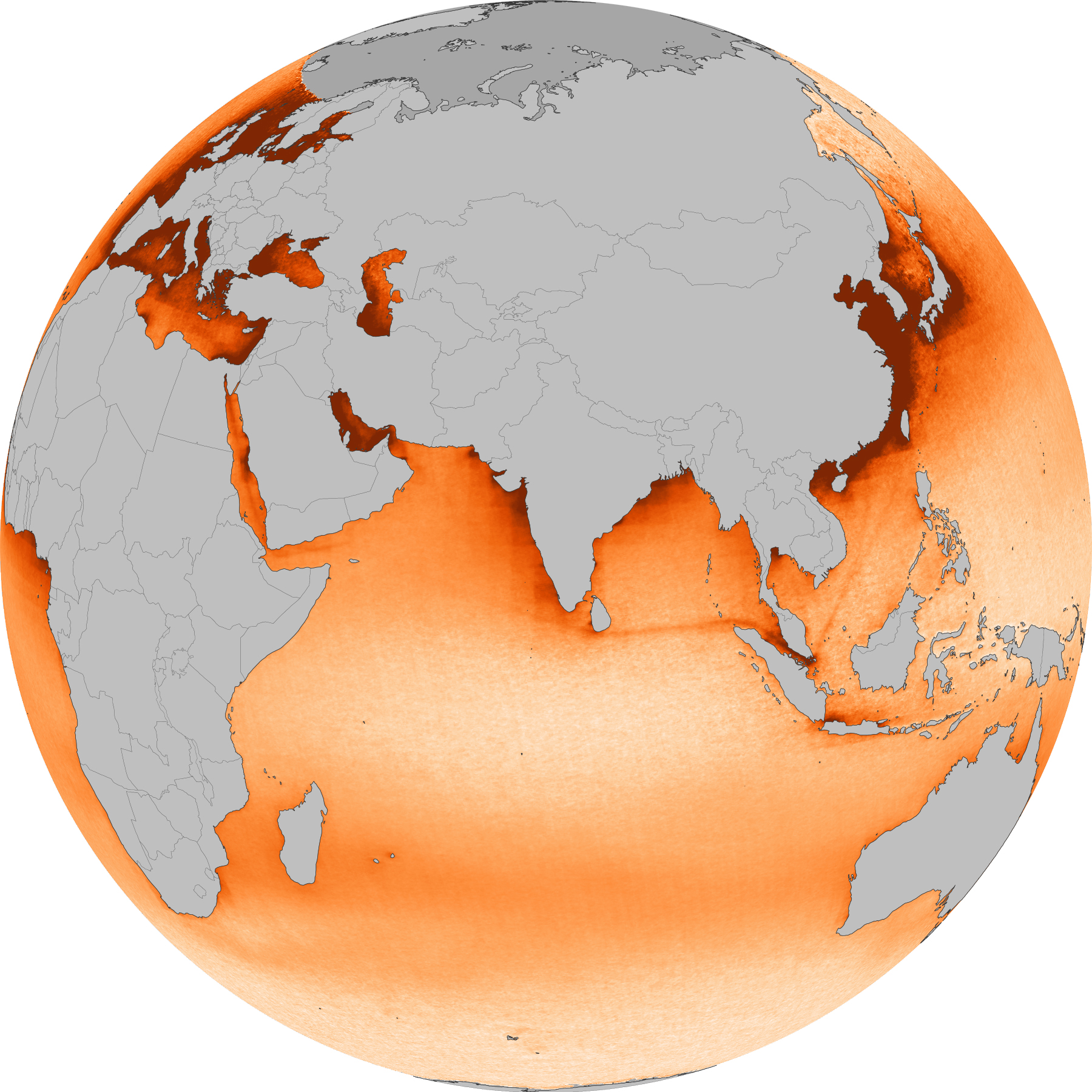
The following image from NASA clearly depicts what are some of the IMPRESSIVE negative externalities caused by the transport of global goods in the region and opens the door for discussing

  • How can we fix this?
  • Who should fix it?
  • Can it be fixed?
  • Can we reduce the future impacts in the area?
  • What solutions are available?
A Satellite’s View of Ship Pollution

Color bar for A Satellite’s View of Ship Pollution
acquired 2005 – 2012 download large image (2 MB, JPEG, 1800×1800)

Elevated levels of nitrogen dioxide pop out over certain shipping lanes in observations made by the Aura satellite between 2005-2012. The signal was the strongest over the northeastern Indian Ocean.

Data from the Dutch and Finnish-built Ozone Monitoring Instrument (OMI) on NASA’s Aura satellite show long tracks of elevated nitrogen dioxide (NO2) levels along certain shipping routes. NO2, is among a group of highly-reactive oxides of nitrogen, known as NOx, that can lead to the production of fine particles and ozone that damage the human cardiovascular and respiratory systems. Combustion engines, such as those that propel ships and motor vehicles, are a major source of NO2 pollution.

To learn some more on the importance of the Strait of Malacca and the value of this shipping lane you can read the essay I wrote titled “The Strait of Malacca as one of the most important geopolitical regions for the People’s Republic of China. Download (.pdf)

Gun control, school massacres and state-failure

The article “More Guns = More Killing” By came to my attention as a good reference of how sometimes more “global approaches” to what we could explain as “local problems” results in sophistic arguments that are of no use.

The article is astonishingly confusing and misleading because the author arguments that it is more/less guns what results in more/less deaths.  And as such, that only by decreasing the amount of available guns the deaths can be reduced.  In order to defend this position she tries to defend her position by bringing a sometimes useful comparison of explaining local problems (those of the U.S.) by comparison to more global regions (in this case, Latin America).

Rosenthal does not propose a better solution than the one she is trying to question and which was proposed by the NRA (National Rifle Association) to President Obama.  Truth, “A society that is relying on guys with guns to stop violence is a sign of a society where institutions have broken down”. Why? Because the bureaucrats and the NRA consider as she does that it are guns the ones that “kill” and as such, it are guns the ones that “give life“.  Neither of the cases can be more false.
The parallels between the Latin American countries with high homicide rates and the US Massacre of schools kids cannot be correctly understood behind the “more guns/less-more deaths” causal relationship.

Then, how? As usual in this times of miss-integration of concepts.  The events in Latin American countries with high homicide rates and the US Massacre of schools kids have no parallels.  The high homicide rates in Latin America are the result of a failed War on Drugs and the institutional decay caused by corruption, state failure in providing rule of law and the reconfiguration of power relations amongst many other causes.  In this case the guns are not a cause nor a solution.  The massacres in U.S. schools are in my opinion the result of a decay of family values and a philosophical problem of identity that can only be solved behind an urgently much needed moral revolution.  In this last case it is not guns or the state which can do much about to change things.

Future massacres in schools can only by stopped from happening when the roots of family decomposition are diminished (divorces, unemployment, family violence, alcoholism, drug addiction, among many others).  The murderers in these schools were seeking for revenge from society and saw that killing kids was the perfect way of enacting revenge on those he was angry with.   Until we understand this things I see no probable hope for future improvement of any of the cases. As well, for as long we have journalists with a philosophy of life that relies on the State as the “giver” or “healer” of society’s problems things are also going to continue going in the wrong direction…

Conference: Global History of Agrarian Labor Regimes, 1750 to 2000 (Harvard University)

My interest in Agrarian Labor Regimes was first awaken in my research on Opium trade in India. Since then, more readings have made me realize the complex structures behind the history of agrarian labor in a global context.

If you are also interested in the topic, the *Weatherhead Initiative on Global History (WIGH)* at Harvard University is planning a conference for *April 2013* that is focusing on changing labor regimes within global agriculture.

As posted by Blog de la AMHE by Manuel Bautista, they are interested in exploring the diversity of labor regimes, the paths along which they changed, and—most especially—the connections between these changes in different parts of the world. We are interested in work that explores the connected histories of propertied farming, sharecropping, wage labor, slavery, *cultures obligatoires*, and other such forms of labor, and how they have been connected to the spatial and social spread of capitalism.We are seeking proposals from historians, political scientists, economists, sociologists, and anthropologists at all stages of their academic career, including graduate students. We encourage proposals from those in relevant career paths or institutions outside the university. We are particularly interested in forging a global discussion of these topics, and therefore welcome especially contributions from outside North America and Europe.

The conference will try to balance broad comparative papers and revealing case studies. The Weatherhead Initiative on Global History is a newly created center that responds to the growing interest at Harvard in the encompassing study of global history. The Initiative is committed to the systematic scrutiny of developments that have unfolded across national, regional, and continental boundaries as well as to analysis of the interconnections—cultural, economic, ecological and demographic—among world societies. For further information about WIGH as well as the conference, please consult our website at http://wigh.wcfia.harvard.edu.

Proposals should include an abstract of no more than two pages and a brief curriculum vita. Please email your submissions to Jessica Barnard ( jbarnard @ wcfia.harvard.edu ) before *November 30, 2012*. Travel expenses as well as accommodation will be covered.

Holger Droessler hdroessl @ fas.harvard.edu

Poor Haitians Reading #FirstWorldProblems Tweets Might Be The Best Ad Of The Year

I was just told about this ad campaign and I couldn’t more than agree.  Because #FirstWorldProblems are not real problems when understood in a global context,

DDB New York has created an ad for the Haitian charity “Water Is Life” that humiliates whiners on Twitter who use the “#Firstworldproblems” hashtag to complain about life’s trivial challenges.

In the video (below), ordinary Haitians — standing amid shanty huts, broken school buses and wrecked buildings — read the inane tweets of self-entitled idiots who complain about phone cords that won’t reach their beds, and leather car seats that aren’t heated.

A GPE perspective: World’s richest woman makes case for $2-a-day pay

The top 10 most competitive economies in the world. By: The World Economic Forum’s Global Competitiveness Report 2012-2013

Reaction to article: Lazarus, David. 2012. She’s back: World’s richest woman makes case for $2-a-day pay. Los Angeles Times, 5. September, sec. Money.

A month ago the world’s richest woman made a comment that got everyone’s attention.  Major sensationalist papers in the globe elaborated different arguments on Gina Rinehart case for a $2-a-day pay.  But putting emotions aside, what was she really talking about?  Well, she was explaining in very rough terms what globalization is about and what is the role of competition in the global political economy.

In order to understand what Ms. Rinehart referred to, it is necessary first to briefly evaluate the history of the word competitiveness. The term is historically rooted in the writings of classical economics. Its core is the theory of comparative advantage expressed by David Ricardo in 1819, in which he underlined how countries should/do compete.  Later on, the term was used by Marxist economists starting with Marx’s “Capital: A Critique of Political Economy” where he emphasized the impact of the sociopolitical environment on economic development in a global perspective, and therefore the communist idea that changing the political context should precede economic performance. Later, in 1942 the term was integrated to the role played by capitalists and entrepreneurs in the writings of Joseph Schumpeter, who stressed their creative and economic (“economic” here refers to capital as a mean of production) role as a factor of competitiveness by underlining that progress is the result of disequilibrium, which favors innovation and technological improvement.  Further, Israel Kirzner’s emphasis on the redefinition of entrepreneurship by highlighting how global competitiveness is more about the capitalist’s innovative abilities rather than just the capital accumulated and how he/she invests it.

Ms. Rinehart’s comment reflects both the impact she plays as an actor in the global sociopolitical environment and her role as a capitalist and entrepreneur capable of generating innovation and of inciting creative destruction.

A $2-a-day pay in Africa means that many capitalists and entrepreneurs as Gina Rinehart are considering the possibility of moving their investments from less competitive continents to places in which competitiveness allow them to produce at lower costs.

Unfortunately, the region Ms. Rinehart was referring to has disincentives to competitiveness and innovation.  Competitiveness is more than just lower wages and a cheap offer of labor.  By following Ricardo, Marx, Schumpeter and Kirzner in order for Africa to become competitive in global terms the regions will require also to achieve what Stéphane Garelli in the “IMD World Competitiveness Yearbook 2012” explains as the need to also A.) Create a stable and predictable legislative and administrative environment. B.) Ensure speed, transparency and accountability in the administration, as well as the ease of doing business. C.) Invest continually in developing and maintaining infrastructure both economic (road, air, telecom, etc.) and social (health, education, pension, etc.). And finally, D.) Strengthen the middle class: a key source of prosperity and long-term stability.

Ms. Rinehart’s comments were not a call for Australians to lower their wages to a $2-a-day pay since they have already achieved other of Garelli’s requirements for competitiveness. Her comments are a very clear example on how global economy works.  If African governments manage to improve the rule of law in their territories, develop infrastructure and allow for a stronger middle class then the chances that investment will move to Africa are going to be higher.  As such, economies as Australia’s should continue producing at the same efficiency rates or improve and innovate in order to avoid losing investors. Ms. Rinehart’s comment on how “her country’s mining industry couldn’t compete with nations that are willing to pay workers less than $2 a day for their sweat and labor” is as such partially truth. Australia’s economy has many other competitive assets to offer and as such do not require to compete by offering lower wages.  The country has many other competitive assets to offer for investors.  However, as time has passed since Australia’s boom in the last decades many other countries are also trying to spur competitiveness.

There is much more to be said about this topic and on how global competitiveness allows for rising standards of life and prosperity. Also there is much more to be said on how competitiveness in other regions of the world can destroy (remember Schumpeter’s work) the not-so efficient economies of other countries that have not managed to cope with a changing global economy.