I just got my hands in a great article on Southeast Asia issues. Here’s the abstract for the article (via Project MUSE) and I hope you’ll get to enjoy it too,
Conventional geography’s boundary line between a “Southeast Asia” and an “East Asia,” following a “civilizational” divide between a “Confucian” sphere and a “Vietnam aside, everything but Confucian” zone, obscures the essential unity of the two regions. This article argues the coherence of a macroregion “Sino-Pacifica” encompassing both and explores this new framework’s implications: the Yangzi River basin, rather than the Yellow River basin, pioneered the developments that led to the rise of Chinese civilization, and the eventual prominence of the Yellow River basin came not from centrality but rather from its liminality—its position as the contact zone between Inner Eurasia and Southeast Asia.
In a sense . . . the frontier of Southeast Asia has retreated slowly from the line of the Yangzi (in what is now central China) to the Mekong delta (in what is now southern Vietnam).
—Charles Holcombe, The Genesis of East Asia
[T]he Vietnamese-Lao wars of the seventeenth century were resolved wisely when the Le rulers in Vietnam and the Lao monarch agreed that every inhabitant in the upper Mekong valley who lived in a house built on stilts owed allegiance to Laos, while those whose homes had earth floors owed allegiance to Vietnam.
—The Emergence of Modern Southeast Asia: A New History [End Page 659]
The question of boundaries is the first to be encountered; from it all others flow.
In conventional geography, the largest division of the human community is the continental or subcontinental scale “world region.” World regions are the most useful as concepts when their boundaries can be seen as enduring, immobile, and, above all, easy to map. Yet, in the first quotation above, we see a border between two world regions, Southeast and East Asia, that rolls southward thousands of miles over thousands of years. In the second quotation, we see a border between two kingdoms within the same world region, Southeast Asia, that cannot be traced as a simple line on the ground, being created by the contrasting cultural preferences of inextricably mixed populations. The moving boundary and the undrawable boundary are actually the same, the frontiers between Sinified Vietnam and its un-Sinified neighbors.
Its been long since the last time I heard a candidate from the GOP really defending the values of fiscal conservatism, respect for individual freedom and a non-interventionist foreign policy for the US in a debate. I have heard it in some Democrat candidates from past debates but never in a Republican debate. Luckily, I was happy to hear Ron Paul doing so and getting my support and applauses.
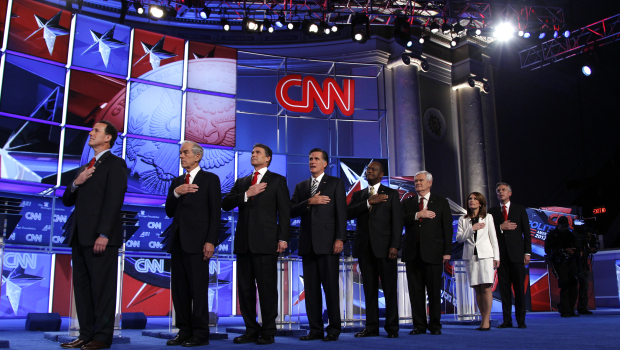
Last night, November 23th 2011, CNN, the American Enterprise Institute and the Heritage Foundation sponsored a debate on foreign policy. I leave you now with an interesting summary and some notes done by CBS of the most relevant candidates:
This was the Texas lawmaker’s strongest debate, getting lots of airtime and challenging many of his rivals about U.S. foreign policy. His views are not in the mainstream of Republican orthodoxy, but he is consistent in his beliefs and not afraid to tell voters what he really thinks. His fundraising numbers could go up in the short-term, based on his debate performance Tuesday night, even if long-term it may be hard for him to broaden his support.
Success begets success. Newt has done well in past debates and it has helped him in the polls. With his polling success, moderators gave him more airtime, which allowed the one-time afterthought and current front-runner to show off his debating skills. He took a risk by going against conservative Republican orthodoxy on immigration, and that could backfire, but overall Gingrich showed that he has been thinking about these issues for decades. And since it was a debate focused on foreign policy, no one asked him about his relationship with mortgage giant Freddie Mac and the $1.6 million he earned, which also helped the former House speaker.
Jon Huntsman
As the former ambassador to both China and Singapore, Tuesday’s national security debate was Jon Huntsman’s moment to shine. And for the most part, he succeeded: Huntsman, who touted throughout the debate his experience living abroad, presented clear policy positions on Pakistan and Afghanistan – at one point getting into a heated debate with Mitt Romney over the Afghan troop drawdown ¬- and even managed to bring the conversation back around to the American economy. Perhaps for the first time in the campaign, the former Utah governor was able to set himself apart from the rest of the GOP crowd.
Despite having largely been written off as a major player in the race for the Republican presidential nomination, Rep. Michele Bachmann delivered a strong performance in Tuesday’s debate, demonstrating her confidence discussing policy issues, and taking her competitors to task when they faltered. In a heated exchange with Rick Perry over providing aid to Pakistan, the Minnesota lawmaker blasted the Texas governor for what she described as his “highly naïve” take on the issue; later, she sparred with Newt Gingrich for his stance on immigration. Whether or not Bachmann’s performance was strong enough to get her back in the game remains to be seen – but she certainly earned more screen time than in recent debates.
Mitt Romney
Romney had one of his worst performances of the 11 debates so far, but he still managed to do fairly well. Romney is a front-runner for a reason: he has been running for president for five years and that practice has paid off for the former Massachusetts governor. Romney skillfully turned questions about foreign policy into answers about domestic issues where he was able to contrast his own positions with those of President Obama, cementing the idea that this race is going to come down to Romney and one other candidate.
Rick Santorum
Rick Santorum is still widely considered a long-shot candidate, but he earned his fair share of airtime in Tuesday’s debate. And while the former Pennsylvania senator may not have said much to change how America feels about him – he endorsed racial profiling Muslims and mistakenly referred to Africa as a country – he made his best effort to make his way back onto the public’s radar.
Herman Cain did not have the standout moment he needed to prove to voters he has a command of foreign policy. After surging in the polls, Cain’s campaign has lost momentum in recent days, most notably after stumbling over a question regarding Libya. The only memorable moment from Cain in this debate came when he flubbed debate moderator Wolf Blitzer’s name, calling the CNN anchor “Blitz.”
Rick Perry
The Texas governor took some bold positions during this debate, but his policy stances were vigorously challenged by his colleagues. Perry almost seemed to immediately backtrack on the tough stance he took against foreign aid to Pakistan after Michele Bachmann called his position “naive.” Perry was also on the defense when other candidates — Mitt Romney, Herman Cain and Ron Paul — said they disagreed with Perry’s assertion that the U.S. should consider a no-fly zone over Syria.
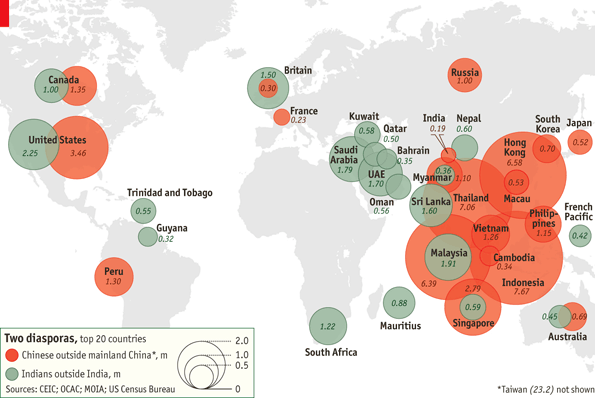
The Economist published a mind-blowing graphic depicting the migration of Chinese and Indian people around the world. The asses that “more Chinese people live outside mainland China than French people live in France, with some to be found in almost every country. Some 22m ethnic Indians are scattered across every continent.” More so, they emphasize that even though Diasporas have been a part of the world for millennia; their size and the ease of staying in touch with those at home are making them matter much more with the emergence of social network online technologies.
World's top 20 destinations for Chinese and Indian migrants
Now, this is once again part o the large “discourse of newness” that embeds great part of current mainstream history. This is something that has been denied and discussed by Prof. Adam McKeown in the article “Article: Global Migration, 1846–1940” who claims after doing a extensive research of migration from China and India during the 19th Century that the amount of immigrants and the global effect it had is comparable (and at some points superior) to the more known Atlantic migration from Europe to America. I strongly suggest you checking the Article by Prof. McKeown an check also Dr. Dirk Hoerder great book titled: Cultures in Contact in case you are interested in this subject.
Most of the cocaine shipped north from Central and South America these days travels through Guatemala and into Mexico before eventually crossing the border to the United States. The value of that cocaine, even before it enters the US market, is approximately $40 billion a year. That’s nearly the size of Guatemala’s entire economy.
The drug cartels in Guatemala act with impunity and effectively control much of the country. As Guatemala’s President Alvaro Colom recently told Al Jazeera, “The drug traffickers are much better armed and financed than our military and our government.” Guatemala, as a result, has become a very dangerous place to live.
What’s the solution? According to Giancarlo Ibarguen, president of the Universidad Francisco Marroquin, the US government should end its war on drugs.
Approximately 5 minutes.
Produced by Paul Feine and Alex Manning.
Go to http://reason.tv for downloadable versions and subscribe to Reason.tv’s YouTube Channel to receive automatic notification when new material goes live.
Rudolph Vecoli introduced his edited volume A Century of European Migrations, 1830–1930 with the statement “[w]e need to move beyond the framework of the ‘Atlantic Migration’ . . . It [has] blinkered us to the global nature of [migration].”
And indeed, that is what Prof. Adam McKeown planned to demonstrate in the article “Global Migration, 1846–1940”. The article is a great tool to understand the role that global interconnectedness, industrialization and increase in trade meant for the world. McKeown explains how was it that millions of migrants during the period of his study enabled for the population of America, Southeast Asia and Manchuria to increased more quickly than world population.




 Globalization & Capitalism