PPs, from Spain to Guatemala

Belisaire demandant l'aumone Jacques-Louis de ...

The PP’s have just won the executive elections in two very distinct cultural, political and economical contexts in Spain and in Guatemala.

The PP’s (The Partido Popular in Spain and the Partido Patriotain Guatemala) implemented a ochlocratic discourse with which they won the support of the majorities. In Spain, the Partido Popular discourse appealed to the masses by claiming that the Socialist Party (PSOE) had failed to be responsible in managing the economic crisis and that the solution was a paternalistic leader like Mariano Rajoy who was to bring order.   In Spain, the  current economic and social crisis raised the unemployment rate from 8.1% in 2006 to a historical level of 20% by 2010 an 21.5% by September, 2011. More so, the increasing financial crisis in the region continued to  debilitate the government of José Luis Rodríguez Zapatero (PSOE) whose premiership policies of raising taxes and the lack of a coherent economic plan were ineffective to tackle unemployment and reducing the government deficits from two digit numbers.

In Guatemala, the same ochlocratic discourse won the support of the masses by criticizing the Party Unión de Esperanza Nacional (UNE) and its irresponsibility to stop the organized crime elites that control most of the government’s structures (corruption with money from organized crime has captured the local, judicial, legislative and executive powers). Their campaign also identified in the figure of Otto Perez Molina (known as Mano Dura ‘hard fist’) the leader that was going to stop the advance of corruption and organized crime.

Independently of the achievements that either of these political programs will have in their countries; it is evident that the paternalist and populist discourse is again an effective tool to manipulate the masses in moments of economic and social crisis. Unfortunately, these discourses implemented by the “Conservative/Right” movements in their respective contexts have historically failed to solve the problems they aimed to fix. The long-term effects of these discourses have led to an increased disenchantment with the economic elites (usually linked to right movements) and to the reelection of leftist movements after the end of the “conservative/rightist” terms.

The problem with these discourses is linked to one single philosophical concept. That is the concept of Collectivism that has caused for several centuries so much poverty, hunger and suffering around the globe,

“The political expression of altruism is collectivism or statism, which holds that man’s life and work belong to the state—to society, to the group, the gang, the race, the nation—and that the state may dispose of him in any way it pleases for the sake of whatever it deems to be its own tribal, collective good.” Ayn Rand

Let us hope that Spain and Guatemala will find a right philosophy sooner than later.

The Lord’s Resistance Army: End Game?

Ugandan districts affected by Lords Resistance...
Image via Wikipedia

Nairobi/Brussels, 17 November 2011 (via International Crisis Group): Insufficient political will has thwarted regional efforts to stop the murderous Lord’s Resistance Army (LRA) but vigorous diplomacy led by the African Union (AU), an immediate military push and complementary civilian initiatives could end the misery of thousands.

The Lord’s Resistance Army: End Game?, the latest report from the International Crisis Group, explains why Uganda’s half-hearted three-year offensive has failed to eliminate Joseph Kony‘s guerrilla band and why there is now a new window of opportunity. Since peace talks with the erstwhile northern Ugandan insurgency collapsed and a first assault on Kony’s camps was botched in late 2008, the Ugandan army has been trying to catch scattered groups of fighters along the borders of DR Congo (DRC), the Central African Republic (CAR) and South Sudan. In that period, the LRA, now only a small but deadly criminal and terror band, has killed some 2,400 civilians, abducted some 3,400 and caused 440,000 to flee homes.

“The reasons for the military failure are at root political; Ugandan President Museveni scaled down the anti-LRA mission to pursue other ventures that would win him greater political capital at home and abroad”, says Ned Dalby, Crisis Group’s Central Africa Analyst. “Since the LRA no longer poses a threat to northern Uganda, few opposition politicians or community leaders there demand Museveni finish it off”.

Uganda’s efforts to pursue combatants in DRC have been dogged by the host army’s refusal to cooperate and grant access to LRA-affected areas. Uganda invaded DRC in the late 1990s, plundered its natural resources and earned President Joseph Kabila‘s lasting mistrust. CAR President François Bozizé, equally suspicious, has insisted the Ugandans leave diamond mining areas in his country.

At the request of some members, the AU stepped forward and said it would authorise a counter-LRA mission. It plans to appoint a special envoy to smooth relations between Kinshasa and Kampala and create new military structures to improve coordination between the armies. However, planning has foundered due to political constraints and the African body’s limited capacity.

The Ugandan army, with its record of abuse and failure to protect civilians is an imperfect vehicle, distrusted in the area. Kampala’s commitment now that the LRA no longer directly endangers its interests is reason for scepticism it has the will to see the job through. But a military operation combined with civilian efforts to entice surrenders remains the most feasible solution, and the Ugandans are the only troops at hand for this. The U.S. is strengthening its political and military engagement, including by sending several score advisers to help them in the field on a short-term basis. Kony is believed to be in the CAR. Before he crosses back into DRC and while U.S. support is strong, the Ugandan army should make an urgent military push, prioritising civilian protection, humanitarian access, better coordination and strict accountability.

To ensure dividends, the AU must live up to its responsibilities as guarantor of continental security and oversee a multi-dimensional regional initiative, continuing after Kony’s death or capture. It should appoint quickly a special envoy to rally the political commitment of Uganda and the three affected states and introduce a common operational and legal framework for the military operation, keyed to civilian protection, thus giving continent-wide legitimacy. Uganda and the U.S. should fold their efforts into the initiative.

“The LRA issue illustrates the desperate need for African and international actors to fulfil their responsibility to protect”, says Thierry Vircoulon, Crisis Group’s Central Africa Project Director. “Ensuring complementarity between the political and military actions of all stakeholders is key to their success and to ending a 24-year-long history of violence”.

Executive Summary | Full PDF report |

Book Reco: El amanecer de la libertad by Carlos Sabino

Carlos Sabino‘s latests book composes an historiographic evaluation of Latin American history and its heroes from a pro-libertarian, free market perspective. The book is an evaluation of the intellectual influences behind the Independence Movements in the region and how they still influence current political structures. I invite you to listen to this lecture by Prof. Sabino, (audio in Spanish)

Presentación del libro “El amanecer de la libertad”

Amazon’s top 10 History Books of 2011

In the Garden of Beasts: Love, Terror, and an American Family in Hitler's BerlinLost in Shangri-La: A True Story of Survival, Adventure, and the Most Incredible Rescue Mission of World War IICatherine the Great: Portrait of a WomanThe Greater Journey: Americans in ParisA History of the World in 100 Objects

The Best Books of 2011

Save up to 40% on our editors’ picks for the top 100 best books of the year, plus year-end top 10s in over two dozen categories

So many books. So many choices. It’s not easy putting together a list of the year’s best books, but we’ve held many meetings and votes, we’ve pored over the books and occasionally poured our hearts out to get you this final Top 100. For every book on the list, there has been an impassioned plea and an argument made–so don’t just look at the Top 10 or 20. There are great books all up and down the Top 100 list. One of them might be the perfect read for you.


The Great Sea: A Human History of the Mediterranean
Radioactivity: A History of a Mysterious ScienceDestiny of the Republic: A Tale of Madness, Medicine and the Murder of a President

The Longest War: The Enduring Conflict between America and Al-Qaeda1861: The Civil War Awakening


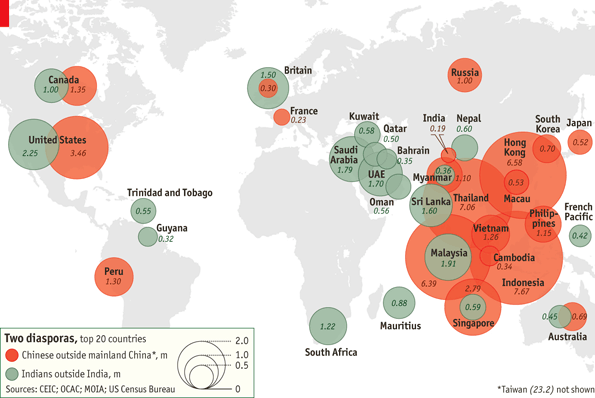
Where are the world’s biggest Chinese and Indian immigrant communities?

The Economist published a mind-blowing graphic depicting the migration of Chinese and Indian people around the world. The asses that “more Chinese people live outside mainland China than French people live in France, with some to be found in almost every country. Some 22m ethnic Indians are scattered across every continent.” More so, they emphasize that even though Diasporas have been a part of the world for millennia; their size and the ease of staying in touch with those at home are making them matter much more with the emergence of social network online technologies.

World's top 20 destinations for Chinese and Indian migrants

Now, this is once again part o the large “discourse of newness” that embeds great part of current mainstream history.  This is something that has been denied and discussed by Prof. Adam McKeown in the article “Article: Global Migration, 1846–1940” who claims after doing a extensive research of migration from China and India during the 19th Century that the amount of immigrants and the global effect it had is comparable (and at some points superior) to the more known Atlantic migration from Europe to America. I strongly suggest you checking the Article by Prof. McKeown an check also Dr. Dirk Hoerder great book titled: Cultures in Contact in case you are interested in this subject.