On how Islam violates individual rights

Wealth is produced for the purpose of creating a monetary profit (a moral value) that will enable a man to pursue other values.  The process of creating wealth is the result of a man’s reason put in practice.  This process of acting requires that man be free in order to pursue his rational and objective values and to make use of them as he pleases.  The previous process I have mentioned is much more complex to understand and requires pages of explanation. For anyone interested in learning how man’s mind works I recommend you to check the writings of Ludwig von Mises and Ayn Rand as a starting point.

There are many philosophies of life and religions that are in opposition to individual freedom because of the religious dogma from which they are rooted.  These people’s philosophies and religions have codes of values that deny an individual’s right to their life and the pursue of their happiness.  Religions are anti-life since they proclaim rules believed by faith that require man to suffer, sacrifice and do irrational actions in the aim of fulfilling their dogma. The religion that strikes me the most is Islam because it is not only a religious creed but also a political mean of organizing human life through the Sharia and Fiqh.

Ellaborating on how Islam is anti-life would take also dozens of pages with explanations and examples of how it does so.  A great reference to start learning is the book “Winning the Unwinnable War: America’s Self-Crippled Response to Islamic Totalitarianism” which clear examples on how Islam and the practice of Sharia and the Fiqh violate individual rights, disincentive man’s creativity to pursue happiness and create wealth. Also, I recommend you to check the following blog post “Islam Violates our human rights” which enumerates very shortly and clearly good examples of violations done by Islamics,

  • Violation of Article 23 (1) and 26 (1) of the UDHR Article 23 (1) of theUniversal Declaration of Human Rights states: Everyone has the right to work, to free choice of employment, to just and favorable conditions of work and to protection against unemployment. Article 26 (1) states: Everyone has the right to education.

But in Afghanistan, a muslim country, girls are not allowed education. Girls schools are banned and those caught running these schools, can be punished by law.

This continued for about 5 years, during the reign of the Taliban, the oppressive Islamic extremists, who were finally eliminated by theAmericans. (Thank you, America)

  • Violation of Article 19 of the UDHR Article 19 of the Universal Declaration of Human Rights states: Everyone has the right to freedom of opinion and expression; this right includes freedom to hold opinions without interference and to seek, receive and impart information and ideas through any media and regardless of frontiers.

Maldives, Pakistan, Afghanistan and other muslim countries do not allow freedom of speech, regarding criticism on Mohammed, the prophet of Islam. This has taken the shape of a Blasphemy Law, where any person who speaks negatively about Mohammed, can be given death sentence or life imprisonment and/or fine.

An example of this is the recent death sentence given to Dr. Younus Shiekh for correctly pointing out that the Prophet Mohammed did not become Muslim until the age of 40 (which was when he received his first revelation) and that his parents were non-Muslims (as they died before Islam was proposed by the Prophet).

  • Violation of Article 18 of the UDHR Article 18 of the Universal Declaration of Human Rights states: Everyone has the right to freedom of thought, conscience and religion; this right includes freedom to change his religion or belief, and freedom, either alone or in community with others and in public or private, to manifest his religion or belief in teaching, practice, worship and observance.

But the Quran says that:

Any religion except Islam will not be accepted

Quran 3.85 : If anyone desires a religion other than Islam, never will it be accepted of him; and in the Hereafter He will be in the ranks of those who have lost.

This is also mentioned in Violation 5, where those who dont believe in Allah, will be tortured severely.

  • In Iran, and Afghanistan, brutal punishments are give for extra-marital sex. Stoning to death was ordered by Mohammed, and is still used in Iran. This is a very cruel brutal punishment and its only aim is to inflict maximum pain on the individual. Muslims in Afghanistan and Iran can be flogged for consuming alcohol, slandering or for adultery while they are not married.

Flogging is ordered by the Quran:

And those who accuse free women and bring not for witnesses, flog them with eighty stripes.”59 For the adulterer, God says :”The adulteress and the adulterer, flog each of them with a hundred stripes.” 60 s

These punishments are condemned by the International Community

Islam also orders cutting of hands and feet :

Quran 5.38 As to the thief, Male or female, cut off his or her hands: a punishment by way of example, from Allah, for their crime: and Allah is Exalted in power.

Read here the complete post on how Islam violates rights…

Occupy the Mind with Economics

Video: Occupy Wall Street & Capitalism: A Professor’s Response

Karl Marx was an intellectual radical.  What that means is that he sought to get at the root cause of social ills with his analysis.  Despite my extreme disagreement with Marx on his diagnosis, I have always been attracted to intellectual radicalism.  Not the fashionable radical chic of rock stars, etc., but the nerdy radicalism of scholars and public intellectuals.  Not a radicalism evident where the cool-kids party while skipping school, but a radicalism born in the library and in reading dusty old books and studying long and hard to try and figure things out.  Think hard, read widely, think even harder, then attempt to write clearly — that is the intellectual radicalism that I find exciting.”

Continue reading via: Occupy the Mind with Economics

Republican Debate Highlights on Foreign Policy and National Security

Its been long since the last time I heard a candidate from the GOP really defending the values of fiscal conservatism, respect for individual freedom and a non-interventionist foreign policy for the US in a debate. I have heard it in some Democrat candidates from past debates but never in a Republican debate.  Luckily, I was happy to hear Ron Paul doing so and getting my support and applauses.

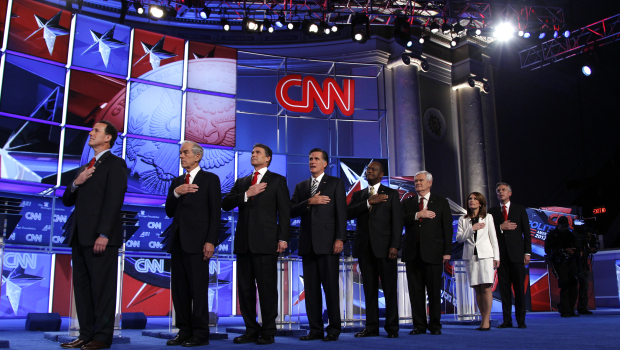
Last night, November 23th 2011, CNN, the American Enterprise Institute and the Heritage Foundation sponsored a debate on foreign policy. I leave you now with an interesting summary and some notes done by CBS of the most relevant candidates:

  • WINNERS:

Ron Paul

This was the Texas lawmaker’s strongest debate, getting lots of airtime and challenging many of his rivals about U.S. foreign policy. His views are not in the mainstream of Republican orthodoxy, but he is consistent in his beliefs and not afraid to tell voters what he really thinks. His fundraising numbers could go up in the short-term, based on his debate performance Tuesday night, even if long-term it may be hard for him to broaden his support.

Newt Gingrich

Success begets success. Newt has done well in past debates and it has helped him in the polls. With his polling success, moderators gave him more airtime, which allowed the one-time afterthought and current front-runner to show off his debating skills. He took a risk by going against conservative Republican orthodoxy on immigration, and that could backfire, but overall Gingrich showed that he has been thinking about these issues for decades. And since it was a debate focused on foreign policy, no one asked him about his relationship with mortgage giant Freddie Mac and the $1.6 million he earned, which also helped the former House speaker.

Jon Huntsman

As the former ambassador to both China and Singapore, Tuesday’s national security debate was Jon Huntsman’s moment to shine. And for the most part, he succeeded: Huntsman, who touted throughout the debate his experience living abroad, presented clear policy positions on Pakistan and Afghanistan – at one point getting into a heated debate with Mitt Romney over the Afghan troop drawdown ¬- and even managed to bring the conversation back around to the American economy. Perhaps for the first time in the campaign, the former Utah governor was able to set himself apart from the rest of the GOP crowd.

Michele Bachmann

Despite having largely been written off as a major player in the race for the Republican presidential nomination, Rep. Michele Bachmann delivered a strong performance in Tuesday’s debate, demonstrating her confidence discussing policy issues, and taking her competitors to task when they faltered. In a heated exchange with Rick Perry over providing aid to Pakistan, the Minnesota lawmaker blasted the Texas governor for what she described as his “highly naïve” take on the issue; later, she sparred with Newt Gingrich for his stance on immigration. Whether or not Bachmann’s performance was strong enough to get her back in the game remains to be seen – but she certainly earned more screen time than in recent debates.

Mitt Romney

Romney had one of his worst performances of the 11 debates so far, but he still managed to do fairly well. Romney is a front-runner for a reason: he has been running for president for five years and that practice has paid off for the former Massachusetts governor. Romney skillfully turned questions about foreign policy into answers about domestic issues where he was able to contrast his own positions with those of President Obama, cementing the idea that this race is going to come down to Romney and one other candidate.

Rick Santorum

Rick Santorum is still widely considered a long-shot candidate, but he earned his fair share of airtime in Tuesday’s debate. And while the former Pennsylvania senator may not have said much to change how America feels about him – he endorsed racial profiling Muslims and mistakenly referred to Africa as a country – he made his best effort to make his way back onto the public’s radar.

  • LOSERS

Herman Cain

Herman Cain did not have the standout moment he needed to prove to voters he has a command of foreign policy. After surging in the polls, Cain’s campaign has lost momentum in recent days, most notably after stumbling over a question regarding Libya. The only memorable moment from Cain in this debate came when he flubbed debate moderator Wolf Blitzer’s name, calling the CNN anchor “Blitz.”

Rick Perry

The Texas governor took some bold positions during this debate, but his policy stances were vigorously challenged by his colleagues. Perry almost seemed to immediately backtrack on the tough stance he took against foreign aid to Pakistan after Michele Bachmann called his position “naive.” Perry was also on the defense when other candidates — Mitt Romney, Herman Cain and Ron Paul — said they disagreed with Perry’s assertion that the U.S. should consider a no-fly zone over Syria.

Book Reco: El amanecer de la libertad by Carlos Sabino

Carlos Sabino‘s latests book composes an historiographic evaluation of Latin American history and its heroes from a pro-libertarian, free market perspective. The book is an evaluation of the intellectual influences behind the Independence Movements in the region and how they still influence current political structures. I invite you to listen to this lecture by Prof. Sabino, (audio in Spanish)

Presentación del libro “El amanecer de la libertad”

Jefferson: The Civil must always be in complete control of The Military

Lady Justice Takes the Bus
Image by djking via Flickr

The ideas of the Founding Father‘s were an inspiration across the breath of Europe and Latin America. Even now, more than 200 years later, the words of the great Thomas Jefferson should and must be remembered now that the new governments we elected continuously impulse the centralization of agricultural, commercial and industrial production.

“But the true barriers [bulwarks] of our liberty in this country are our State governments . . . Agriculture, manufactures, commerce, and navigation, the four pillars of our prosperity, are the most thriving when left most free to individual enterprise . . . standing armies in time of peace should be avoided as dangerous to liberty; and that in all cases the military should be under strict subordination to, and governed by, the civil power.”  Jefferson, Thomas. Annual Message to Congress (1801)

As important, Thomas Jefferson’s message to the new Citizens of the United States was that it was fundamental to the survival of a Republican country that The Civil must always be in complete control of The Military. Jefferson had made this warning as an answer to the Constitution that Virginians had written. Nowadays, however, the message goes to the citizenry that fails to recognize that the role of an army in time of peace should be avoided and kept under strict subordination to, and governed by, the civil power.

These are some of Jefferson’s messages that helped the United States build a stable government based on Republicanism. In the cases in which The Military and their allies may sometimes control the executive power they must constantly be remembered that it is the strict following of The Constitution their most important obligation. This is the only tool in which The Civil will complete The Military; failing to do so will only secure autocratic governments in which The Civil loses their rights just as history has shown.