The papers, books and studies related to the urban development of gated communities in the Global South have provided lots of information by problematizing the history and politics behind the imaginary of these projects. Urban developers all over Latin America, Africa and Asia are building hundreds of communities and apartment buildings that imitate European and Western Styles of construction, lifestyle, norms and regulations. This morning I got my hands in one more of these advertisements for a housing project located in a recently developed dormitory city near Guatemala City, Guatemala.
The community is called “Residenciales Pasaje Español” and the development aims at replicating the lifestyle of a Spaniard ideal of a community (while, of course, ignoring reality about Spain’s complexities). The advertisements are all directed at the appeals of the growing middle-class market in Guatemala which is backed by a search for: affordable housing, accesible parks, gated walls around the housing project, 24/7 private police service, white houses that offer access to parking spaces for family-sized cars. All of this providing a “theme-park” feeling that enables you to transport yourself from the violent and insecure life outside of the gates.
Guatemala City and the dormitory cities around it are inhabited by aprox. 3.5 million people with more than 1 million cars and the figures are quickly rising. Many of the gated communities are 1 or 1.5 hours away from most of the office and industrial areas and traffic jam is a constant worry for this people. Alienated from crime and lack of rule of law, these gated-communities offer an escape from public worries to taxpayers and an excuse to ignore the country’s multiple problems.
But as any other theme-park there are many flaws and dangers in the aim to replicate the “ideal society”. The complex is located straight next to a line of huge power towers that represent a health menace to the people that will live in the houses. Also, the gated-community is surrounded by hundreds of new houses and dozens of new gated-communities that once completed and sold will represent an increase in the traffic jam outside of the “housing dream”.
Perhaps it is still time to Rethink the future of our cities. We still have time to further problematize our development model and think about the contradictions behind these city-building dystopias. And bring to light more information regarding how these gated-communities further weaken collaboration, cooperation and citizenship in our societies…
The book by the French economist Thomas Piketty’s Capital in the Twenty-First Century has already become part of everyday discussions and is being referenced among academics. The research by Piketty has come in the perfect time and there are plenty of reasons why. Piketty’s book discussion brings some light to the study of income quintiles and deciles into a new debate of the “the skyrocketing incomes of the 1% — and the mind-boggling gains of the 0.1% and 0.01% — by gathering and publishing income tax data that nobody had bothered with before. Piketty was behind similar projects in France, Britain, Japan, and other countries.” (via Justin Fox at the Harvard Business Review)
I finished reading the book this weekend and it was eye-opening. The book presents great challenges to the study of capital and inequalities in the developed economies as well as in the rest of the world. The book also opens the doors for a wider discussion on the effects European Capital has had in the global economy. Further, the book invites globalists to challenge our understanding of European-centric terms that over longer periods of time become, perhaps, insufficient to comprehend global economic processes over the passing of centuries and how these processes have changed and transformed themselves by a complex evolution and redefinition.
It can’t be denied that capital during all of the 19th Century and in the beginning of the 20th Century was centered in the main European metropolises and extracted most of the goods from the periphery. Few Capital remained in colonies and protectorates. Wealth belonged to the Empires and Poverty remained in colonial territories. Even the poorest of the European was considered Rich by comparison to the inhabitants of Colonies.
Today, European Empires are gone for a while, U.S. Capital increased and gained from the fall of the European Empires and new economies started developing in former Colonies. Giant Economies like China and Russia woke up after decades of isolation from global trade and today reconfigured our understanding of Capital. Piketty’s book somehow fails to explore this Global political changes and its economic effects.
Piketty’s central argument has a gigantic weakness since it is tied to nation-states and cannot be compared or understood in reference to Global Capital flows in today’s multinational economy. Very few references are made to the role played by Multinational Companies and foreign national investments and savings by State Companies in the world. And less is mentioned of global inequalities and the North-South divide that has been increased by the investments done by Developed and Developing Economies in the rest of the world. Piketty argues that Capital has tended over time to grow faster than the overall economy (he focuses on European and US economies); and that income from capital is invariably much less evenly distributed than labor income (again he focuses on European and US economies). Thus failing to acknowledge how Labor income stopped been localized during the 20th Century and it involved multiple polities far away from the metropolis. Piketty argues that together (Capital growth and its uneven distribution) amount to a powerful force for increasing inequality.
Piketty doesn’t take things as far as Marx and this is a pitty. Marx’s methodology involved the State but it also referenced to its effects both and from the peripheries through the pass of longer periods of time. This is one of the most important contributions of Marx: his global understand of the economy.
Piketty shows how over the two-plus centuries for which good records exist, the only major decline in capital’s economic share and in economic inequality was the result of World Wars I and II, which destroyed lots of capital and brought much higher taxes in the U.S. and Europe. However, he again fails to acknowledge how Capital grew in the Global South after these wars as a result of increased inequalities in the Colonies and Agriculture-centered States in South America and Asia. During the wars Capital destruction was followed by a spectacular run of economic growth that involved the entire globe and not only Europe and the U.S. The Cold War is a good reference for finding how Capital flows went from Europe to Asia, America and Africa. As well, the run of economic growth started involving non-State actors in which Capital continue increasing at a higher and faster rate than the one he references and studies. Failing to study this shows in Piketty’s book that after decades of peace, slowing growth, and declining tax rates, capital and inequality are on the rise all over the developed world only, and it’s not clear what if anything will alter that trajectory in the decades to come. However, the declining tax rates, capital and inequality are on the rise at a faster pace in the developing economies and in the “puppet states” (Nigeria, Chile, the Middle East countries) which have emerged around them as sources of petrol, minerals and rare earths.
Piketty’s main worry as points out Justin Fox is that “growing wealth in Europe will bring a return to 19th century circumstances in which most affluent people get that way through inheritance.” Plus, “U.S. median income will continue lossing ground relative to other nations in the following years”. But this are not the only worries that we should identify. The BRICS countries are probably a good source of comparison to see how the growing wealth of the 20th Century remains on the hands of the few rich and is currently been passed through inheritance. Further, developing economies in South America and Africa are an extreme case of the last.
Piketty’s solution to Europe’s and U.S. problems is that a progressive global wealth tax be established. But this tax will fail to be the best response to the current dynamics of inequality if Capital continues flowing outside of Europe into multinational capital investments overseas and into State companies overseas.
I enjoyed this political economy analysis and will continue learning a lot from it. Piketty’s solution is a challenge for the study of global political economy and the reconfiguration of the global economy in the 21st Century. Perhaps if a new book is published studying the shareholders who own the most stock in almost every Fortune 500 company and the Capital of any major global company instead of only the economies of France, Germany or the United States more accurate insights will be found.
“The United States believes that the establishment of diplomatic relations with the People’s Republic will contribute to the welfare of the American people, to the stability of Asia where the United States has major security and economic interest, and to the peace of the entire world.”
The American Presidency Project. December 15, 1978
Unfortunately, this is not a conspiracy theory. 2013 is a decisive year to deter the escalation of a war between Japan & the People’s Republic of China. Who can stop it? According to this impressive video, the United States of America has a decisive role to play in this global arena.
A major conflict between the region’s two largest economies would not only impose a harsh dilemma on U.S. diplomats, but also have a significant impact on the entire global economy. It is in every nation’s best interest that the Chinese and Japanese settle their territorial dispute peacefully.
The team at One Minute MBA explains that
“The conflict between China and Japan has put the United States in a precarious position: if a full-scale war were to erupt, the U.S. would be forced to choose between a long-time ally (Japan) and its largest economic lender (China). Last year, China’s holdings in U.S. securities reached $1.73 trillion and goods exported from the U.S. to China exceeded $100 billion. The two countries also share strong economic ties due to the large number of American companies that outsource jobs to China.
However, the U.S. government may be legally obligated to defend Japan. In November, the U.S. Senate added an amendment to the National Defense Authorization Act that officially recognizes Japan’s claims to the disputed islands; the U.S. and Japan are also committed to a mutual defense treaty that requires either country to step in and defend the other when international disputes occur. Not honoring this treaty could very easily tarnish America’s diplomatic image.
The countries of the Asia-Pacific region are collectively responsible for 55 percent of the global GDP and 44 percent of the world’s trade. A major conflict between the region’s two largest economies would not only impose a harsh dilemma on U.S. diplomats, but also have a significant impact on the entire global economy. It is in every nation’s best interest that the Chinese and Japanese settle their territorial dispute peacefully.”
22 February, 1784: The first American trade ship to China weighs anchor in New York City. The history of trade between China and the West is fraught with conflict and cultural complications, as demonstrated by the audacious 19th-century attempt by the British to steal China’s tea crop and transplant it to its own plantations in India. The caper is recounted in Sarah Rose‘s FOR ALL THE TEA IN CHINA.
In the dramatic story of one of the greatest acts of corporate espionage ever committed, Sarah Rose recounts the fascinating, unlikely circumstances surrounding a turning point in economic history. By the middle of the nineteenth century, the British East India Company faced the loss of its monopoly on the fantastically lucrative tea trade with China, forcing it to make the drastic decision of sending Scottish botanist Robert Fortune to steal the crop from deep within China and bring it back to British plantations in India. Fortune’s danger-filled odyssey, magnificently recounted here, reads like adventure fiction, revealing a long-forgotten chapter of the past and the wondrous origins of a seemingly ordinary beverage.
Title: The Clash. By: Alfredo Gálvez Suárez. A depiction of the battle of 1524 in which the Spanish conquistadores defeated the Army leaded by Tecum Umam.
The term Globalization refers to what many different historians considered a process of interrelation (or unification) of the world. It was a process of cultural, political and economic relations that for the first time in history united all mankind. One of these critical events of unification and clash of cultural and political relations took place in February 20 1524. This day is commemorated by Guatemalans to remember the leaders and events of the “The battle of Llanos del Pinal“ ((The Society of Geography and History of Guatemala documented that this battle actually took place on February 12 1524) which took place in the vicinity of the K’iche’ Mayan city of Xelajú (located in today’s mountainous area of Guatemala in Central America).
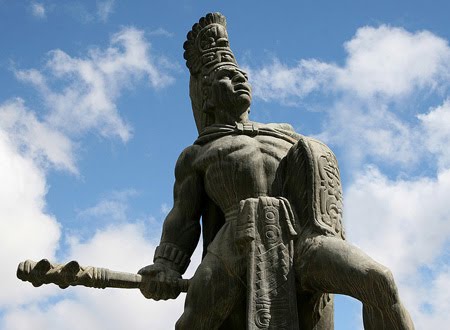
In this battle, the K’iche’ Rajpop Achij Tecum Umam (Guatemala’s National Hero and K’iche’ Mayan Captain of the army) commanded an army of 72,000 warriors (as narrated by the Chronicler Francisco de Fuentes y Guzmán) that fought against the invading hordes of the conquistador Pedro de Alvarado and his indigenous allies from the territories that are today the South of Mexico. While the invaders defeated the K’iche’ army, the chroniclers of this battle remembered Tecum Umam as the glorious warrior and miraculous hero that started to be referred in the narrations with epic roles and anthropomorphic abilities.
After this battle that “tainted all the neighbouring rivers red of blood” the Spanish conquistadores continued their invasion in the following month of the city of Q’umarkaj (also known as Utatlán). This secured for them the hegemony over the other less powerful cities of Iximche, Mixco Viejo, and Zaculeu that were located in the Southernmost part of the Sierra Madre mountain range.
By the beginning of the Spanish conquest the territory of Mesoamerica the Mayan Civilisation was already extinguished and dozens of different indigenous tribes leaded by caciques, warriors and priests controlled weaker and less advanced forced-labor societies. This enabled the conquest of the territories to be fast and easy.
Just a decade later, by the 1540s, the new elite that ruled this forced-labor societies had already established itself with a mixed Spanish-Indigenous head in control and started the process of acculturation, integration, evangelisation, assimilation and reeducation of a society that went from a tribalist type of life into a mercantilist economy ruled from a metropolitan and global Empire with its head 5,400 miles away in the city of Madrid.
Since 1524, Mesoamerica joined the global community of trade, commerce, acculturation and universalisation of traditions and costumes. This is an important junction that should be remembered by all of us.






 Globalization & Capitalism