Satellite images of negative externalities caused by Globalization

I always keep track of the images from space taken by NASA.  They usually have impressive “natural hazards” photographed with the highest technology available.  However, sometimes the natural hazards to humanity are not caused by the natural cycles of Earth.  In those cases, it is humans who have created hazards for themselves and people die.  Now, why would we create things that harm us so much? Why would we support and contribute to such terrible things?  A good explanation is the one given by economists with the complex and difficult term negative externalities.

A negative externality is a spillover of an economic transaction that negatively impacts a party that is not directly involved in the transaction. The first party bears no costs for their impact on society while the second party receives no benefits from being impacted. This occurs when marginal social cost is greater than marginal private cost (MSC > MPC).

The case of pollution in China elucidates very well how the market-driven approach to correcting externalities by “internalizing” third party costs and benefits fails to work in a globalized economy.  For example, by requiring a polluter to repair any damage caused. But, in many cases internalizing costs or benefits is not feasible, especially if the true monetary values cannot be determined.  In fact, our technological gadgets and thousands of products imported from China are the cause of the hazardous health conditions in that country.  We as consumers are part of this chain by buying the products. How can we do something?

I would suggest that the best way to participate in a positive way is to continue creating awareness of the failure of the government of China to protect the lives of the Chinese people.  It is at the end of the day the responsibility of that government to protect the life and property of its citizens, not ours.  We as consumers can only morally sanction them and stop consuming their products whenever possible.

This is a good (and very unfortunate) example of how globalization without an objective code of values becomes a zero sum game.  I share with you the information regarding how dangerous has become the air in the surroundings of Beijing and Tianjin,

—-
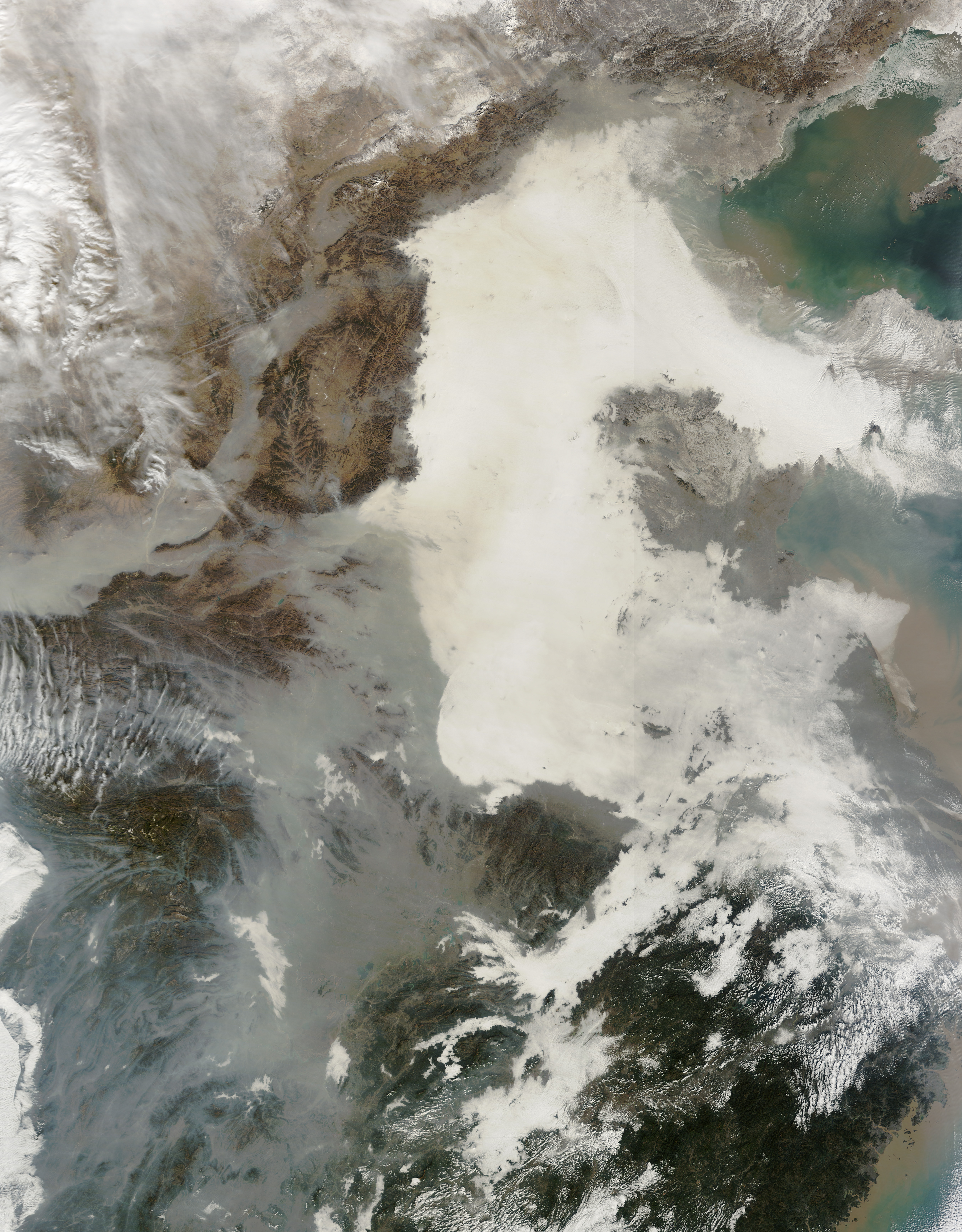
Air Quality Suffering in China

acquired January 14, 2013download large image (7 MB, JPEG, 5000×6400)
acquired January 14, 2013download GeoTIFF file (47 MB, TIFF)
Air Quality Suffering in China

acquired January 3, 2013download large image (8 MB, JPEG, 5000×6400)
acquired January 3, 2013download GeoTIFF file (51 MB, TIFF)
acquired January 3 – 14, 2013download Google Earth file (KMZ)

Residents of Beijing and many other cities in China were warned to stay inside in mid-January 2013 as the nation faced one of the worst periods of air quality in recent history. The Chinese government ordered factories to scale back emissions, while hospitals saw spikes of more than 20 to 30 percent in patients complaining of respiratory issues, according to news reports.

The Moderate Resolution Imaging Spectroradiometer (MODIS) on NASA’s Terra satellite acquired these natural-color images of northeastern China on January 14 (top) and January 3, 2013. The top image shows extensive haze, low clouds, and fog over the region. The brightest areas tend to be clouds or fog, which have a tinge of gray or yellow from the air pollution. Other cloud-free areas have a pall of gray and brown smog that mostly blots out the cities below. In areas where the ground is visible, some of the landscape is covered with lingering snow from storms in recent weeks. (Snow is more prominent in the January 3 image.)

At the time that the January 14 image was taken by satellite, ground-based sensors at the U.S. Embassy in Beijingreported PM2.5 measurements of 291 micrograms per cubic meter of air. Fine, airborne particulate matter (PM) that is smaller than 2.5 microns (about one thirtieth the width of a human hair) is considered dangerous because it is small enough to enter the passages of the human lungs. Most PM2.5 aerosol particles come from the burning of fossil fuels and biomass (wood fires and agricultural burning). The World Health Organization considers PM2.5to be safe when it is below 25.

Also at the time of the image, the air quality index (AQI) in Beijing was 341. An AQI above 300 is considered hazardous to all humans, not just those with heart or lung ailments. AQI below 50 is considered good. On January 12, the peak of the current air crisis, AQI was 775 the U.S Embassy Beijing Air Quality Monitor—off the U.S. Environmental Protection Agency scale—and PM2.5 was 886 micrograms per cubic meter.

  1. Resources

  2. Air Pollution in China: Real-time Air Quality Index Visual Map. Accessed January 14, 2013.
  3. China Air Daily. Accessed January 14, 2013.
  4. U.S Embassy Beijing Air Quality Monitor. Accessed January 14, 2013.
  1. References

  2. Associated Press, via Yahoo News (2013, January 14) Beijing warns residents after off-the-charts smog . Accessed January 14, 2013.
  3. NASA (2010, September 22) New Map Offers a Global View of Health-Sapping Air Pollution.Accessed January 14, 2013.
  4. NASA Earth Observatory (2012, March 23) Satellites Map Fine Aerosol Pollution Over China.
  5. The New York Times (2013, January 14) China allows media to report alarming air pollution crisis. Accessed January 14, 2013.
  6. Yahoo News (2013, January 14) China’s air pollution problem slideshow. Accessed January 14, 2013.

NASA image courtesy Jeff Schmaltz, LANCE MODIS Rapid Response. Caption by Mike Carlowicz.

Today January 27 is International Holocaust Memorial Day

Let us never forget,

“Selektion” on the Judenrampe, Auschwitz, May/June 1944. To be sent to the right meant slave labor; to the left, the gas chamber. This image shows the arrival of Hungarian Jews from Carpatho-Ruthenia, many of them from the Berehov ghetto. The photographer was Ernst Hofmann or Bernhard Walter of the SS. Image by Yad Vashem.

Holocaust Memorial Day Documentary

Tribute to holocaust victims – We shall never forget!

RIP James M. Buchanan (October 3, 1919 – January 9, 2013)

Nobel laureate and Classical Liberal economist James M. Buchanan has died today.  He was one of the most important economist of the 20th. Century and will be long remembered for his work on the principles of economic self-interest and their use to understand why politicians do what they do.

He received a Doctor Honoris Causa Degree from my home university at Universidad Francisco Marroquin in 2001 (link to video of his visit to UFM) and his books were some of the most important ones in my education during my college years.  At UFM I learned about Buchanan with Carrol Rios de Rodriguez.  Prof. Rodriguez is one of my favorite teachers and she was the former Director of the a Center for the Study of Public Choice, where the ideas of Buchanan and Tullock first were taught to me.

Here are some interviews to remember the work of this great man and I invite you all to read his books and continue learning!

Hayek and Buchanan: Rawls, Egalitarianism and Social Justice

James Buchanan on Chicago School Thinking: Old and New

James M. Buchanan on Economists and the Great Recession

James M. Buchanan on “Institutional Sources of America’s Fiscal Tragedy”

buchanan521

Rest in Peace James M. Buchanan

(October 3, 1919 – January 9, 2013)

I don’t want a cheaper and weaker iPhone!

I read today’s article”A Low-Priced iPhone Awaits” in the Wall Street Journal with disappointment.  For some reason, it has become widespread for people to think that “successful products = low price” and that “happy costumers = low price“.

While those affirmations are truth I consider them to be only partially truth.

I want to bring into consideration the fact that it is not only “low-price” products what makes customers happy.  As a owner of stores that sell electronic accessories and as a user of cellphones I can tell you this:

  • No matter how expensive a telephone is, the owner of those products is going to be willing to take care of it without caring much for the original price paid for their phone. So, no matter if the phone is a $500 iPhone or a $50 Samsung S 1st Generation.  Both of the owners would consider paying from as little as $10.00 to as much as $75.00 in extra accessories to PROTECT and personalize their phones.
  • The owners of more expensive phones are always willing to invest a little bit extra to protect their phones.  However, the owners of cheaper phones are also going to be willing to pay a little bit extra to “improve” their phones quality and DURABILITY by adding other electronic accessories or gadgets.

That being said, while companies may continue offering lower-price products the overall quality of these items continues decreasing.  It is IMPRESSIVE the amount of customers I used to received in my store with broken screens in their iPhone’s, Samsung’s, and other Smartphone devices.  Those companies are REALLY making a profit by selling products that can be damaged very easily while forcing costumers to buy new ones.

  • When did design became more important than functionality and durability?
  • Why do big screens are so easily to get broken and they are not made with better products?
  • The best example for this is the iPhone that has also what seems to be some type of glass cover in the back! It was impressive to see many of those covers broken and hearing the stories of sad costumers who want to replace it! The behind glass has no functional use rather than just making the product being overall weaker and less resistant…

While the Wall Street Journal article says that “Apple is working on a lower-end iPhone” the only thing I read is “Apple is working on an EVEN LESS DURABLE, WORSE QUALITY and lower-end iPhone”.  This is unfortunate… specially because I still have many of the old generation “black bean” phones that I used to own 10 years ago that are in perfect shape and resistant very hard falls from my pockets when I was younger.

Lets fight this wave of “lower-end products”!  As consumers we should receive the best we can get for our money! Not the worse we can get for it!

Gun control, school massacres and state-failure

The article “More Guns = More Killing” By came to my attention as a good reference of how sometimes more “global approaches” to what we could explain as “local problems” results in sophistic arguments that are of no use.

The article is astonishingly confusing and misleading because the author arguments that it is more/less guns what results in more/less deaths.  And as such, that only by decreasing the amount of available guns the deaths can be reduced.  In order to defend this position she tries to defend her position by bringing a sometimes useful comparison of explaining local problems (those of the U.S.) by comparison to more global regions (in this case, Latin America).

Rosenthal does not propose a better solution than the one she is trying to question and which was proposed by the NRA (National Rifle Association) to President Obama.  Truth, “A society that is relying on guys with guns to stop violence is a sign of a society where institutions have broken down”. Why? Because the bureaucrats and the NRA consider as she does that it are guns the ones that “kill” and as such, it are guns the ones that “give life“.  Neither of the cases can be more false.
The parallels between the Latin American countries with high homicide rates and the US Massacre of schools kids cannot be correctly understood behind the “more guns/less-more deaths” causal relationship.

Then, how? As usual in this times of miss-integration of concepts.  The events in Latin American countries with high homicide rates and the US Massacre of schools kids have no parallels.  The high homicide rates in Latin America are the result of a failed War on Drugs and the institutional decay caused by corruption, state failure in providing rule of law and the reconfiguration of power relations amongst many other causes.  In this case the guns are not a cause nor a solution.  The massacres in U.S. schools are in my opinion the result of a decay of family values and a philosophical problem of identity that can only be solved behind an urgently much needed moral revolution.  In this last case it is not guns or the state which can do much about to change things.

Future massacres in schools can only by stopped from happening when the roots of family decomposition are diminished (divorces, unemployment, family violence, alcoholism, drug addiction, among many others).  The murderers in these schools were seeking for revenge from society and saw that killing kids was the perfect way of enacting revenge on those he was angry with.   Until we understand this things I see no probable hope for future improvement of any of the cases. As well, for as long we have journalists with a philosophy of life that relies on the State as the “giver” or “healer” of society’s problems things are also going to continue going in the wrong direction…